
Loading...
Pubblicazioni Scientifiche
Filtri di ricerca 2 risultati
Pubblicazioni per anno
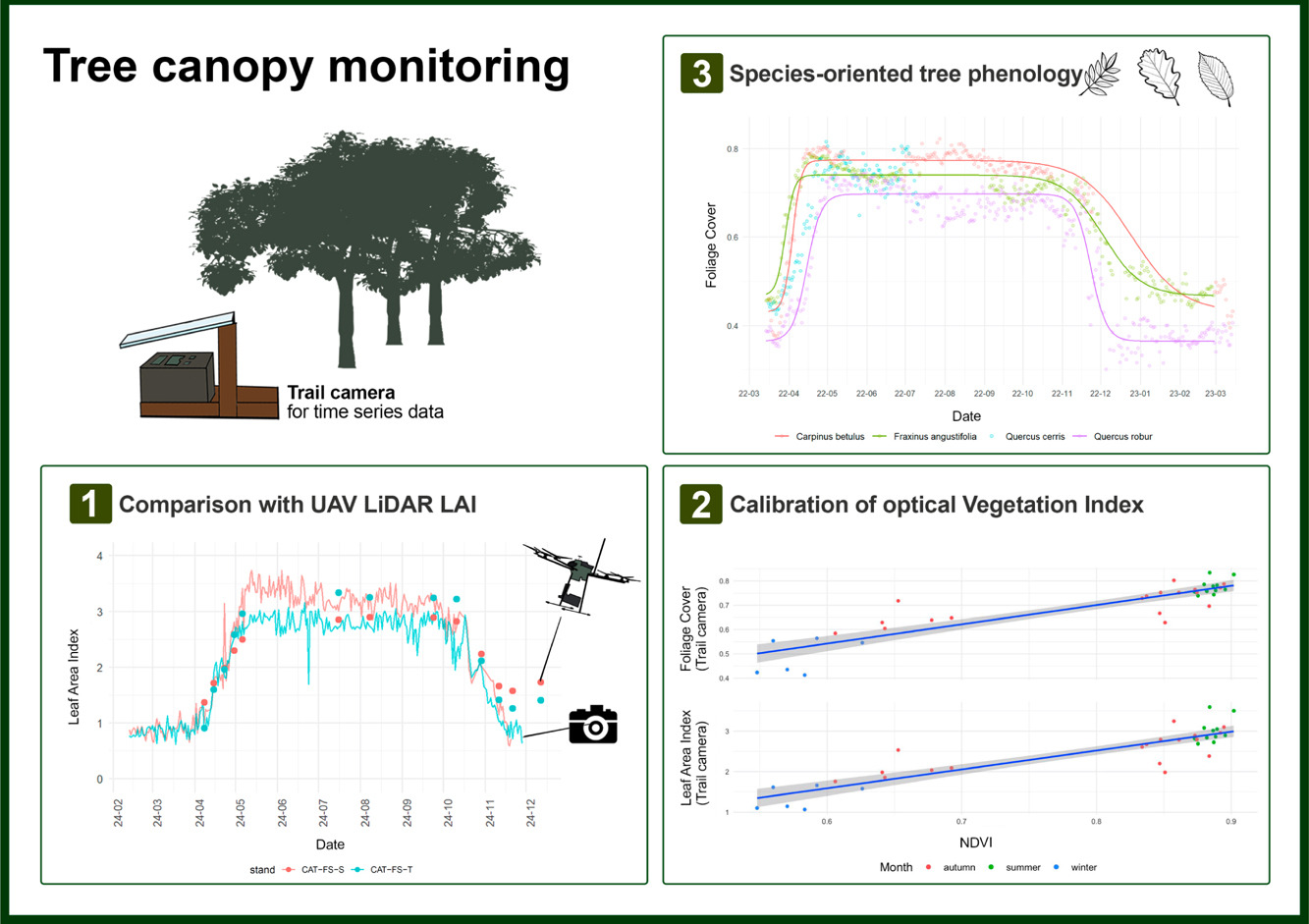
CrowNet: a trail-camera canopy monitoring system
Chianucci
,
Francesco
,
Lenzi
,
Alice
,
Minari
,
Emma
,
Guasti
,
Matteo
,
Gisondi
,
Silvia
,
Gonnelli
,
Marco
,
Innocenti
,
Simone
,
Ferrara
,
Carlotta
,
Campanaro
,
Alessandro
,
Ciampelli
,
Paola
,
Cutini
,
Andrea
,
Puletti
,
Nicola
Mostra abstract
Continuous monitoring of forest canopy structure and phenology is pivotal for the assessment of ecosystem responses to environmental variability and changes. The present study evaluated the use of repeat digital trail cameras as a low-cost, flexible, and accessible in situ monitoring solution for quantifying daily canopy attributes, including effective leaf area index (Le) and canopy cover. A trial camera monitoring network (CrowNet) was established encompassing 20 forest stands in Italy, under different management and environmental conditions, resulting in over 44,000 daily images collected over three years. We demonstrated that taking the mean daily canopy attribute allowed to obtain smooth time series from trail cameras, from which phenological transition dates can be inferred. Daily canopy attributes were validated against manual digital cover photography measurement. To further explore the applicability of this monitoring solution, we performed a comparison between daily Le time series derived from a subset of trail cameras located in beech forests and data collected by multitemporal UAV LiDAR. Results demonstrated the close agreement between the two methods across the entire phenological period (start and end of season). We also illustrated use of continuous trail camera estimates to calibrate a vegetation index (NDVI) to infer leaf area and canopy cover from optical multi-temporal UAV data. We further investigated use of trail camera to detect species-specific differences in tree phenology from time series acquired in a mixed oak-hornbeam forest. We found different canopy structure and phenological transition dates in three broadleaved species (oak, ash, hornbeam), supporting the effectiveness of trail cameras for species-oriented phenology monitoring. We conclude that trail cameras provide a reliable solution for daily canopy monitoring, offering a significant cost-effective and flexible alternative to traditional field methods and providing potential to calibrate, validate or integrate remotely-sensed information. However, camera failures during adverse weather, and the need for more efficient image data quality checking procedures, still represent open challenges. Future improvements, such as weatherproof housing and automated pre-processing screening procedures, are therefore recommended for making trail camera fully operational in ground canopy and phenology monitoring. © 2025 Elsevier B.V.

coveR: an R package for processing digital cover photography images to retrieve forest canopy attributes
Mostra abstract
Key message: coveR is an R package for estimating canopy attributes from digital cover photography (DCP) images. The simplicity of the method and the open-accessibility of coveR can effectively extend the accessibility and applicability of DCP to a wider audience. Abstract: Digital cover photography (DCP) is an increasingly popular tool for estimating canopy cover and leaf area index (LAI). However, existing solutions to process canopy images are predominantly tailored for hemispherical photography, whereas open-access tools for DCP are lacking. We developed an R package (coveR) to support the whole processing of DCP images in an automated, fast, and reproducible way. The package functions, which are designed for step-by-step single-image analysis, can be performed sequentially in a pipeline while ensuring quality-checking of each processing step. A wrapper function ‘coveR()’ is also created to perform all the image processing workflow in a single function. A case study is presented to demonstrate the reliability of canopy attributes derived from coveR in pure beech (Fagus sylvatica L.) stands with variable canopy density and structure. Estimates of gap fraction and effective LAI from DCP were validated against reference measurements obtained from terrestrial laser scanning. By providing a simple, transparent, and flexible image processing procedure, coveR supported the use of DCP for routine measurements and monitoring of forest canopy attributes. This, combined with the possibility to implement DCP in many devices, including smartphones, micro-cameras, and remote trail cameras, can greatly expand the accessibility of the method also by non-experts. © 2022, The Author(s), under exclusive licence to Springer-Verlag GmbH Germany, part of Springer Nature.