
Loading...
Pubblicazioni Scientifiche
Filtri di ricerca 6 risultati
Pubblicazioni per anno
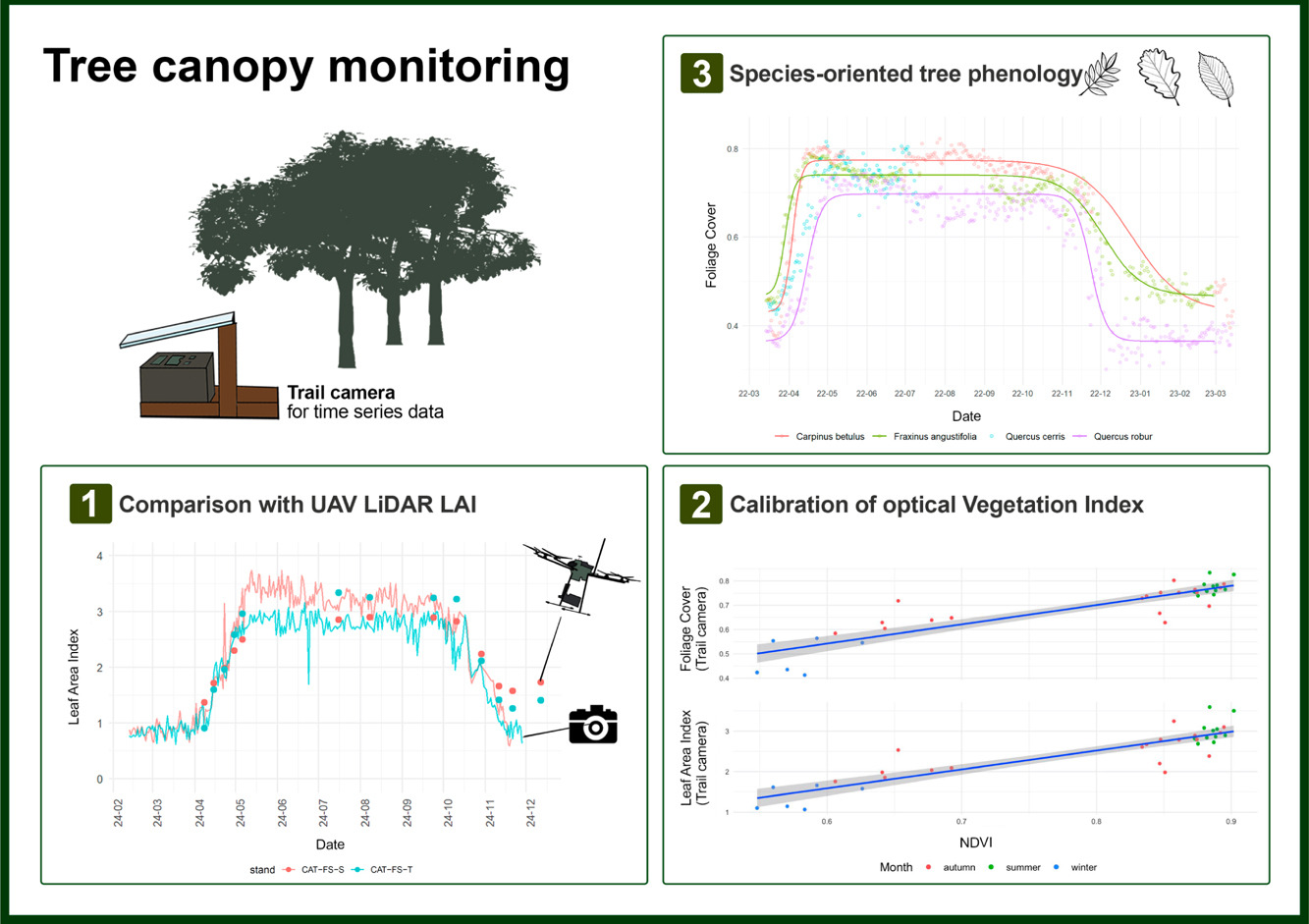
CrowNet: a trail-camera canopy monitoring system
Chianucci
,
Francesco
,
Lenzi
,
Alice
,
Minari
,
Emma
,
Guasti
,
Matteo
,
Gisondi
,
Silvia
,
Gonnelli
,
Marco
,
Innocenti
,
Simone
,
Ferrara
,
Carlotta
,
Campanaro
,
Alessandro
,
Ciampelli
,
Paola
,
Cutini
,
Andrea
,
Puletti
,
Nicola
Mostra abstract
Continuous monitoring of forest canopy structure and phenology is pivotal for the assessment of ecosystem responses to environmental variability and changes. The present study evaluated the use of repeat digital trail cameras as a low-cost, flexible, and accessible in situ monitoring solution for quantifying daily canopy attributes, including effective leaf area index (Le) and canopy cover. A trial camera monitoring network (CrowNet) was established encompassing 20 forest stands in Italy, under different management and environmental conditions, resulting in over 44,000 daily images collected over three years. We demonstrated that taking the mean daily canopy attribute allowed to obtain smooth time series from trail cameras, from which phenological transition dates can be inferred. Daily canopy attributes were validated against manual digital cover photography measurement. To further explore the applicability of this monitoring solution, we performed a comparison between daily Le time series derived from a subset of trail cameras located in beech forests and data collected by multitemporal UAV LiDAR. Results demonstrated the close agreement between the two methods across the entire phenological period (start and end of season). We also illustrated use of continuous trail camera estimates to calibrate a vegetation index (NDVI) to infer leaf area and canopy cover from optical multi-temporal UAV data. We further investigated use of trail camera to detect species-specific differences in tree phenology from time series acquired in a mixed oak-hornbeam forest. We found different canopy structure and phenological transition dates in three broadleaved species (oak, ash, hornbeam), supporting the effectiveness of trail cameras for species-oriented phenology monitoring. We conclude that trail cameras provide a reliable solution for daily canopy monitoring, offering a significant cost-effective and flexible alternative to traditional field methods and providing potential to calibrate, validate or integrate remotely-sensed information. However, camera failures during adverse weather, and the need for more efficient image data quality checking procedures, still represent open challenges. Future improvements, such as weatherproof housing and automated pre-processing screening procedures, are therefore recommended for making trail camera fully operational in ground canopy and phenology monitoring. © 2025 Elsevier B.V.

coveR: an R package for processing digital cover photography images to retrieve forest canopy attributes
Mostra abstract
Key message: coveR is an R package for estimating canopy attributes from digital cover photography (DCP) images. The simplicity of the method and the open-accessibility of coveR can effectively extend the accessibility and applicability of DCP to a wider audience. Abstract: Digital cover photography (DCP) is an increasingly popular tool for estimating canopy cover and leaf area index (LAI). However, existing solutions to process canopy images are predominantly tailored for hemispherical photography, whereas open-access tools for DCP are lacking. We developed an R package (coveR) to support the whole processing of DCP images in an automated, fast, and reproducible way. The package functions, which are designed for step-by-step single-image analysis, can be performed sequentially in a pipeline while ensuring quality-checking of each processing step. A wrapper function ‘coveR()’ is also created to perform all the image processing workflow in a single function. A case study is presented to demonstrate the reliability of canopy attributes derived from coveR in pure beech (Fagus sylvatica L.) stands with variable canopy density and structure. Estimates of gap fraction and effective LAI from DCP were validated against reference measurements obtained from terrestrial laser scanning. By providing a simple, transparent, and flexible image processing procedure, coveR supported the use of DCP for routine measurements and monitoring of forest canopy attributes. This, combined with the possibility to implement DCP in many devices, including smartphones, micro-cameras, and remote trail cameras, can greatly expand the accessibility of the method also by non-experts. © 2022, The Author(s), under exclusive licence to Springer-Verlag GmbH Germany, part of Springer Nature.
An overview of in situ digital canopy photography in forestry
canopy cover
leaf area index
canopy photography
canopy openness
hemispherical sensors
restricted view angle sensors
Mostra abstract
Since the 1960s, canopy photography has been widely used in forestry. Hemispherical photography has been the most widely used technique, but a great drawback of this method is its perceived sensitivity to hemispherical image acquisition and processing. Over the last decade, several alternative photographic approaches using restricted view angle have been proposed. Cover photography acquired via a normal lens was the first of the recently introduced photographic techniques. Use of a restricted view (often fixed) lens has subsequently contributed to the extension of canopy photography to new sensors and platforms, which ultimately have provided answers to some previous challenges regarding within-crown clumping correction, isolated and urban tree measurements, understory assessment, operational leaf inclination angle measurements, and phenological monitoring. This study provides a comprehensive review of the use of canopy photography in forestry and describes the theory and definitions of the variables used to quantify canopy structure. A case study is presented to illustrate and compare the different features and performance of the existing overstory photographic techniques; the results make it possible to suggest sampling strategies for consistent overstory canopy photographic measurements. Emerging operational fields of canopy photography are also described and discussed. © 2020, Canadian Science Publishing. All rights reserved.
An objective image analysis method for estimation of canopy attributes from digital cover photography
Mostra abstract
Key message: A method was proposed to remove the subjectivity of gap size analyses approaches implemented by default in cover photography. The method yielded robust and replicable measurements of forest canopy attributes. Abstract: Digital cover photography (DCP) is an increasingly popular method to estimate canopy attributes of forest canopies. Compared with other canopy photographic methods, DCP is fast, simple, and less sensitive to image acquisition and processing. However, the image processing steps used by default in DCP have a large substantial subjective component, particularly regarding the separation of canopy gaps into large gaps and small gaps. In this study, we proposed an objective procedure to analyse DCP based on the statistical distribution of gaps occurring in any image. The new method was tested in 11 deciduous forest stands in central Italy, with different tree composition, stand density, and structure, which is representative of the natural variation of these forest types. Results indicated that the new method removed the subjectivity of manual and semi-automated gap size classifications performed so far in cover photography. A comparison with direct LAI measurements demonstrated that the new method outperformed the previous approaches and increased the precision of LAI estimates. Results have important implications in forestry, because the simplicity of the method allowed objective, reliable, and highly reproducible estimates of canopy attributes, which are largely suitable in forest monitoring, where measures are routinely repeated. In addition, the use of a restricted field of view enables implementation of this photographic method in many devices, including smartphones, downward-looking cameras, and unmanned aerial vehicles. © 2018, Springer-Verlag GmbH Germany, part of Springer Nature.
The estimation of canopy attributes from digital cover photography by two different image analysis methods
Mostra abstract
Proximal sensing methods using digital photography have gained wide acceptance for describing and quantifying canopy properties. Digital hemispherical photography (DHP) is the most widely used photographic technique for canopy description. However, the main drawbacks of DHP have been the tedious and time-consuming image processing required and the sensitivity of the results to the image analysis methods. Recently, an alternative approach using vertical photography has been proposed, namely, digital cover photography (DCP). The method captures detailed vertical canopy gaps and performs canopy analysis by dividing gap fractions into large between-crown gaps and small withincrown gaps. Although DCP is a rapid, simple and readily available method, the processing steps involved in gap fraction analysis have a large subjective component by default. In this contribution, we propose an alternative simple, more objective and easily implemented procedure to perform gap fraction analysis of DCP images. We compared the performance of the two image analysis methods in dense deciduous forests. Leaf area index (LAI) estimates from the two image analysis methods were compared with reference LAI measurements obtained through the use of litter traps to measure leaf fall. Both methods provided accurate estimates of the total gap fraction and, thus, accurate estimates of the LAI. The new proposed procedure is recommended for dense canopies because the subjective classification of large gaps is most error-prone in stands with dense canopy cover. © SISEF.
Stand structure and ecological changes in holm oak coppices 25 years later the opening of thinning operations for the conversion into high forest; Cambiamenti strutturali ed ecologici in cedui di leccio in Sardegna a 25 anni dal taglio di avviamento ad altofusto
Manetti
,
Maria Chiara
,
Giannini
,
Tessa
,
Chianucci
,
Francesco
,
Casula
,
Antonio
,
Cutini
,
Andrea
Mostra abstract
Holm oak (Quercus ilex L.) is one of the most diffuse and economically important forest species in Sardinia, where it holds about 40% of holm oak cover in Italy. The forest type has also acquired a high ecological, recreational and landscape value over the last decades. Most of holm oak stands originated from overgrown coppice forests partly undergoing conversion into high forest. This study was set up in 1994 to analyse, as a function of site-index, the effects of conversion thinning on productivity, biodiversity, structural dynamics and canopy characteristics in an holm oak forest located in southern Sardinia. Two experimental permanent plots, differing in site index, stand structure and tree density, were established. The surveys were carried out in 1994-95 and 2010-11. The analysis included growth pattern, dynamics of stand structure and estimation of forest canopy attributes as leaf area index and canopy transmittance. Results pointed out the simplified stand structure, the poor biodiversity, the low LAI and high transmittance values 9 years after thinning implementation. These characteristics were more pronounced in the less productive area, characterised by substantial canopy gaps. 25 years after thinning implementation, both stands showed significant increase in the number of trees, strengthening of the clustered structure and high canopy recovery. Conversely, no significant changes in biodiversity and vertical structure were observed. Overall results contributed to a positive evaluation of the conversion practice based on periodical thinnings, even if the excessive reduction of tree density, mainly in the lower site-index area, did not allow yet the fully achievement of canopy recovery.