
Loading...
Pubblicazioni Scientifiche
Filtri di ricerca 5 risultati
Pubblicazioni per anno
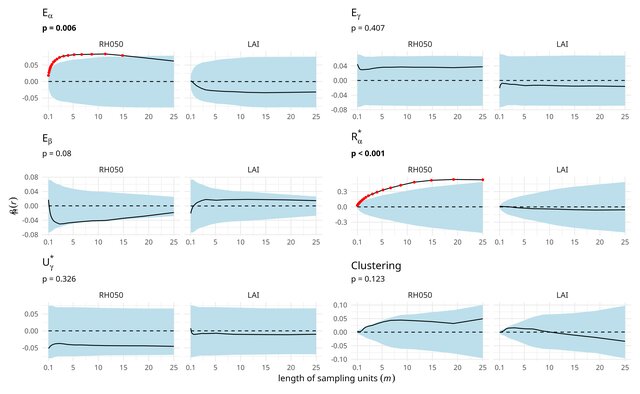
Forest structure and understory functional diversity at multiple scales: The importance of median tree height
de Benedictis
,
Luciano Ludovico Maria
,
Chelli
,
Stefano
,
Zhu
,
Zhengxue
,
Cervellini
,
Marco
,
Canullo
,
R.
,
Chianucci
,
Francesco
,
Puletti
,
Nicola
,
Tsakalos
,
James L.
,
Bartha
,
Sándor
,
Campetella
,
Giandiego

Multiple drivers of functional diversity in temperate forest understories: Climate, soil, and forest structure effects
Chelli
,
Stefano
,
Bricca
,
Alessandro
,
Tsakalos
,
James L.
,
Andreetta
,
Anna
,
Bonari
,
Gianmaria
,
Campetella
,
Giandiego
,
Carnicelli
,
Stefano
,
Cervellini
,
Marco
,
Puletti
,
Nicola
,
Wellstein
,
Camilla
,
Canullo
,
R.
climate change
functional diversity
bud bank
forest management
plant height
seed mass
specific leaf area
Mostra abstract
In macroecology, shifting from coarse- to local-scale explanatory factors is crucial for understanding how global change impacts functional diversity (FD). Plants possess diverse traits allowing them to differentially respond across a spectrum of environmental conditions. We aim to assess how macro- to microclimate, stand-scale measured soil properties, forest structure, and management type, influence forest understorey FD at the macroecological scale. Our study covers Italian forests, using thirteen predictors categorized into climate, soil, forest structure, and management. We analyzed five traits (i.e., specific leaf area, plant size, seed mass, belowground bud bank size, and clonal lateral spread) capturing independent functional dimensions to calculate the standardized effect size of functional diversity (SES-FD) for all traits (multi-trait) and for single traits. Multiple regression models were applied to assess the effect of predictors on SES-FD. We revealed that climate, soil, and forest structure significantly drive SES-FD of specific leaf area, plant size, seed mass, and bud bank. Forest management had a limited effect. However, differences emerged between herbaceous and woody growth forms of the understorey layer, with herbaceous species mainly responding to climate and soil features, while woody species were mainly affected by forest structure. Future warmer and more seasonal climate could reduce the diversity of resource economics, plant size, and persistence strategies of the forest understorey. Soil eutrophication and acidification may impact the diversity of regeneration strategies; canopy closure affects the diversity of above- and belowground traits, with a larger effect on woody species. Multifunctional approaches are vital to disentangle the effect of global changes on functional diversity since independent functional specialization axes are modulated by different drivers. © 2024 The Authors
TRY plant trait database – enhanced coverage and open access
Kattge
,
Jens
,
Bönisch
,
Gerhard
,
Díaz
,
Sandra M.
,
Lavorel
,
Sandra
,
Prentice
,
Iain Colin
,
Leadley
,
Paul W.
,
Tautenhahn
,
Susanne
,
Werner
,
Gijsbert
,
Aakala
,
Tuomas
,
Abedi
,
Mehdi
,
Acosta
,
Alicia Teresa Rosario
,
Adamidis
,
George C.
,
Adamson
,
Kairi
,
Aiba
,
Masahiro
,
Albert
,
Cécile Hélène
,
Alcántara
,
Julio M.
,
Alcázar C
,
Carolina
,
Aleixo
,
Izabela
,
Ali
,
Hamada E.
,
Amiaud
,
Bernard
,
Ammer
,
Christian
,
Amoroso
,
Mariano Martín
,
Anand
,
Madhur
,
Anderson
,
Carolyn G.
,
Anten
,
Niels P.R.
,
Antos
,
Joseph A.
,
Apgaua
,
Deborah Mattos Guimarães
,
Ashman
,
Tia Lynn
,
Asmara
,
Degi Harja
,
Asner
,
Gregory P.
,
Aspinwall
,
Michael J.
,
Atkin
,
Owen K.
,
Aubin
,
Isabelle
,
Baastrup-Spohr
,
Lars
,
Bahalkeh
,
Khadijeh
,
Bahn
,
Michael
,
Baker
,
Timothy R.
,
Baker
,
William J.
,
Bakker
,
Jan P.
,
Baldocchi
,
Dennis D.
,
Baltzer
,
Jennifer L.
,
Banerjee
,
Arindam
,
Baranger
,
Anne
,
Barlow
,
Jos B.
,
Barneche
,
Diego R.
,
Baruch
,
Zdravko
,
Bastianelli
,
Denis
,
Battles
,
John J.
,
Bauerle
,
William L.
,
Bauters
,
Marijn
,
Bazzato
,
Erika
,
Beckmann
,
Michael
,
Beeckman
,
Hans
,
Beierkuhnlein
,
Carl
,
Bekker
,
Renée M.
,
Belfry
,
Gavin
,
Belluau
,
Michaël
,
Beloiu Schwenke
,
Mirela
,
Benavides
,
Raquel
,
Benomar
,
Lahcen
,
Berdugo-Lattke
,
Mary Lee
,
Berenguer
,
Erika
,
Bergamin
,
Rodrigo Scarton
,
Bergmann
,
Joana
,
Carlucci
,
Marcos B.
,
Berner
,
Logan T.
,
Bernhardt-Römermann
,
Markus
,
Bigler
,
Christof
,
Bjorkman
,
Anne D.
,
Blackman
,
Chris J.
,
Blanco
,
Carolina Casagrande
,
Blonder
,
Benjamin Wong
,
Blumenthal
,
Dana M.
,
Bocanegra-González
,
Kelly Tatiana
,
Boeckx
,
Pascal
,
Bohlman
,
Stephanie Ann
,
Böhning-Gaese
,
Katrin
,
Boisvert-Marsh
,
Laura
,
Bond
,
William J.
,
Bond-Lamberty
,
Ben P.
,
Boom
,
Arnoud
,
Boonman
,
Coline C.F.
,
Bordin
,
Kauane Maiara
,
Boughton
,
Elizabeth H.
,
Boukili
,
Vanessa K.S.
,
Bowman
,
David M.J.S.
,
Bravo
,
Sandra Josefina
,
Brendel
,
Marco R.
,
Broadley
,
Martin R.
,
Brown
,
Kerry A.
,
Bruelheide
,
Helge
,
Brumnich
,
Federico
,
Bruun
,
Hans Henrik
,
Bruy
,
David
,
Buchanan
,
Serra Willow
,
Bucher
,
Solveig Franziska
,
Buchmann
,
Nina
,
Buitenwerf
,
Robert
,
Bunker
,
Daniel E.
,
Bürger
,
Jana
functional diversity
data coverage
data integration
data representativeness
plant traits
try plant trait database
Mostra abstract
Plant traits—the morphological, anatomical, physiological, biochemical and phenological characteristics of plants—determine how plants respond to environmental factors, affect other trophic levels, and influence ecosystem properties and their benefits and detriments to people. Plant trait data thus represent the basis for a vast area of research spanning from evolutionary biology, community and functional ecology, to biodiversity conservation, ecosystem and landscape management, restoration, biogeography and earth system modelling. Since its foundation in 2007, the TRY database of plant traits has grown continuously. It now provides unprecedented data coverage under an open access data policy and is the main plant trait database used by the research community worldwide. Increasingly, the TRY database also supports new frontiers of trait-based plant research, including the identification of data gaps and the subsequent mobilization or measurement of new data. To support this development, in this article we evaluate the extent of the trait data compiled in TRY and analyse emerging patterns of data coverage and representativeness. Best species coverage is achieved for categorical traits—almost complete coverage for ‘plant growth form’. However, most traits relevant for ecology and vegetation modelling are characterized by continuous intraspecific variation and trait–environmental relationships. These traits have to be measured on individual plants in their respective environment. Despite unprecedented data coverage, we observe a humbling lack of completeness and representativeness of these continuous traits in many aspects. We, therefore, conclude that reducing data gaps and biases in the TRY database remains a key challenge and requires a coordinated approach to data mobilization and trait measurements. This can only be achieved in collaboration with other initiatives. © 2019 The Authors. Global Change Biology published by John Wiley & Sons Ltd
Silvicultural regime shapes understory functional structure in European forests
Chianucci
,
Francesco
,
Napoleone
,
Francesca
,
Ricotta
,
Carlo
,
Ferrara
,
Carlotta
,
Fusaro
,
Lina
,
Balducci
,
Lorenzo
,
Trentanovi
,
Giovanni
,
Bradley
,
Owen
,
Kovács
,
Bence
,
Mina
,
Marco
,
Cerabolini
,
Bruno Enrico Leone
,
Vandekerkhove
,
Kris
,
de Smedt
,
Pallieter
,
Lens
,
Luc
,
Hertzog
,
Lionel R.
,
Verheyen
,
Kris
,
Hofmeister
,
Jeňýk
,
Hošek
,
Jan
,
Matula
,
Radim
,
Doerfler
,
Inken
,
Müller
,
Jörg C. C.
,
Weisser
,
Wolfgang W.
,
Helback
,
Jan
,
Schall
,
Peter
,
Fischer
,
Markus
,
Heilmann-Clausen
,
Jacob
,
Riis-Hansen
,
Rasmus
,
Goldberg
,
Irina
,
Aude
,
Erik
,
Kepfer-Rojas
,
Sebastian
,
Kappel Schmidt
,
Inger
,
Riis-Nielsen
,
Torben
,
Mårell
,
Anders
,
Dumas
,
Yann
,
Janssen
,
Philippe
,
Paillet
,
Yoan
,
Archaux
,
Frédéric
,
Xystrakis
,
Fotios
,
Tinya
,
Flóra
,
Ódor
,
Péter
,
Aszalós
,
Réka
,
Bölöni
,
János
,
Cutini
,
Andrea
,
Bagella
,
Simonetta
,
Sitzia
,
Tommaso
,
Brazaitis
,
Gediminas
,
Marozas
,
Vitas
,
Ujházyová
,
Mariana
,
Ujházy
,
Karol
,
Máliš
,
František
,
Nordén
,
Björn
,
Burrascano
,
Sabina
functional diversity
functional redundancy
forest understory
sustainable forest management
unmanaged forests
ecosystem resilience
silvicultural regime
Mostra abstract
Managing forests to sustain their diversity and functioning is a major challenge in a changing world. Despite the key role of understory vegetation in driving forest biodiversity, regeneration and functioning, few studies address the functional dimensions of understory vegetation response to silvicultural management. We assessed the influence of the silvicultural regimes on the functional diversity and redundancy of European forest understory. We gathered vascular plant abundance data from more than 2000 plots in European forests, each associated with one out of the five most widespread silvicultural regimes. We used generalized linear mixed models to assess the effect of different silvicultural regimes on understory functional diversity (Rao's quadratic entropy) and functional redundancy, while accounting for climate and soil conditions, and explored the reciprocal relationship between three diversity components (functional diversity, redundancy and dominance) across silvicultural regimes through a ternary diversity diagram. Intensive silvicultural regimes are associated with a decrease in functional diversity and an increase in functional redundancy, compared with unmanaged conditions. This means that although intensive management may buffer communities' functions against species or functional losses, it also limits the range of understory response to environmental changes. Policy implications. Different silvicultural regimes influence different facets of understory functional features. While unmanaged forests can be used as a reference to design silvicultural practices in compliance with biodiversity conservation targets, different silvicultural options should be balanced at landscape scale to sustain the multiple forest functions that human societies are increasingly demanding. © 2024 The Author(s). Journal of Applied Ecology published by John Wiley & Sons Ltd on behalf of British Ecological Society.
Relationships between overstory and understory structure and diversity in semi-natural mixed floodplain forests at Bosco Fontana (Italy)
Chianucci
,
Francesco
,
Minari
,
Emma
,
Fardusi
,
Most Jannatul
,
Merlini
,
Paolo
,
Cutini
,
Andrea
,
Corona
,
P.
,
Mason
,
Franco
Mostra abstract
The "Bosco Fontana" natural reserve includes the last remaining mixed floodplain forest in northern Italy and one of the most endangered ecosystems in Europe. Its effective management is hindered by the complexity of interactions of mixed-tree species and the influence of environmental factors on understory plant diversity. In this study we analyzed the patterns of natural evolution in semi-natural floodplain forest stands at Bosco Fontana with the aim of better understanding its current natural processes and dynamics. Stand structure, taxonomic and functional diversity, species composition, and leaf area index (LAI) of overstory and understory layers were surveyed in permanent plots over two inventory years (1995, 2005). The influence of environmental factors on understory plant diversity was assessed using Ellenberg’s indices for light, soil moisture, soil nutrient and soil reaction. Results indicated that overstory species composition varies according to the soil moisture, with hornbeam prevailing in xeric sites and deciduous oak species in mesic sites. Xeric sites showed high functional dispersion in both drought and shade tolerant traits, while it was significantly lower in both overstory and understory in the moist site. Functional dispersion of drought tolerance in the overstory and understory layers was positively correlated, while species richness was negatively correlated between the two layers. Diversity in the understory was mainly correlated with soil conditions. Understory LAI was positively correlated with overstory LAI in xeric and mesic plots, while no correlations were found in the moist plot. Overall, our results suggest that site conditions (soil conditions and water availability) are the major drivers of understory and overstory dynamics in the study forest. Hence, local site conditions and the understory should be carefully considered in the management of mixed floodplain forests. © SISEF.