
Loading...
Pubblicazioni Scientifiche
Filtri di ricerca 4 risultati
Pubblicazioni per anno
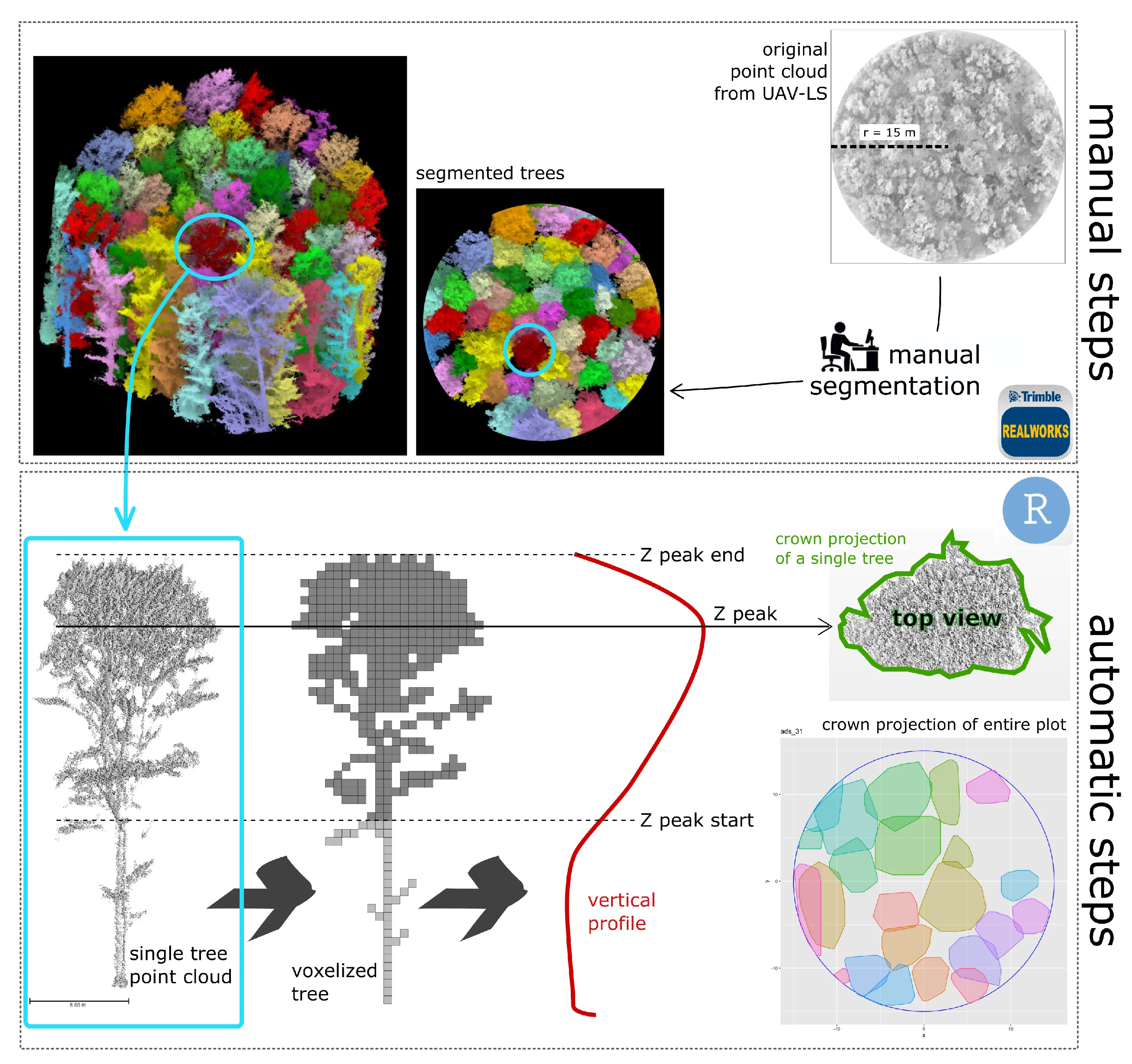
A Semi-Automatic Approach for Tree Crown Competition Indices Assessment from UAV LiDAR
beech forests
individual tree segmentation
precision forestry
size differation index
vertical profile traits
Mostra abstract
Understanding the spatial heterogeneity of forest structure is crucial for comprehending ecosystem dynamics and promoting sustainable forest management. Unmanned aerial vehicle (UAV) LiDAR technology provides a promising method to capture detailed three-dimensional (3D) information about forest canopies, aiding in management and silvicultural practices. This study investigates the heterogeneity of forest structure in broadleaf forests using UAV LiDAR data, with a particular focus on tree crown features and their different information content compared to diameters. We explored a non-conventionally used method that emphasizes crown competition by employing a nearest neighbor selection technique based on metrics derived from UAV point cloud profiles at the tree level, rather than traditional DBH (diameter at breast height) spatial arrangement. About 300 vegetation elements within 10 plots collected in a managed Beech forest were used as reference data. We demonstrate that crown-based approaches, which are feasible with UAV LiDAR data at a reasonable cost and time, significantly enhances the understanding of forest heterogeneity, adding new information content for managers. Our findings underscore the utility of UAV LiDAR in characterizing the complexity and variability of forest structure at high resolution, offering valuable insights for carbon accounting and sustainable forest management. © 2024 by the authors.

LAIr: an R package to estimate LAI from Normalized Difference Vegetation Index
Bajocco
,
Sofia
,
Ferrara
,
Carlotta
,
Savian
,
Francesco
,
Ginaldi
,
Fabrizio
,
Puletti
,
Nicola
,
Crecco
,
Lorenzo
,
Bregaglio
,
Simone Ugo Maria
,
Chianucci
,
Francesco
Mostra abstract
Leaf area index (LAI) is an important biophysical parameter describing vegetation. LAI is typically retrieved from optical remote sensing by empirical models relating LAI to vegetation indices, such as the Normalized Difference Vegetation Index (NDVI). As the relationship between LAI and NDVI is non-linear and crop type dependant, several specific empirical equations relating LAI to NDVI have been developed using field data. This study presented LAIr, an R package to derive LAI from NDVI data from the most comprehensive library of conversion equations. In the package, the range of functions differs on environmental factors, sensors, and vegetation types, allowing flexibility in choosing appropriate options based on specific application, scale of investigation and data availability. We illustrated the use of the package with a case study to compare a generic LAI product with specific NDVI-based LAI estimations. By leveraging empirical knowledge, LAIr enables accurate and context-specific estimation of LAI. The deployment of an open-source R package serves as a valuable tool for aiding researchers in selecting the most appropriate equations for conducting NDVI-to-LAI conversion. © 2024
One to rule them all? Assessing the performance of sustainable forest management indicators against multitaxonomic data for biodiversity conservation
Paillet
,
Yoan
,
Zapponi
,
Livia
,
Schall
,
Peter
,
Monnet
,
Jean Matthieu
,
Ammer
,
Christian
,
Balducci
,
Lorenzo
,
Boch
,
Steffen
,
Brazaitis
,
Gediminas
,
Campanaro
,
Alessandro
,
Chianucci
,
Francesco
,
Doerfler
,
Inken
,
Fischer
,
Markus
,
Gosselin
,
Marion
,
Goßner
,
Martin M.
,
Heilmann-Clausen
,
Jacob
,
Hofmeister
,
Jeňýk
,
Hošek
,
Jan
,
Jung
,
Kirsten G.
,
Kepfer-Rojas
,
Sebastian
,
Ódor
,
Péter
,
Tinya
,
Flóra
,
Trentanovi
,
Giovanni
,
Vacchiano
,
Giorgio
,
Vandekerkhove
,
Kris
,
Weisser
,
Wolfgang W.
,
Wohlwend
,
Michael Rudolf
,
Burrascano
,
Sabina
Mostra abstract
Several regional initiatives and reporting efforts assess the state of forest biodiversity through broad-scale indicators based on data from national forest inventories. Although valuable, these indicators are essentially indirect and evaluate habitat quantity and quality rather than biodiversity per se. Therefore, their link to biodiversity may be weak, which decreases their usefulness for decision-making. For several decades, Forest Europe indicators assessed the state of European forests, in particular their biodiversity. However, no extensive study has been conducted to date to assess their performance – i.e. the capacity of the indicators to reflect variations in biodiversity – against multitaxonomic data. We hypothesized that no single biodiversity indicator from Forest Europe can represent overall forest biodiversity, but that several indicators would reflect habitat quality for at least some taxa in a comprehensive way. We tested the set of Forest Europe's indicators against the species richness of six taxonomic and functional groups across several hundreds of sampling units over Europe. We showed that, while some indicators perform relatively well across groups (e.g. deadwood volume), no single indicator represented all biodiversity at once, and that a combination of several indicators performed better. Forest Europe indicators were chosen for their availability and ease of understanding for most people. However, we showed that gaps in the monitoring framework persist, and that surveying certain taxa along with stand structure is necessary to support policymaking and tackle forest biodiversity loss at the large scale. Adding context (e.g. forest type) may also contribute to increase the performance of biodiversity indicators. © 2024 Elsevier Ltd
Silvicultural regime shapes understory functional structure in European forests
Chianucci
,
Francesco
,
Napoleone
,
Francesca
,
Ricotta
,
Carlo
,
Ferrara
,
Carlotta
,
Fusaro
,
Lina
,
Balducci
,
Lorenzo
,
Trentanovi
,
Giovanni
,
Bradley
,
Owen
,
Kovács
,
Bence
,
Mina
,
Marco
,
Cerabolini
,
Bruno Enrico Leone
,
Vandekerkhove
,
Kris
,
de Smedt
,
Pallieter
,
Lens
,
Luc
,
Hertzog
,
Lionel R.
,
Verheyen
,
Kris
,
Hofmeister
,
Jeňýk
,
Hošek
,
Jan
,
Matula
,
Radim
,
Doerfler
,
Inken
,
Müller
,
Jörg C. C.
,
Weisser
,
Wolfgang W.
,
Helback
,
Jan
,
Schall
,
Peter
,
Fischer
,
Markus
,
Heilmann-Clausen
,
Jacob
,
Riis-Hansen
,
Rasmus
,
Goldberg
,
Irina
,
Aude
,
Erik
,
Kepfer-Rojas
,
Sebastian
,
Kappel Schmidt
,
Inger
,
Riis-Nielsen
,
Torben
,
Mårell
,
Anders
,
Dumas
,
Yann
,
Janssen
,
Philippe
,
Paillet
,
Yoan
,
Archaux
,
Frédéric
,
Xystrakis
,
Fotios
,
Tinya
,
Flóra
,
Ódor
,
Péter
,
Aszalós
,
Réka
,
Bölöni
,
János
,
Cutini
,
Andrea
,
Bagella
,
Simonetta
,
Sitzia
,
Tommaso
,
Brazaitis
,
Gediminas
,
Marozas
,
Vitas
,
Ujházyová
,
Mariana
,
Ujházy
,
Karol
,
Máliš
,
František
,
Nordén
,
Björn
,
Burrascano
,
Sabina
functional diversity
functional redundancy
forest understory
sustainable forest management
unmanaged forests
ecosystem resilience
silvicultural regime
Mostra abstract
Managing forests to sustain their diversity and functioning is a major challenge in a changing world. Despite the key role of understory vegetation in driving forest biodiversity, regeneration and functioning, few studies address the functional dimensions of understory vegetation response to silvicultural management. We assessed the influence of the silvicultural regimes on the functional diversity and redundancy of European forest understory. We gathered vascular plant abundance data from more than 2000 plots in European forests, each associated with one out of the five most widespread silvicultural regimes. We used generalized linear mixed models to assess the effect of different silvicultural regimes on understory functional diversity (Rao's quadratic entropy) and functional redundancy, while accounting for climate and soil conditions, and explored the reciprocal relationship between three diversity components (functional diversity, redundancy and dominance) across silvicultural regimes through a ternary diversity diagram. Intensive silvicultural regimes are associated with a decrease in functional diversity and an increase in functional redundancy, compared with unmanaged conditions. This means that although intensive management may buffer communities' functions against species or functional losses, it also limits the range of understory response to environmental changes. Policy implications. Different silvicultural regimes influence different facets of understory functional features. While unmanaged forests can be used as a reference to design silvicultural practices in compliance with biodiversity conservation targets, different silvicultural options should be balanced at landscape scale to sustain the multiple forest functions that human societies are increasingly demanding. © 2024 The Author(s). Journal of Applied Ecology published by John Wiley & Sons Ltd on behalf of British Ecological Society.