
Loading...
Pubblicazioni Scientifiche
Filtri di ricerca 20 risultati
Pubblicazioni per anno
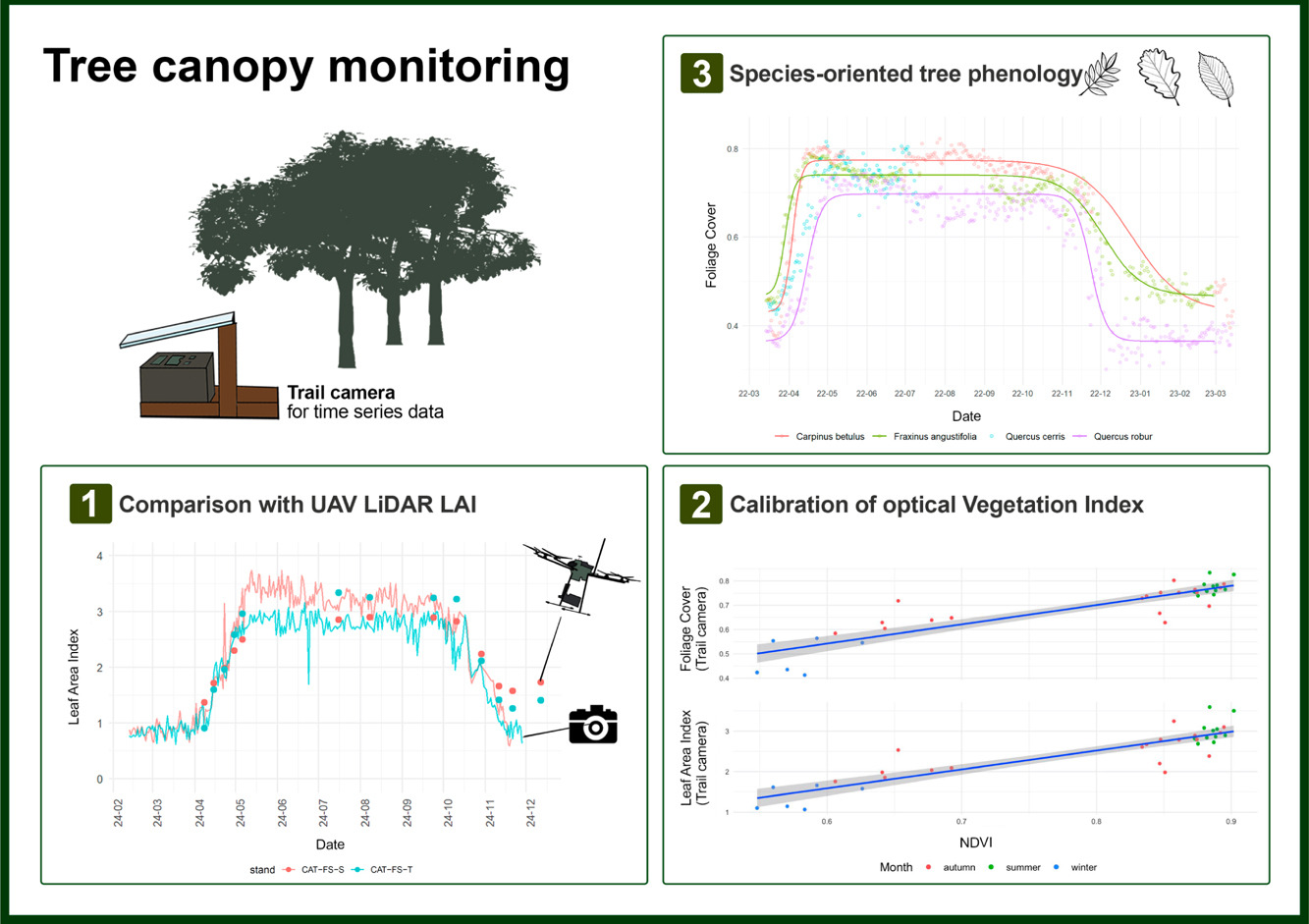
CrowNet: a trail-camera canopy monitoring system
Chianucci
,
Francesco
,
Lenzi
,
Alice
,
Minari
,
Emma
,
Guasti
,
Matteo
,
Gisondi
,
Silvia
,
Gonnelli
,
Marco
,
Innocenti
,
Simone
,
Ferrara
,
Carlotta
,
Campanaro
,
Alessandro
,
Ciampelli
,
Paola
,
Cutini
,
Andrea
,
Puletti
,
Nicola
Mostra abstract
Continuous monitoring of forest canopy structure and phenology is pivotal for the assessment of ecosystem responses to environmental variability and changes. The present study evaluated the use of repeat digital trail cameras as a low-cost, flexible, and accessible in situ monitoring solution for quantifying daily canopy attributes, including effective leaf area index (Le) and canopy cover. A trial camera monitoring network (CrowNet) was established encompassing 20 forest stands in Italy, under different management and environmental conditions, resulting in over 44,000 daily images collected over three years. We demonstrated that taking the mean daily canopy attribute allowed to obtain smooth time series from trail cameras, from which phenological transition dates can be inferred. Daily canopy attributes were validated against manual digital cover photography measurement. To further explore the applicability of this monitoring solution, we performed a comparison between daily Le time series derived from a subset of trail cameras located in beech forests and data collected by multitemporal UAV LiDAR. Results demonstrated the close agreement between the two methods across the entire phenological period (start and end of season). We also illustrated use of continuous trail camera estimates to calibrate a vegetation index (NDVI) to infer leaf area and canopy cover from optical multi-temporal UAV data. We further investigated use of trail camera to detect species-specific differences in tree phenology from time series acquired in a mixed oak-hornbeam forest. We found different canopy structure and phenological transition dates in three broadleaved species (oak, ash, hornbeam), supporting the effectiveness of trail cameras for species-oriented phenology monitoring. We conclude that trail cameras provide a reliable solution for daily canopy monitoring, offering a significant cost-effective and flexible alternative to traditional field methods and providing potential to calibrate, validate or integrate remotely-sensed information. However, camera failures during adverse weather, and the need for more efficient image data quality checking procedures, still represent open challenges. Future improvements, such as weatherproof housing and automated pre-processing screening procedures, are therefore recommended for making trail camera fully operational in ground canopy and phenology monitoring. © 2025 Elsevier B.V.

LAIr: an R package to estimate LAI from Normalized Difference Vegetation Index
Bajocco
,
Sofia
,
Ferrara
,
Carlotta
,
Savian
,
Francesco
,
Ginaldi
,
Fabrizio
,
Puletti
,
Nicola
,
Crecco
,
Lorenzo
,
Bregaglio
,
Simone Ugo Maria
,
Chianucci
,
Francesco
Mostra abstract
Leaf area index (LAI) is an important biophysical parameter describing vegetation. LAI is typically retrieved from optical remote sensing by empirical models relating LAI to vegetation indices, such as the Normalized Difference Vegetation Index (NDVI). As the relationship between LAI and NDVI is non-linear and crop type dependant, several specific empirical equations relating LAI to NDVI have been developed using field data. This study presented LAIr, an R package to derive LAI from NDVI data from the most comprehensive library of conversion equations. In the package, the range of functions differs on environmental factors, sensors, and vegetation types, allowing flexibility in choosing appropriate options based on specific application, scale of investigation and data availability. We illustrated the use of the package with a case study to compare a generic LAI product with specific NDVI-based LAI estimations. By leveraging empirical knowledge, LAIr enables accurate and context-specific estimation of LAI. The deployment of an open-source R package serves as a valuable tool for aiding researchers in selecting the most appropriate equations for conducting NDVI-to-LAI conversion. © 2024
coveR: an R package for processing digital cover photography images to retrieve forest canopy attributes
Mostra abstract
Key message: coveR is an R package for estimating canopy attributes from digital cover photography (DCP) images. The simplicity of the method and the open-accessibility of coveR can effectively extend the accessibility and applicability of DCP to a wider audience. Abstract: Digital cover photography (DCP) is an increasingly popular tool for estimating canopy cover and leaf area index (LAI). However, existing solutions to process canopy images are predominantly tailored for hemispherical photography, whereas open-access tools for DCP are lacking. We developed an R package (coveR) to support the whole processing of DCP images in an automated, fast, and reproducible way. The package functions, which are designed for step-by-step single-image analysis, can be performed sequentially in a pipeline while ensuring quality-checking of each processing step. A wrapper function ‘coveR()’ is also created to perform all the image processing workflow in a single function. A case study is presented to demonstrate the reliability of canopy attributes derived from coveR in pure beech (Fagus sylvatica L.) stands with variable canopy density and structure. Estimates of gap fraction and effective LAI from DCP were validated against reference measurements obtained from terrestrial laser scanning. By providing a simple, transparent, and flexible image processing procedure, coveR supported the use of DCP for routine measurements and monitoring of forest canopy attributes. This, combined with the possibility to implement DCP in many devices, including smartphones, micro-cameras, and remote trail cameras, can greatly expand the accessibility of the method also by non-experts. © 2022, The Author(s), under exclusive licence to Springer-Verlag GmbH Germany, part of Springer Nature.
Estimation of forest leaf area index using satellite multispectral and synthetic aperture radar data in Iran
Vafaei
,
Sasan
,
Fathizadeh
,
Omid
,
Puletti
,
Nicola
,
Fadaei
,
Hadi
,
Rasooli
,
Sabri Baqer
,
Vaglio Laurin
,
Gaia
Mostra abstract
Different satellite datasets, including multispectral Sentinel 2 and synthetic aperture radar Sentinel 1 and ALOS2, were tested to estimate the Leaf Area Index (LAI) in the Zagros forests, Ilam province, in Iran. Field data were collected in 61 sample plots by hemispherical photographs, to train and validate the LAI estimation models. Different satellite data combinations were used as input in regression models built with the following algorithms: Multiple Linear Regression, Random Forests, and Partial Least Square Regression. The results indicate that Leaf Area Index can be best estimated using integrated ALOS2 and Sentinel 2 data; these inputs generated the model with higher accuracy (R<sup>2</sup> = 0.84). The combination of a single band and a vegetation index from Sentinel 2 also led to successful results (R<sup>2</sup> = 0.81). Lower accuracy was obtained when using only ALOS 2 (R<sup>2</sup> = 0.72), but this dataset is helpful where cloud coverage affects optical data. Sentinel 1 data was not useful for LAI predic-tion. The optimal model was based on the traditional Multiple Linear Regression algorithm, using a preliminary input selection step to exclude multi-collinearity effects. To avoid this step, the use of Partial Least Square Regression may be an alternative, as this algorithm was able to produce estimates similar to those obtained with the best model. © SISEF.
Estimation of leaf area index in isolated trees with digital photography and its application to urban forestry
Mostra abstract
Accurate estimates of leaf area index (L) are strongly required for modelling ecophysiological processes within urban forests. The majority of methods available for estimating L is ideally applicable at stand scale and is therefore poorly suitable in urban settings, where trees are typically sparse and isolated. In addition, accurate measurements in urban settings are hindered by proximity of trees to infrastructure elements, which can strongly affect the accuracy of tree canopy analysis.In this study we tested whether digital photography can be used to obtain indirect estimate of L of isolated trees. The sampled species were Platanus orientalis, Liquidambar styraciflua and Juglans regia. Upward-facing photography was used to estimate gap fraction and foliage clumping from images collected in unobstructed (open areas) and obstructed (nearby buildings) settings; two image classification methods provided accurate estimates of gap fraction, based on comparison with measurements obtained from a high quality quantum sensor (LAI-2000). Leveled photography was used to characterize the leaf angle distribution of the examined tree species. L estimates obtained combining the two photographic methods agreed well with direct L measurements obtained from harvesting. We conclude that digital photography is suitable for estimating leaf area in isolated urban trees, due to its simple, fast and cost-effective procedures. Use of vegetation indices allows extending significantly the applicability of the photographic method in urban settings, including green roofs and vertical greenery systems. © 2015 Elsevier GmbH.
An overview of in situ digital canopy photography in forestry
canopy cover
leaf area index
canopy photography
canopy openness
hemispherical sensors
restricted view angle sensors
Mostra abstract
Since the 1960s, canopy photography has been widely used in forestry. Hemispherical photography has been the most widely used technique, but a great drawback of this method is its perceived sensitivity to hemispherical image acquisition and processing. Over the last decade, several alternative photographic approaches using restricted view angle have been proposed. Cover photography acquired via a normal lens was the first of the recently introduced photographic techniques. Use of a restricted view (often fixed) lens has subsequently contributed to the extension of canopy photography to new sensors and platforms, which ultimately have provided answers to some previous challenges regarding within-crown clumping correction, isolated and urban tree measurements, understory assessment, operational leaf inclination angle measurements, and phenological monitoring. This study provides a comprehensive review of the use of canopy photography in forestry and describes the theory and definitions of the variables used to quantify canopy structure. A case study is presented to illustrate and compare the different features and performance of the existing overstory photographic techniques; the results make it possible to suggest sampling strategies for consistent overstory canopy photographic measurements. Emerging operational fields of canopy photography are also described and discussed. © 2020, Canadian Science Publishing. All rights reserved.
Reliability of canopy photography for forest ecology and biodiversity studies
von Meijenfeldt
,
Anouk
,
Chianucci
,
Francesco
,
Rigo
,
Francesca
,
Ottenburghs
,
Jente
,
Hilpold
,
Andreas
,
Mina
,
Marco
leaf area index
canopy photography
canopy structure
hemispherical photography
mountain forests
understory vegetation
Mostra abstract
Understory is a key component of forest biodiversity. The structure of the forest stand and the horizontal composition of the canopy play a major role on the light regime of the understory, which in turn affects the abundance and the diversity of the understory plant community. Reliable assessments of canopy structural attributes are essential for forest research and biodiversity monitoring programs, as well as to study the relationship between canopy and understory plant communities. Canopy photography is a widely used method but it is still not clear which photographic techniques is better suited to capture canopy attributes at stand-level that can be relevant in forest biodiversity studies. For this purpose, we collected canopy structure and understory plant diversity data on 51 forest sites in the north-eastern Italian Alps, encompassing a diversity of forest types from low-elevation deciduous, to mixed montane stands to subalpine coniferous forests. Canopy images were acquired using both digital cover (DCP) and hemispherical (DHP) photography, and analysed canopy structural attributes. These attributes were then compared to tree species composition data to evaluate whether they were appropriate to differentiate between forest types. Additionally, we tested what canopy attributes derived from DCP and DHP best explained the species composition of vascular plants growing in the understory. We found that hemispherical canopy photography was most suitable to capture differences in forest types, which was best expressed by variables such as leaf inclination angle and canopy openness. On our sites, DHP-based canopy attributes were also able to better distinguish between different conifer forests. Leaf clumping was the most important attribute for determining plant species distribution of the understory, indicating that diverse gap structures create different microclimate conditions enhancing diverse plant species with different ecological strategies. This study supports the reliability of canopy photography to derive meaningful indicators in forest and biodiversity research, but also provide insights for increasing understory diversity in managed forests of high conservation value. © 2025
hemispheR: an R package for fisheye canopy image analysis
Mostra abstract
Hemispherical photography is a relevant tool to estimate canopy attributes such as leaf area index (LAI). Advancements in digital photography and image processing tools have supported long-lasting use of digital hemispherical photography (DHP). While some open-source tools exists for DHP, very few solutions have been made available in R programming packages, and none of these allows a full processing workflow to retrieve LAI and other canopy attributes from fisheye images. To fill this gap, we developed an R package (hemispheR) to support the whole processing of DHP images in an automated, fast, and reproducible way. The package functions, which are designed for step-by-step single-image analysis, can be performed sequentially in a pipeline, while allowing inspecting the quality of each image processing step. The package allows to analyze both circular and fullframe fisheye images, collected either with upward facing (forest canopies) or downward facing (short canopies and crops) camera orientation. In addition, the package allows to implement two consolidated LAI methods (LAI-2000/2200 and 57° method). A case study is presented to demonstrate the reliability of canopy attributes derived from hemispheR in temperate deciduous forests with variable canopy density and structure. Canopy attributes were validated against either results obtained from a reference proprietary software, either by benchmarking plot-level LAI with measurements obtained from littertraps. Results indicated hemispheR provide reliable openness and leaf area index in forest canopies as compared with reference values. We also found that combining hemispheR with other R packages further advance analysis of hemispherical canopy images, by reducing the sensitivity of results to camera exposure in both raw and non-raw canopy imagery. By providing a simple, transparent, and flexible image processing procedure, hemispheR supported the use of DHP for routine measurements and monitoring of forest canopy attributes. Hosting the package in a Git repository can further support development of the package, through either collaborative coding or forking projects. © 2023 Elsevier B.V.
Dataset of tree inventory and canopy structure in poplar plantations in Northern Italy
Chianucci
,
Francesco
,
Marchino
,
Luca
,
Bidini
,
Claudio
,
Giorcelli
,
Achille
,
Coaloa
,
Domenico
,
Chiarabaglio
,
Pier Mario
,
Giannetti
,
Francesca
,
Chirici
,
Gherardo
,
Tattoni
,
Clara
Mostra abstract
The dataset reports data collected in 38 square (50 x 50m) 0.25 ha plots representative of poplar plantations in Lombardy Region (Northern Italy), which were used to calibrate optical information derived from unmanned aerial vehicle (UAV) and satellite (Sentinel-2) sensors. In each plot, the diameter at breast height was measured using a caliper; height, stem and crown volume of each tree were then derived from diameter using allometric equations developed in an independent study. Additional canopy attributes (foliage and crown cover, crown porosity, leaf area index) were derived in each plot from 12-20 optical images collected using digital cover photography (DCP). The collected data allows characterizing the assessment of structure of these plantations, along with their variation over the rotation time. Canopy and crown data also enable the evaluation of optimal rotation and tree spacing, as well as the relationship between stand and canopy structure. The raw datasets consist of 2,591 records (trees) associated with inventory measurements and 616 records (images) associated with optical canopy measurements. An R code was also provided to calculate plot-level attributes from raw data. Dataset and associated metadata are freely available at http://dx.doi.org/10.17632/ycr7w5pvkt.1. © 2021 Centro di Ricerca per la Selvicoltura, Consiglio per la Ricerca in Agricoltura e l'Analisi dell'Economia Agraria. All rights reserved.
Multi-temporal dataset of stand and canopy structural data in temperate and Mediterranean coppice forests
Chianucci
,
Francesco
,
Ferrara
,
Carlotta
,
Bertini
,
Giada
,
Fabbio
,
Gianfranco
,
Tattoni
,
Clara
,
Rocchini
,
Duccio
,
Corona
,
P.
,
Cutini
,
Andrea
Mostra abstract
Key message: We provided long-term stand and canopy structural data from permanent monitoring plots representative of some most diffuse temperate and Mediterranean forests, under different coppice management regimes. Periodic inventories were performed in the surveyed plots since the 1970s. Annual litterfall production and its partitioning (leaf, woody, reproductive parts) and optical canopy measurements using the LAI-2000 Plant Canopy Analyzer were performed every year in fully equipped plots since the 1990s. These data can be used for evaluating the influence of coppice management in the stand and canopy structure, the parametrization of radiative transfer models that require accurate ground truth data, and the calibration of high to medium resolution remotely sensed data. Dataset access is at https://doi.org/10.17632/z8zm3ytkcx.2. Associated metadata is available at https://agroenvgeo.data.inra.fr/geonetwork/srv/eng/catalog.search#/metadata/2bd2d77f-3cf8-43da-b1b5-9f8196dc017f . © 2019, INRA and Springer-Verlag France SAS, part of Springer Nature.
A new method to estimate clumping index integrating gap fraction averaging with the analysis of gap size distribution
leaf area index
hemispherical photography
canopy nonrandomness
ordered weighted averaging (owa) operator
orness
Mostra abstract
Estimates of clumping index (Ω) are required to improve the indirect estimation of leaf area index (L) from optical field-based instruments such as digital hemispherical photography (DHP). A widely used method allows estimation of Ω from DHP using simple gap fraction averaging formulas (LX). This method is simple and effective but has the disadvantage of being sensitive to the spatial scale (i.e., the azimuth segment size in DHP) used for averaging and canopy density. In this study, we propose a new method to estimate Ω (LXG) based on ordered weighted gap fraction averaging (OWA) formulas, which addresses the disadvantages of LX and also accounts for gap size distribution. The new method was tested in 11 broadleaved forest stands in Italy; Ω estimated from LXG was compared with other commonly used clumping correction methods (LX, CC, and CLX). Results showed that LXG yielded more accurate Ω estimates, which were also more correlated with the values obtained from the gap size distribution methods (CC and CLX) than Ω obtained from LX. Leaf area index estimates, adjusted by LXG, are only 5%–6% lower than direct measurements obtained from litter traps, while other commonly used clumping correction methods yielded more underestimation. © 2019, Canadian Science Publishing. All rights reserved.
An objective image analysis method for estimation of canopy attributes from digital cover photography
Mostra abstract
Key message: A method was proposed to remove the subjectivity of gap size analyses approaches implemented by default in cover photography. The method yielded robust and replicable measurements of forest canopy attributes. Abstract: Digital cover photography (DCP) is an increasingly popular method to estimate canopy attributes of forest canopies. Compared with other canopy photographic methods, DCP is fast, simple, and less sensitive to image acquisition and processing. However, the image processing steps used by default in DCP have a large substantial subjective component, particularly regarding the separation of canopy gaps into large gaps and small gaps. In this study, we proposed an objective procedure to analyse DCP based on the statistical distribution of gaps occurring in any image. The new method was tested in 11 deciduous forest stands in central Italy, with different tree composition, stand density, and structure, which is representative of the natural variation of these forest types. Results indicated that the new method removed the subjectivity of manual and semi-automated gap size classifications performed so far in cover photography. A comparison with direct LAI measurements demonstrated that the new method outperformed the previous approaches and increased the precision of LAI estimates. Results have important implications in forestry, because the simplicity of the method allowed objective, reliable, and highly reproducible estimates of canopy attributes, which are largely suitable in forest monitoring, where measures are routinely repeated. In addition, the use of a restricted field of view enables implementation of this photographic method in many devices, including smartphones, downward-looking cameras, and unmanned aerial vehicles. © 2018, Springer-Verlag GmbH Germany, part of Springer Nature.
Relationships between overstory and understory structure and diversity in semi-natural mixed floodplain forests at Bosco Fontana (Italy)
Chianucci
,
Francesco
,
Minari
,
Emma
,
Fardusi
,
Most Jannatul
,
Merlini
,
Paolo
,
Cutini
,
Andrea
,
Corona
,
P.
,
Mason
,
Franco
Mostra abstract
The "Bosco Fontana" natural reserve includes the last remaining mixed floodplain forest in northern Italy and one of the most endangered ecosystems in Europe. Its effective management is hindered by the complexity of interactions of mixed-tree species and the influence of environmental factors on understory plant diversity. In this study we analyzed the patterns of natural evolution in semi-natural floodplain forest stands at Bosco Fontana with the aim of better understanding its current natural processes and dynamics. Stand structure, taxonomic and functional diversity, species composition, and leaf area index (LAI) of overstory and understory layers were surveyed in permanent plots over two inventory years (1995, 2005). The influence of environmental factors on understory plant diversity was assessed using Ellenberg’s indices for light, soil moisture, soil nutrient and soil reaction. Results indicated that overstory species composition varies according to the soil moisture, with hornbeam prevailing in xeric sites and deciduous oak species in mesic sites. Xeric sites showed high functional dispersion in both drought and shade tolerant traits, while it was significantly lower in both overstory and understory in the moist site. Functional dispersion of drought tolerance in the overstory and understory layers was positively correlated, while species richness was negatively correlated between the two layers. Diversity in the understory was mainly correlated with soil conditions. Understory LAI was positively correlated with overstory LAI in xeric and mesic plots, while no correlations were found in the moist plot. Overall, our results suggest that site conditions (soil conditions and water availability) are the major drivers of understory and overstory dynamics in the study forest. Hence, local site conditions and the understory should be carefully considered in the management of mixed floodplain forests. © SISEF.
Estimation of canopy attributes in beech forests using true colour digital images from a small fixed-wing UAV
Chianucci
,
Francesco
,
Disperati
,
L.
,
Guzzi
,
Donatella
,
Bianchini
,
Daniele
,
Nardino
,
Vanni
,
Lastri
,
Cinzia
,
Rindinella
,
Andrea
,
Corona
,
P.
Mostra abstract
Accurate estimates of forest canopy are essential for the characterization of forest ecosystems. Remotely-sensed techniques provide a unique way to obtain estimates over spatially extensive areas, but their application is limited by the spectral and temporal resolution available from these systems, which is often not suited to meet regional or local objectives. The use of unmanned aerial vehicles (UAV) as remote sensing platforms has recently gained increasing attention, but their applications in forestry are still at an experimental stage. In this study we described a methodology to obtain rapid and reliable estimates of forest canopy from a small UAV equipped with a commercial RGB camera. The red, green and blue digital numbers were converted to the green leaf algorithm (GLA) and to the CIE L<sup>*</sup>a<sup>*</sup>b<sup>*</sup> colour space to obtain estimates of canopy cover, foliage clumping and leaf area index (L) from aerial images. Canopy attributes were compared with in situ estimates obtained from two digital canopy photographic techniques (cover and fisheye photography). The method was tested in beech forests. UAV images accurately quantified canopy cover even in very dense stand conditions, despite a tendency to not detecting small within-crown gaps in aerial images, leading to a measurement of a quantity much closer to crown cover estimated from in situ cover photography. Estimates of L from UAV images significantly agreed with that obtained from fisheye images, but the accuracy of UAV estimates is influenced by the appropriate assumption of leaf angle distribution. We concluded that true colour UAV images can be effectively used to obtain rapid, cheap and meaningful estimates of forest canopy attributes at medium-large scales. UAV can combine the advantage of high resolution imagery with quick turnaround series, being therefore suitable for routine forest stand monitoring and real-time applications. © 2015 Elsevier B.V.
Long-term response to thinning in a beech (Fagussylvatica L.) coppice stand under conversion to high forest in central Italy
Chianucci
,
Francesco
,
Salvati
,
Luca
,
Giannini
,
Tessa
,
Chiavetta
,
U.
,
Corona
,
P.
,
Cutini
,
Andrea
Mostra abstract
European beech (Fagus sylvatica L.) forests have a long history of coppicing, but the majority of formerly managed coppices are currently under conversion to high forest. The long time required to achieve conversion requires a long-term perspective to fully understand the implication of the applied conversion practices. In this study, we showed results from a long-term (1992–2014) casestudy comparing two management options (natural evolution and periodic thinning) in a beech coppice in conversion to high forest. Leaf area index, litter production, radiation transmittance and growth efficiency taken as relevant stand descriptors, were estimated using both direct and indirect optical methods. Overall, results indicated that beech coppice showed positive and prompt responses to active conversion practices based on periodic medium-heavy thinning. A growth efficiency index showed that tree growth increased as the cutting intensity increased. Results from the case study supported the effectiveness of active conversion management from an economic (timber harvesting) and ecological (higher growth efficiency) point of view. © 2016, Finnish Society of Forest Science. All rights reserved.
Is anticipated seed cutting an effective option to accelerate transition to high forest in European beech (Fagus sylvatica L.) coppice stands?
Cutini
,
Andrea
,
Chianucci
,
Francesco
,
Giannini
,
Tessa
,
Manetti
,
Maria Chiara
,
Salvati
,
Luca
Mostra abstract
Key message: Traditional coppice conversion to high forest through periodic thinning requires a long period to attain the regeneration stage. We showed that anticipating seed cutting can accelerate the progression of the stands towards more adult stand conditions, compared with traditional management. The application of different active management options in the same landscape can contribute to increase landscape diversity. Context: In southern European beech forests, coppice is a widespread management system, especially due to the past uses. The existence of large areas either abandoned or under protracted transitory stage raises questions concerning environmental and economic revenues related to the different management options. Aims: We evaluated the effectiveness of anticipating seed cutting in beech coppices to accelerate the coppice transition to high forest, compared with traditional management (periodic thinning) and natural evolution pattern (unthinned control). Methods: We used an exploratory analysis of ecological variables related to structure, dynamics, and productivity of the stands (growth efficiency, leaf area index, litter production, transmittance, and canopy heterogeneity), which were monitored during 10 years in beech coppices in Central Italy. Results: Anticipating seed cutting produced stronger modification in canopy structure, improving growth efficiency as a result of higher resource availability, supporting higher seed production which accelerated the progression of the stand towards more adult stand conditions, compared with traditional management and unthinned control. Conclusion: The application of different active management options can increase landscape heterogeneity under the conditions in which increasing landscape diversity represents a priority management issue, while simultaneously allowing environmental and economic revenues. © 2015, INRA and Springer-Verlag France.
Estimation of foliage clumping from the LAI-2000 Plant Canopy Analyzer: effect of view caps
leaf area index
hemispherical photography
apparent clumping index
effective leaf area
logarithm averaging
Mostra abstract
Key message: Foliage clumping can be estimated from logarithm averaging method in LAI-2000. The spatial scaling of clumping effects considered by the instrument is dependent on the sensor’s azimuthal view. Accurate estimates of foliage clumping index (Ω) are required to improve the retrieval of leaf area index (L) from optical instruments like LAI-2000/2200 Plant Canopy Analyzer (PCA) and digital hemispherical photography (DHP). The logarithm averaging method is often used to approximate L because clumping effects are considered at scales larger than the sensor’s field of view. However, the spatial scaling considered for logarithm averaging typically differs between PCA and DHP, resulting in different estimates of foliage clumping. Based on simulation, we demonstrated that applying restricting azimuth view caps (e.g., 45° or 10°) allows reliable estimation of Ω and more accurate estimation of L from PCA. Simulated Ω and L values were comparable to those measured using the PCA, DHP and litter traps. Linear averaging of the gap fractions across readings at a plot or site yields a concurrent estimate of effective leaf area index (L<inf>e</inf>), thus enabling the calculation of L<inf>e</inf>, L, and Ω from a single instrument fitted with view caps. Users need to be aware that the method they use for averaging gap fractions determines whether they are measuring L<inf>e</inf> or L, and PCA users need to be aware that they are applying increasingly large corrections for foliage clumping as they use more restrictive view caps, a fact that they can use to their advantage to improve estimates of L. © 2014, Springer-Verlag Berlin Heidelberg.
The estimation of canopy attributes from digital cover photography by two different image analysis methods
Mostra abstract
Proximal sensing methods using digital photography have gained wide acceptance for describing and quantifying canopy properties. Digital hemispherical photography (DHP) is the most widely used photographic technique for canopy description. However, the main drawbacks of DHP have been the tedious and time-consuming image processing required and the sensitivity of the results to the image analysis methods. Recently, an alternative approach using vertical photography has been proposed, namely, digital cover photography (DCP). The method captures detailed vertical canopy gaps and performs canopy analysis by dividing gap fractions into large between-crown gaps and small withincrown gaps. Although DCP is a rapid, simple and readily available method, the processing steps involved in gap fraction analysis have a large subjective component by default. In this contribution, we propose an alternative simple, more objective and easily implemented procedure to perform gap fraction analysis of DCP images. We compared the performance of the two image analysis methods in dense deciduous forests. Leaf area index (LAI) estimates from the two image analysis methods were compared with reference LAI measurements obtained through the use of litter traps to measure leaf fall. Both methods provided accurate estimates of the total gap fraction and, thus, accurate estimates of the LAI. The new proposed procedure is recommended for dense canopies because the subjective classification of large gaps is most error-prone in stands with dense canopy cover. © SISEF.
Estimation of canopy properties in deciduous forests with digital hemispherical and cover photography
leaf area index
cover photography
digital hemispherical photography
clumping
light extinction coefficient
Mostra abstract
Rapid, reliable and meaningful estimates of forest canopy are essential to the characterization of forest ecosystems. In this paper the accuracy of digital hemispherical (DHP) and cover (DCP) photography for the estimation of canopy properties in deciduous forests was evaluated. Leaf area index (LAI) estimated from both these photographic methods and from light transmittance data derived from DHP were compared with direct measurements obtained by litter traps (LAI<inf>LT</inf>) and an AccuPAR ceptometer. Also, comparison with different gap fraction methods used to calculate LAI in DHP and LAI-2000 PCA were performed.We applied these methods in four forest stands of Quercus cerris, two stands of Castanea sativa and four stands of Fagus sylvatica, the most common deciduous species in Italy, where LAI<inf>LT</inf> ranged from 3.9 to 7.3. Both photographic methods provided good indirect estimates of LAI<inf>LT</inf>. The DCP method provided estimates of crown porosity, crown cover, foliage cover and the clumping index at the zenith, but required assumptions about the light extinction coefficient at the zenith (k), to accurately estimate LAI. Cover photography provided good indirect estimates of LAI assuming a spherical leaf angle distribution, even though k appeared to decrease as LAI increased, thus affecting the accuracy of LAI estimates in DCP. In contrast, the accuracy of LAI estimates in DHP appeared insensitive to LAI<inf>LT</inf> values, but the method was sensitive to photographic exposure and more time-consuming than DCP.The studied stands were characterized by higher within-crown clumping than between-crowns clumping; only the segmented analysis of gap fraction for each ring of the fisheye images was found to provide reliable and useful clumping index in DHP. The 1-azimuth segment method employed in PCA poorly detected clumping in dense canopies.The correlation between transmittance estimates by DHP with values measured at noon with the AccuPAR ceptometer was linear and significant, although the variability observed in reference measures suggested that results obtained with the ceptometer should be treated with caution.We conclude both photographic methods are suitable for dense deciduous forests. Cover photography holds great promise as a means to quickly obtain inexpensive estimates of LAI over large areas. However, in situations where no direct reference measurements of . k are available, we recommend using both DHP and DCP, in order to cross-calibrate the two methods; DCP could then be used for more routinely indirect measurement and monitoring of LAI. © 2012 Elsevier B.V.
Digital hemispherical photography for estimating forest canopy properties: Current controversies and opportunities
Mostra abstract
Hemispherical photography has been used since the 1960s in forest ecology. Nevertheless, specific constraints related to film cameras have progressively prevented widespread adoption of this photographic method. Advances in digital photographic technology hold great promise to overcome the major drawbacks of hemispherical photography, particularly regarding field techniques and image processing aspects. This contribution is aimed to: (i) provide a basic foreground of digital hemispherical photography; (ii) illustrate the major strengths and weakness of the method; (iii) provide an reliable protocol for image acquisition and analysis, to get the most out of using hemispherical photography for canopy properties extraction. © SISEF.