
Loading...
Pubblicazioni Scientifiche
Filtri di ricerca 11 risultati
Pubblicazioni per anno
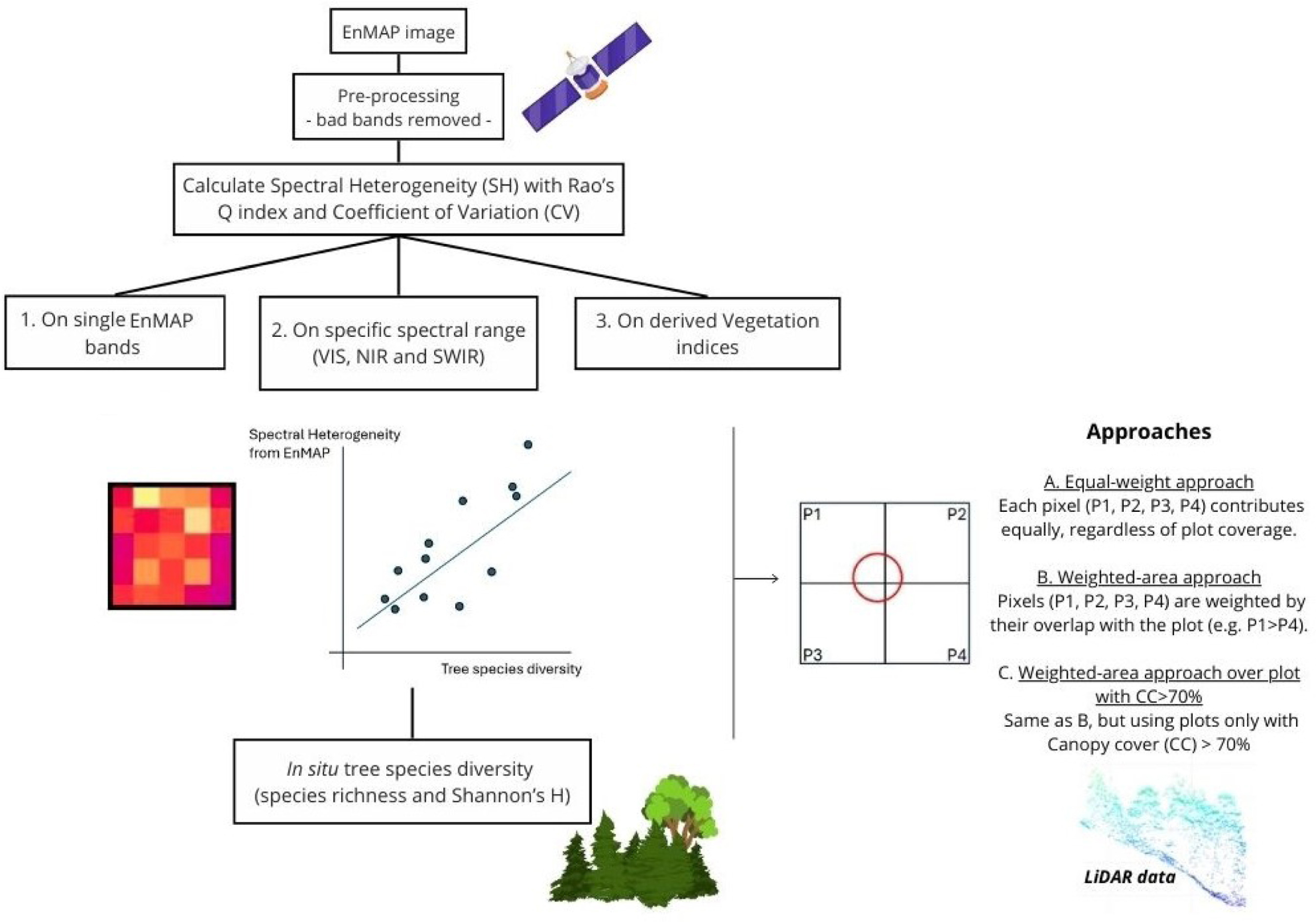
Spectral heterogeneity from the spaceborne imaging spectrometer EnMAP reveals biodiversity patterns in forest ecosystems
Torresani
,
Michele
,
Rossi
,
Christian
,
Mina
,
Marco
,
Menegaldo
,
Irene
,
Cappuccio
,
Matteo
,
Perrone
,
Michela
,
Hakkenberg
,
Christopher R.
,
Rocchini
,
Duccio
,
Puletti
,
Nicola
,
Stendardi
,
Laura
,
Montagnani
,
Leonardo
,
Tognetti
,
Roberto
Mostra abstract
The Spectral Variation Hypothesis (SVH) proposes that spectral heterogeneity (SH), derived from optical data, can serve as a proxy for estimating biodiversity. In this study, we tested the SVH across 42 forest plots in the Italian Alps using imaging spectroscopy data from the EnMAP satellite. We investigated the relationship between SH—quantified using two different metrics, Rao's Q and the coefficient of variation (CV)—and tree species diversity (using Shannon's H index and species richness). We applied three levels of spectral analysis: (1) SH calculated for each individual EnMAP band; (2) SH aggregated across broader spectral ranges (Visible -VIS-, Near Infrared -NIR-, and Shortwave Infrared -SWIR-) and (3) SH derived from vegetation indices (VIs). These analyses were performed under three spatial approaches: (A) a normal approach assigning equal weight to all four EnMAP pixels intersecting a plot; (B) a weighted approach based on the proportional overlap of each pixel with the plot area; and (C) a weighted canopy cover (CC)>70% approach, which included only plots with CC greater than 70% as derived from airborne laser scanning (ALS) LiDAR data. Weak to moderate correlations were observed when SH was derived from single bands, with the strongest relationships in the NIR (R<sup>2</sup> approaching 0.4), followed by the VIS and SWIR regions. A similar trend emerged when SH was aggregated across broader spectral ranges, with the highest correlations again found in the NIR (R<sup>2</sup> up to 0.35). In contrast, lower R<sup>2</sup> values were obtained when SH was computed from specific VIs. The weighted approaches, especially when restricted to plots with CC >70%, consistently yielded higher R<sup>2</sup> values than the equal-weight approach in all three the spectral analysis. Results were consistent across both SH metrics (Rao's Q and CV), with stronger correlations when species richness was used as the biodiversity metric. This work highlights how EnMAP hyperspectral data, despite inherent constraints, can provide valuable insights into forest biodiversity monitoring. © 2025 The Author(s)

Benchmarking tree species classification from proximally sensed laser scanning data: Introducing the FOR-species20K dataset
Puliti
,
Stefano
,
Lines
,
Emily R.
,
Müllerová
,
Jana
,
Frey
,
Julian
,
Schindler
,
Zoe
,
Straker
,
Adrian
,
Allen
,
Matthew J.
,
Winiwarter
,
Lukas
,
Rehush
,
Nataliia
,
Hristova
,
Hristina S.
,
Murray
,
Brent A.
,
Calders
,
Kim
,
Coops
,
Nicholas C.
,
Höfle
,
Bernhard
,
Irwin
,
Liam A.K.
,
Junttila
,
Samuli
,
Kruček
,
Martin
,
Krok
,
G.
,
Král
,
Kamil
,
Levick
,
Shaun R.
,
Lück
,
Linda
,
Missarov
,
Azim
,
Mokroš
,
M.
,
Owen
,
Harry Jon Foord
,
Stereńczak
,
Krzysztof Jan
,
Pitkänen
,
Timo P.
,
Puletti
,
Nicola
,
Saarinen
,
Ninni
,
Hopkinson
,
Chris Dennis
,
Terryn
,
Louise
,
Torresan
,
C.
,
Tomelleri
,
Enrico
,
Weiser
,
Hannah
,
Astrup
,
Rasmus
Mostra abstract
Proximally sensed laser scanning presents new opportunities for automated forest ecosystem data capture. However, a gap remains in deriving ecologically pertinent information, such as tree species, without additional ground data. Artificial intelligence approaches, particularly deep learning (DL), have shown promise towards automation. Progress has been limited by the lack of large, diverse, and, most importantly, openly available labelled single-tree point cloud datasets. This has hindered both (1) the robustness of the DL models across varying data types (platforms and sensors) and (2) the ability to effectively track progress, thereby slowing the convergence towards best practice for species classification. To address the above limitations, we compiled the FOR-species20K benchmark dataset, consisting of individual tree point clouds captured using proximally sensed laser scanning data from terrestrial (TLS), mobile (MLS) and drone laser scanning (ULS). Compiled collaboratively, the dataset includes data collected in forests mainly across Europe, covering Mediterranean, temperate and boreal biogeographic regions. It includes scattered tree data from other continents, totaling over 20,000 trees of 33 species and covering a wide range of tree sizes and forms. Alongside the release of FOR-species20K, we benchmarked seven leading DL models for individual tree species classification, including both point cloud (PointNet++, MinkNet, MLP-Mixer, DGCNNs) and multi-view 2D-based methods (SimpleView, DetailView, YOLOv5). 2D Image-based models had, on average, higher overall accuracy (0.77) than 3D point cloud-based models (0.72). Notably, the performance was consistently >0.8 across scanning platforms and sensors, offering versatility in deployment. The top-scoring model, DetailView, demonstrated robustness to training data imbalances and effectively generalized across tree sizes. The FOR-species20K dataset represents an important asset for developing and benchmarking DL models for individual tree species classification using proximally sensed laser scanning data. As such, it serves as a crucial foundation for future efforts to classify accurately and map tree species at various scales using laser scanning technology, as it provides the complete code base, dataset, and an initial baseline representative of the current state-of-the-art of point cloud tree species classification methods. © 2025 The Author(s). Methods in Ecology and Evolution published by John Wiley & Sons Ltd on behalf of British Ecological Society.
LAIr: an R package to estimate LAI from Normalized Difference Vegetation Index
Bajocco
,
Sofia
,
Ferrara
,
Carlotta
,
Savian
,
Francesco
,
Ginaldi
,
Fabrizio
,
Puletti
,
Nicola
,
Crecco
,
Lorenzo
,
Bregaglio
,
Simone Ugo Maria
,
Chianucci
,
Francesco
Mostra abstract
Leaf area index (LAI) is an important biophysical parameter describing vegetation. LAI is typically retrieved from optical remote sensing by empirical models relating LAI to vegetation indices, such as the Normalized Difference Vegetation Index (NDVI). As the relationship between LAI and NDVI is non-linear and crop type dependant, several specific empirical equations relating LAI to NDVI have been developed using field data. This study presented LAIr, an R package to derive LAI from NDVI data from the most comprehensive library of conversion equations. In the package, the range of functions differs on environmental factors, sensors, and vegetation types, allowing flexibility in choosing appropriate options based on specific application, scale of investigation and data availability. We illustrated the use of the package with a case study to compare a generic LAI product with specific NDVI-based LAI estimations. By leveraging empirical knowledge, LAIr enables accurate and context-specific estimation of LAI. The deployment of an open-source R package serves as a valuable tool for aiding researchers in selecting the most appropriate equations for conducting NDVI-to-LAI conversion. © 2024
Wall-to-Wall Mapping of Forest Biomass and Wood Volume Increment in Italy
Giannetti
,
Francesca
,
Chirici
,
Gherardo
,
Vangi
,
Elia
,
Corona
,
P.
,
Maselli
,
Fabio
,
Chiesi
,
Marta
,
D'Amico
,
Giovanni
,
Puletti
,
Nicola
Mostra abstract
Several political initiatives aim to achieve net-zero emissions by the middle of the twenty-first century. In this context, forests are crucial as a carbon sink to store unavoidable emissions. Assessing the carbon sequestration potential of forest ecosystems is pivotal to the availability of accurate forest variable estimates for supporting international reporting and appropriate forest management strategies. Spatially explicit estimates are even more important for Mediterranean countries such as Italy, where the capacity of forests to act as sinks is decreasing due to climate change. This study aimed to develop a spatial approach to obtain high-resolution maps of Italian forest above-ground biomass (ITA-BIO) and current annual volume increment (ITA-CAI), based on remotely sensed and meteorological data. The ITA-BIO estimates were compared with those obtained with two available biomass maps developed in the framework of two international projects (i.e., the Joint Research Center and the European Space Agency biomass maps, namely, JRC-BIO and ESA-BIO). The estimates from ITA-BIO, JRC-BIO, ESA-BIO, and ITA-CAI were compared with the 2nd Italian NFI (INFC) official estimates at regional level (NUT2). The estimates from ITA-BIO are in good agreement with the INFC estimates (R<sup>2</sup> = 0.95, mean difference = 3.8 t ha<sup>−1</sup>), while for JRC-BIO and ESA-BIO, the estimates show R<sup>2</sup> of 0.90 and 0.70, respectively, and mean differences of 13.5 and of 21.8 t ha<sup>−1</sup> with respect to the INFC estimates. ITA-CAI estimates are also in good agreement with the INFC estimates (R<sup>2</sup> = 0.93), even if they tend to be slightly biased. The produced maps are hosted on a web-based forest resources management Decision Support System developed under the project AGRIDIGIT (ForestView) and represent a key element in supporting the new Green Deal in Italy, the European Forest Strategy 2030 and the Italian Forest Strategy. © 2022 by the authors.
Integrating terrestrial and airborne laser scanning for the assessment of single-tree attributes in Mediterranean forest stands
Giannetti
,
Francesca
,
Puletti
,
Nicola
,
Quatrini
,
Valerio
,
Travaglini
,
Davide
,
Bottalico
,
Francesca
,
Corona
,
P.
,
Chirici
,
Gherardo
Mostra abstract
The development of laser scanning technologies has gradually modified methods for forest mensuration and inventory. The main objective of this study is to assess the potential of integrating ALS and TLS data in a complex mixed Mediterranean forest for assessing a set of five single-tree attributes: tree position (TP), stem diameter at breast height (DBH), tree height (TH), crown base height (CBH) and crown projection area radii (CPAR). Four different point clouds were used: from ZEB1, a hand-held mobile laser scanner (HMLS), and from FARO® FOCUS 3D, a static terrestrial laser scanner (TLS), both alone or in combination with ALS. The precision of single-tree predictions, in terms of bias and root mean square error, was evaluated against data recorded manually in the field with traditional instruments. We found that: (i) TLS and HMLS have excellent comparable performances for the estimation of TP, DBH and CPAR; (ii) TH was correctly assessed by TLS, while the accuracy by HMLS was lower; (iii) CBH was the most difficult attribute to be reliably assessed and (iv) the integration with ALS increased the performance of the assessment of TH and CPAR with both HMLS and TLS. © 2018, © 2018 The Author(s). Published by Informa UK Limited, trading as Taylor & Francis Group.
On the temporal mismatch between in-situ and satellite-derived spring phenology of European beech forests
Mostra abstract
Forest phenology plays a key role in the global terrestrial ecosystem influencing a range of ecosystem processes such as the annual carbon uptake period, and many food webs and changes in their timing and progression. The timing of the start of the phenology season has been successfully determined at a range of scales, from the individual tree by in situ observations to landscape and continental scales by using remotely sensed vegetation indices (VIs). The spatial resolution of satellites is much coarser than traditional methods, creating a gap between space-borne and actual field observations, which brings limitations to phenological research at the ecosystem level. Several unconsidered methodological and observational-related limitations may lead to misinterpretation of the timing of the satellite-derived signals. The aim of this study is therefore to clarify the meaning of a set of spring phenology metrics derived from Moderate Resolution Imaging Spectroradiometer (MODIS) Enhanced Vegetation Index (EVI) time series in beech forests distributed across Europe with respect to PEP725 in situ observations, from 2003 to 2020. To this aim, we (i) tested the differences between remotely sensed and in situ start-of-season (SOS) metrics and (ii) quantified the influence of latitude, elevation, temperature, and precipitation on such differences. Results demonstrated that there is a clear temporal gradient among the different SOS metrics, all of them occurring prior to the in situ observations. Furthermore, latitude and temperatures proved to be the main factors guiding the differences between remotely sensed and in situ SOS metrics. Evidence from this study may help in recognizing the actual meaning of what we see by means of remotely sensed phenology metrics. In this perspective, field observations are crucial in understanding phenology events and provide a reference base. Satellite data, on the other hand, complement field observations by filling in gaps in spatial and temporal coverage, thus enhancing the overall understanding. © 2023 The Author(s). Published by Informa UK Limited, trading as Taylor & Francis Group.
IN SITU (TREE TALKER) AND REMOTELY-SENSED MULTISPECTRAL IMAGERY (SENTINEL-2) INTEGRATION FOR CONTINUOUS FOREST MONITORING: THE FIRST STEP TOWARD WALL-TO-WALL MAPPING OF TREE FUNCTIONAL TRAITS
Francini
,
Saverio
,
Zorzi
,
Ilaria
,
Giannetti
,
Francesca
,
Chianucci
,
Francesco
,
Travaglini
,
Davide
,
Chirici
,
Gherardo
,
Cocozza
,
C.
Mostra abstract
Monitoring tree functional traits is essential for understanding forest ecosystems' capability to respond to climate change. Advancements in continuous proximal sensors and IoT technologies hold great potential for monitoring forest and tree ecosystem processes at the finest spatial and temporal scale. An example is the TreeTalker (TT) technology, which features sensors for measurements of the radial growth, sap flow, multispectral light transmission, air temperature, and humidity at tree level with an hourly frequency rate. Such information can be linked with remote sensing data acquired by the Sentinel-2 (S2) mission, allowing for scaling results over more spatially extensive areas. Firstly, we compared six TT with four S2 spectral bands with similar wavelengths. No correlation was found for blue, green and red channels (R<sup>2</sup> ranged between 0.04 and 0.09) while higher values were found for the near-infrared channel (R<sup>2</sup> = 0.9). To obtain an accurate prediction of TTs bands, also for those TTs bands which wavelengths are not similar to that of S2 bands, we implemented a Sentinel-2 to TreeTalker model (S2TT) by using an 8-layers fully connected deep neural network. The model was tested by using 23 Sentinel-2 imagery and data acquired by 40 TreeTalkers located in two different sites in Tuscany (a beech and a silver fir forest stand) in the period between 2020-07-15 and 2020-11-15. The R<sup>2</sup> ranged between 0.61 (B7, blue) and 0.96 (B6, near-infrared band). The S2TT model represents the first link between remote sensing and TreeTalkers, which might allow predicting tree functional traits using Sentinel-2 imagery. © 2021, Italian Society of Remote Sensing. All rights reserved.
Application of k-nearest neighbor on multispectral images to estimate forest parameters; Aplicação de k-nearest neighbor em imagens multispectrais para a estimativa de parâmetros florestais
Giongo
,
Marcos Vinicius
,
Chiavetta
,
U.
,
Soares Koehler
,
Henrique Soares
,
Machado
,
S. A.
,
Kirchner
,
Flávio Felipe
Mostra abstract
Natural resources management requires several parameters estimate in order to support the identification of the best alternatives to forest areas management. In particular, forest ecosystems require a complex and increasing set of descriptive information, where forest inventories put up important information, however not in a continuous spatial way. Lately, several scientific researches have been focusing on establishing methodologies to relate data from field to those obtained from multispectral images. Modeling these relations can extend the estimates of forest inventory data to not sampled areas. This research evaluated performance of non-parametric analysis using the K-Nearest Neighbor (k-NN) on SPOT 5 images. It evaluated the results obtained from the spatialization of some forest attributes in a forest area located at Molise, Italy. Among several methodologies for spatial distance calculations, the use of multiregressive non-parametric distances revealed the best results. Density and number of species on the ground revealed a Pearson correlation coefficient of = 0.58 as compared to data obtained from multispectral images, lightly lower than the obtained for basal area and volume, which were = 0.62 and 0.71, respectively.
Assessment of potential bioenergy from coppice forests trough the integration of remote sensing and field surveys
Lasserre
,
Bruno
,
Chirici
,
Gherardo
,
Chiavetta
,
U.
,
Garfì
,
Vittorio
,
Tognetti
,
Roberto
,
Drigo
,
Rudi
,
Di Martino
,
P.
,
Marchetti
,
Marco
remote sensing
forest inventory
sustainable forest management
coppice
firewood biomass
k-nearest neighbours
Mostra abstract
A spatially explicit knowledge of forest resources is essential to support the sustainable use of wood as a fuel for producing energy (firewood).This paper describes the integrated use of remotely sensed data and sample based forest inventories to derive a biomass map for coppice forest, resulted estimated potential biomass available is contrasted with local domestic consumptions at the municipality level. The test was carried out in an environmentally and socially homogeneous district of Apennine Mountains (Alto Molise, south-central Italy) coupling multispectral high resolution Landsat 7 ETM+ satellite imagery and a local forest inventory trough the application of the non-parametric estimation procedure k-Nearest Neighbours (k-NN). Several forest management scenarios were applied in order to evaluate their impact on the potential availability of firewood from coppice forests.The paper introduces data and methods used and presents the achieved results both in terms of the accuracy of the biomass map produced by k-NN and of the relationship between the potential availability and demand for firewood.These results demonstrated that k-NN is able to estimate the biomass of coppice forest in the test area with an accuracy level comparable with recent similar application of k-NN carried out in Boreal regions (RMSE of 25.6%).The application of different forest management scenarios have a significant impact on local estimated firewood balance between potential supply from coppice forests and demand for domestic consumption, depending of the scenarios the net balance changed up to 84%. © 2010 Elsevier Ltd.
Post fire natural regeneration monitoring with the integrated use of high resolution remotely sensed images: The case study of the Pineta di Castel Fusano; Monitoraggio della rinnovazione naturale post incendio tramite l'uso integrato di immagini telerilevate ad alta risoluzione: Il caso della pineta di Castel Fusano
Chirici
,
Gherardo
,
Balsi
,
Marco
,
Bertini
,
Roberta
,
Bonora
,
Nico
,
Chiavetta
,
U.
,
Ottaviano
,
Marco
,
Corona
,
P.
,
Lamonaca
,
Andrea
,
Giuliarelli
,
Diego
,
Mastronardi
,
Alessandro
,
Nardinocchi
,
Giovanni
,
Sambucini
,
Valter
,
Tonti
,
Daniela
,
Marchetti
,
Marco
remote sensing
forest wildfires
k-nearest neighbors
natural re generation
neural networks
spatialisation
Mostra abstract
Stone pine stand of Castel Fusano (Rome) burnt on July the 4th 2000 during a huge wildfire. As a consequence of the fire an intensive natural sexual and asexual regeneration began. In order to monitor such a regeneration field surveys were carried out in 2003 and 2006 in sample plots. Remotely sensed high resolution images from Ikonos and Quick Bird were acquired for the same years. The purpose of this work is to test different methodologies for modeling existing relationships between remotely sensed images and ground collected data in order to estimate and to map both sexual and asexual regeneration. For such a purpose different methodologies were tested: step-wise Muliple Linear Regression, Neural Networks (Relevance-Vector-Machine and the Multi-Layered-Perceptron) and the k-Nearest-Neighbors. These activities were carried out within the framework of the GRINFOMED- MEDIFIRE also developing a specific software named Spatial Forest Modeler (SFM) able to analyze existing relationships between remotely sensed variables and data collected in the field in order to identify the best available models to map and estimate the studied variables acquired on the basis of a field sampling design. The present paper presents data collected in the field, analysis and modeling methods and achieved results. The SFM software is also presented.
Estimation of forest attributes by integration of inventory and remotely sensed data in Alto Molise; Stima di attributi forestali tramite integrazione di dati inventariali e immagini telerilevate nell'Alto Molise
Chiavetta
,
U.
,
Chirici
,
Gherardo
,
Lamonaca
,
Andrea
,
Lasserre
,
Bruno
,
Ottaviano
,
Marco
,
Marchetti
,
Marco
Mostra abstract
Forest ecosystems for their important multifunctional value, need a complex and increasing amount of descriptive information to support their management. Ecological and environmental related attributes have became nowadays important as traditional ones, such as wood growing stock and basal area. The correct application of Sustainable Forest Management criteria is boosted by spatial contiguous knowledge of such attributes. For such a reason in the last years a huge number of scientific experiences in the forest area have been concentrated to study the relationship between data acquired in the field and remotely sensed multispectral images. Models based on such relationships can be used to estimate and map forest attributes acquired in the field on the basis of a statistical sampling design. can be sucould not take in consideration spatially structured data. In last years many researches have focused on possible relationships between field data and remote sensed informations derived from multispectral imagery. Modeling these relationships allows to extend inventory data to not explored surfaces. In this paper were discussed results on spatializing forest biometrical attributes, tree heterogeneity and dimensional heterogeneity assessed during an inventory of Mountain Community "Alto Molise" (IS) throw Spot 5 and Lansat TM 7 imagery. For this purpose a multilinear regression and a k-Nearest Neighbor classifier were used.