
Loading...
Pubblicazioni Scientifiche
Filtri di ricerca 7 risultati
Pubblicazioni per anno
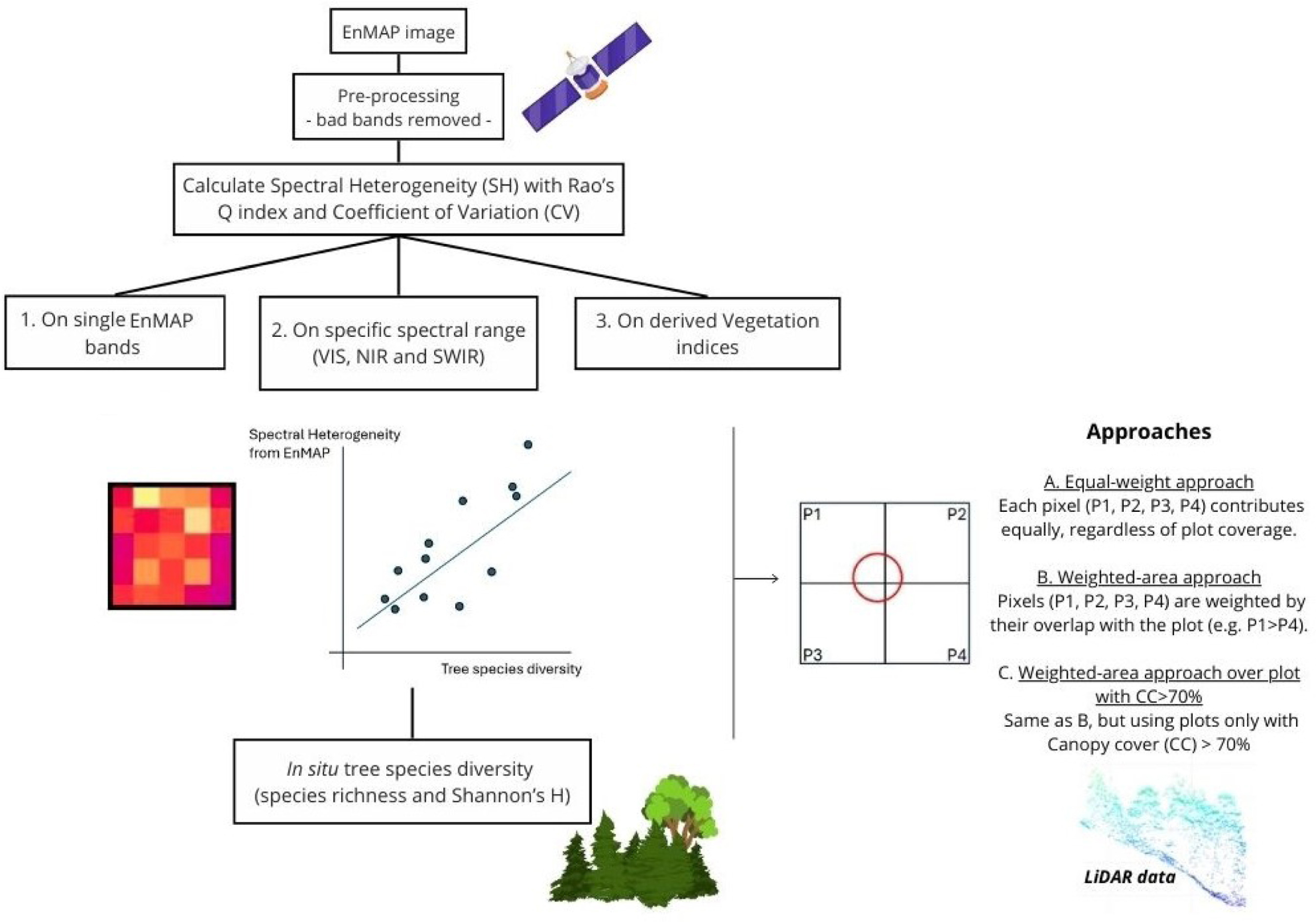
Spectral heterogeneity from the spaceborne imaging spectrometer EnMAP reveals biodiversity patterns in forest ecosystems
Torresani
,
Michele
,
Rossi
,
Christian
,
Mina
,
Marco
,
Menegaldo
,
Irene
,
Cappuccio
,
Matteo
,
Perrone
,
Michela
,
Hakkenberg
,
Christopher R.
,
Rocchini
,
Duccio
,
Puletti
,
Nicola
,
Stendardi
,
Laura
,
Montagnani
,
Leonardo
,
Tognetti
,
Roberto
Mostra abstract
The Spectral Variation Hypothesis (SVH) proposes that spectral heterogeneity (SH), derived from optical data, can serve as a proxy for estimating biodiversity. In this study, we tested the SVH across 42 forest plots in the Italian Alps using imaging spectroscopy data from the EnMAP satellite. We investigated the relationship between SH—quantified using two different metrics, Rao's Q and the coefficient of variation (CV)—and tree species diversity (using Shannon's H index and species richness). We applied three levels of spectral analysis: (1) SH calculated for each individual EnMAP band; (2) SH aggregated across broader spectral ranges (Visible -VIS-, Near Infrared -NIR-, and Shortwave Infrared -SWIR-) and (3) SH derived from vegetation indices (VIs). These analyses were performed under three spatial approaches: (A) a normal approach assigning equal weight to all four EnMAP pixels intersecting a plot; (B) a weighted approach based on the proportional overlap of each pixel with the plot area; and (C) a weighted canopy cover (CC)>70% approach, which included only plots with CC greater than 70% as derived from airborne laser scanning (ALS) LiDAR data. Weak to moderate correlations were observed when SH was derived from single bands, with the strongest relationships in the NIR (R<sup>2</sup> approaching 0.4), followed by the VIS and SWIR regions. A similar trend emerged when SH was aggregated across broader spectral ranges, with the highest correlations again found in the NIR (R<sup>2</sup> up to 0.35). In contrast, lower R<sup>2</sup> values were obtained when SH was computed from specific VIs. The weighted approaches, especially when restricted to plots with CC >70%, consistently yielded higher R<sup>2</sup> values than the equal-weight approach in all three the spectral analysis. Results were consistent across both SH metrics (Rao's Q and CV), with stronger correlations when species richness was used as the biodiversity metric. This work highlights how EnMAP hyperspectral data, despite inherent constraints, can provide valuable insights into forest biodiversity monitoring. © 2025 The Author(s)

Mapping Understory Vegetation Density in Mediterranean Forests: Insights from Airborne and Terrestrial Laser Scanning Integration
forest biodiversity
lidar
terrestrial laser scanner
forest structure
spatial prediction
voxelization
Mostra abstract
The understory is an essential ecological and structural component of forest ecosystems. The lack of efficient, accurate, and objective methods for evaluating and quantifying the spatial spread of understory characteristics over large areas is a challenge for forest planning and management, with specific regard to biodiversity and habitat governance. In this study, we used terrestrial and airborne laser scanning (TLS and ALS) data to characterize understory in a European beech and black pine forest in Italy. First, we linked understory structural features derived from traditional field measurements with TLS metrics, then, we related such metrics to the ones derived from ALS. Results indicate that (i) the upper understory density (5–10 m above ground) is significantly associated with two ALS metrics, specifically the mean height of points belonging to the lower third of the ALS point cloud within the voxel (HM<inf>1/3</inf>) and the corresponding standard deviation (SD<inf>1/3</inf>), while (ii) for the lower understory layer (2–5 m above ground), the most related metric is HM<inf>1/3</inf> alone. As an example application, we have produced a map of forest understory for each layer, extending over the entire study region covered by ALS data, based on the developed spatial prediction models. With this study, we also demonstrated the power of hand-held mobile-TLS as a fast and high-resolution tool for measuring forest structural attributes and obtaining relevant ecological data. © 2023 by the authors.
Characterizing subcanopy structure of Mediterranean forests by terrestrial laser scanning data
forest biodiversity
lidar
terrestrial laser scanner
forest structure
spatial prediction
voxelization
Mostra abstract
Vegetation structure is one of the key factors in forest ecosystems. Especially understory structure has major implications for wildlife habitat selection, reproduction, and survival. Structural indices traditionally used to characterize understory vegetation are based on field vegetation surveys describing general features such as leaf area index (LAI), canopy cover or vegetation height, hiding much of the three-dimensional vegetation structure complexity. The application of terrestrial laser scanning (TLS) in forest ecological and management applications is becoming more effective. In this study, we use TLS data to quantify spatial attributes of forest subcanopy in four different forest strata ranging from 0.5 m to 10 m from the ground. We collected data in 12 plots of mature European beech (Fagus sylvatica L.) forests and 12 plots of mature black pine (Pinus nigra subsp. laricio Maire) forests, located in the Sila National Park, Italy. We propose a TLS-based approach to estimate a fine-scale vegetation density using the Plant Density Index (PDI) and to test the PDI at different height classes. We found a significant relationship between the PDI and the number of trees belonging to the dominant layer, using the Spearman correlation coefficient (r = 0.83, p<inf>val</inf> = 0.001). Basing on PDI values, a cluster analysis of the four subcanopy strata was carried out for deriving clusters of structurally homogeneous forest plots. Results identified three clusters in terms of the vegetation features in the horizontal height classes: the first cluster primarily includes Beech forests characterized by plots with the highest tree densities; the second one includes both Beech and Pine forests characterized by dense ground vegetation and shrubs and an intermediate tree density; the third group is represented by Pine forests with massive presence of vegetation lower strata and moderate tree density. Then, PCA allowed identifying the relationship between the considered subcanopy layers and forest plots. © 2021 Elsevier B.V.
Towards an effective in-situ biodiversity assessment in European forests
Burrascano
,
Sabina
,
Chojnacki
,
Lucas
,
Balducci
,
Lorenzo
,
Chianucci
,
Francesco
,
Haeler
,
Elena
,
Kepfer-Rojas
,
Sebastian
,
Paillet
,
Yoan
,
de Andrade
,
Rafael Barreto
,
Boch
,
Steffen
,
de Smedt
,
Pallieter
,
Fischer
,
Markus
,
Mijangos
,
Itziar Garcia
,
Heilmann-Clausen
,
Jacob
,
Hofmeister
,
Jeňýk
,
Hošek
,
Jan
,
Kozák
,
Daniel
,
Kutszegi
,
Gergely
,
Lachat
,
Thibault
,
Mikoláš
,
Martin
,
Samu
,
Ferenc
,
Ravera
,
Sonia
,
Schall
,
Peter
,
Sitzia
,
Tommaso
,
Svoboda
,
Miroslav
,
Trentanovi
,
Giovanni
,
Ujházyová
,
Mariana
,
Vandekerkhove
,
Kris
,
Tinya
,
Flóra
,
Ódor
,
Péter
forest biodiversity
vascular plants
birds
epiphytic bryophytes
epiphytic lichens
monitoring network
multivariate standard error
rarefaction curves
saproxylic beetles
wood-inhabiting fungi
Mostra abstract
Assessing multi-taxon biodiversity is crucial to understand forests’ response to environmental changes and to inform management strategies. In Europe, forest biodiversity monitoring is still scattered and heterogeneous, although a long-term monitoring network has long been advocated. Given the monitoring aims reported in various EU policies, this network should be accurately designed also through the estimation of its sampling effort, here intended as the number of sampling plots and sites. We used a novel database of forest multi-taxon biodiversity for a pilot study to: estimate the minimum sampling effort needed to: assess variation in species richness and composition; compare these estimates with the efforts invested in the pilot database; discuss estimates’ differences across taxonomic groups and forest categories. We focused on six taxonomic groups (vascular plants, birds, epiphytic lichens and bryophytes, wood-inhabiting fungi and saproxylic beetles) across six forest categories. Based on 6,165 plots at 2,084 different locations across Europe, we benchmarked the effort to achieve: a complete species richness estimate through interpolation/extrapolation curves, and a precise evaluation of species composition variation through multivariate standard error. Our estimates differed widely, especially among taxonomic groups. For species richness, estimates range from 3 to 147 plots per site across 3 to 29 sites per forest category, with birds and epiphytic bryophytes requiring the least effort. For species composition, estimates range from 5 to over 25 plots per site across 5 to 20 sites per forest category, with saproxylic beetles, vascular plants, and fungi displaying the highest estimates. The taxonomic groups requiring an effort comparable to existing data were the least diverse, all the others need greater efforts, either for species richness (e.g., saproxylic beetles), or species composition (e.g., vascular plants), or both (e.g., wood-inhabiting fungi). An effective monitoring network of European forests’ biodiversity should thoroughly account for these benchmarks and for their taxon-dependency. © 2025
Relating forest structural characteristics to bat and bird diversity in the Italian Alps
Rigo
,
Francesca
,
Paniccia
,
Chiara
,
Anderle
,
Matteo
,
Chianucci
,
Francesco
,
Obojes
,
Nikolaus
,
Tappeiner
,
Ulrike
,
Hilpold
,
Andreas
,
Mina
,
Marco
Mostra abstract
The global decline of biodiversity has affected European forests, involving many tree species and forest-dwelling threatened animals. An integrated approach linking forest structure and multi-taxon diversity is increasingly needed to maintain the multifunctionality of forest ecosystems. We investigated the relationship between forest structure, deadwood elements, canopy attributes, and tree-related microhabitats on bat and bird communities in the north-eastern Italian Alps. We collected forest attributes, bats, and bird data on 40 forest plots encompassing the diversity of forest types. To assess the different contributions of each forest attribute variables we performed a two-step statistical analysis using generalised and linear models, including bat and bird taxonomical and functional diversity indices as response variables. Our findings reveal that bats and birds respond differently to variation in forest structural characteristics. Specifically, bat species richness was higher in forests with both higher standing tree and lying deadwood volume. The Shannon diversity index for bird community was higher in forests with high volumes of coarse lying deadwood and stumps. Moreover, plots with mature trees, gaps, and heterogeneous diameter distribution fostered the presence of generalist species of bats and birds, while the abundance of tree-related microhabitats was not significant for these two taxa. This study demonstrates that the optimal habitat conditions for bats and birds in Alpine forests are multifaceted. Promoting distinctive elements within forest stands and a complex forest structure through adaptations in forest management interventions would enhance the conservation of multi-taxon forest biodiversity. © 2024 The Authors
Where are we now with European forest multi-taxon biodiversity and where can we head to?
Burrascano
,
Sabina
,
Chianucci
,
Francesco
,
Trentanovi
,
Giovanni
,
Kepfer-Rojas
,
Sebastian
,
Sitzia
,
Tommaso
,
Tinya
,
Flóra
,
Doerfler
,
Inken
,
Paillet
,
Yoan
,
Nagel
,
Thomas A.
,
Mitić
,
Božena
,
Morillas
,
Lourdes
,
Munzi
,
Silvana
,
Van Der Sluis
,
Theo
,
Alterio
,
Edoardo
,
Balducci
,
Lorenzo
,
de Andrade
,
Rafael Barreto
,
Bouget
,
Christophe
,
Giordani
,
P.
,
Lachat
,
Thibault
,
Matošević
,
Dinka
,
Napoleone
,
Francesca
,
Nascimbene
,
Juri
,
Paniccia
,
Chiara
,
Roth
,
Nicolas
,
Aszalós
,
Réka
,
Brazaitis
,
Gediminas
,
Cutini
,
Andrea
,
D'Andrea
,
Ettore
,
de Smedt
,
Pallieter
,
Heilmann-Clausen
,
Jacob
,
Janssen
,
Philippe
,
Kozák
,
Daniel
,
Mårell
,
Anders
,
Mikoláš
,
Martin
,
Nordén
,
Björn
,
Matula
,
Radim
,
Schall
,
Peter
,
Svoboda
,
Miroslav
,
Ujházyová
,
Mariana
,
Vandekerkhove
,
Kris
,
Wohlwend
,
Michael Rudolf
,
Xystrakis
,
Fotios
,
Aleffi
,
Michele
,
Ammer
,
Christian
,
Archaux
,
Frédéric
,
Asbeck
,
Thomas
,
N Avtzis
,
Dimitrios N.
,
Ayasse
,
Manfred
,
Bagella
,
Simonetta
,
Balestrieri
,
Rosario
,
Barbati
,
Anna
,
Basile
,
Marco
,
Bergamini
,
Ariel
,
Bertini
,
Giada
,
Biscaccianti
,
Alessandro Bruno
,
Boch
,
Steffen
,
Bölöni
,
János
,
Bombi
,
Pierluigi
,
Boscardin
,
Yves
,
Brunialti
,
Giorgio
,
Bruun
,
Hans Henrik
,
Buscot
,
François
,
Byriel
,
David Bille
,
Campagnaro
,
Thomas
,
Campanaro
,
Alessandro
,
Chauvat
,
Matthieu
,
Ciach
,
Michał
,
Čiliak
,
Marek
,
Cistrone
,
Luca
,
Pereira
,
Joaò Manuel Cordeiro
,
Daniel
,
Rolf
,
de Cinti
,
Bruno
,
de Filippo
,
Gabriele
,
Dekoninck
,
Wouter
,
Di Salvatore
,
Umberto
,
Dumas
,
Yann
,
Elek
,
Zoltán
,
Ferretti
,
Fabrizio
,
Fotakis
,
Dimitrios G.
,
Frank
,
Tamás
,
Frey
,
Julian
,
Giancola
,
Carmen
,
Gömöryová
,
Erika
,
Gosselin
,
Marion
,
Gosselin
,
Frédéric
,
Goßner
,
Martin M.
,
Götmark
,
Frank
,
Haeler
,
Elena
,
Hansen
,
Aslak Kappel
,
Hertzog
,
Lionel R.
,
Hofmeister
,
Jeňýk
,
Hošek
,
Jan
,
Johannsen
,
Vivian Kvist
,
Justensen
,
Mathias Just
,
Korboulewsky
,
Nathalie
,
Kovács
,
Bence
,
Lakatos
,
Ferenc
,
Landivar
,
Carlos Miguel
,
Lens
,
Luc
,
Lingua
,
Emanuele
forest biodiversity
biodiversity conservation
forest stand structure
multi-taxon
sustainable management
Mostra abstract
The European biodiversity and forest strategies rely on forest sustainable management (SFM) to conserve forest biodiversity. However, current sustainability assessments hardly account for direct biodiversity indicators. We focused on forest multi-taxon biodiversity to: i) gather and map the existing information; ii) identify knowledge and research gaps; iii) discuss its research potential. We established a research network to fit data on species, standing trees, lying deadwood and sampling unit description from 34 local datasets across 3591 sampling units. A total of 8724 species were represented, with the share of common and rare species varying across taxonomic classes: some included many species with several rare ones (e.g., Insecta); others (e.g., Bryopsida) were represented by few common species. Tree-related structural attributes were sampled in a subset of sampling units (2889; 2356; 2309 and 1388 respectively for diameter, height, deadwood and microhabitats). Overall, multi-taxon studies are biased towards mature forests and may underrepresent the species related to other developmental phases. European forest compositional categories were all represented, but beech forests were over-represented as compared to thermophilous and boreal forests. Most sampling units (94%) were referred to a habitat type of conservation concern. Existing information may support European conservation and SFM strategies in: (i) methodological harmonization and coordinated monitoring; (ii) definition and testing of SFM indicators and thresholds; (iii) data-driven assessment of the effects of environmental and management drivers on multi-taxon forest biological and functional diversity, (iv) multi-scale forest monitoring integrating in-situ and remotely sensed information. © 2023 The Authors
A simple multivariate analysis to assess diversity in a complex long-term managed forest area in central Italy
forest biodiversity
forest ecosystems
sustainable forest management
correlation
principal components analysis
Mostra abstract
Today wood and nonwood forest resources management meets and often clashes with environment and biological diversity protection. A main problem is to understand relationships between the different roles of forest biodiversity, site, and management parameters. A multivariate statistical analysis has been carried out in order to interpret relationships between some forest biodiversity components and forest inventory data. Several indices of floristic diversity, species abundance, and structural heterogeneity at stand level have been calculated. The different components of forest biodiversity were separated by principal components analysis. Relations between forest biodiversity indices and site and management attributes have been investigated by two multivariate statistical techniques: bivariate correlation analysis and multiple linear regression. Results showed a high correlation between all the investigated components of forest biodiversity and some topographic and/or forest management attributes. Results also gave ancillary information to define sustainable forest management criteria. © 2014 Società Botanica Italiana.