
Loading...
Pubblicazioni Scientifiche
Filtri di ricerca 5 risultati
Pubblicazioni per anno
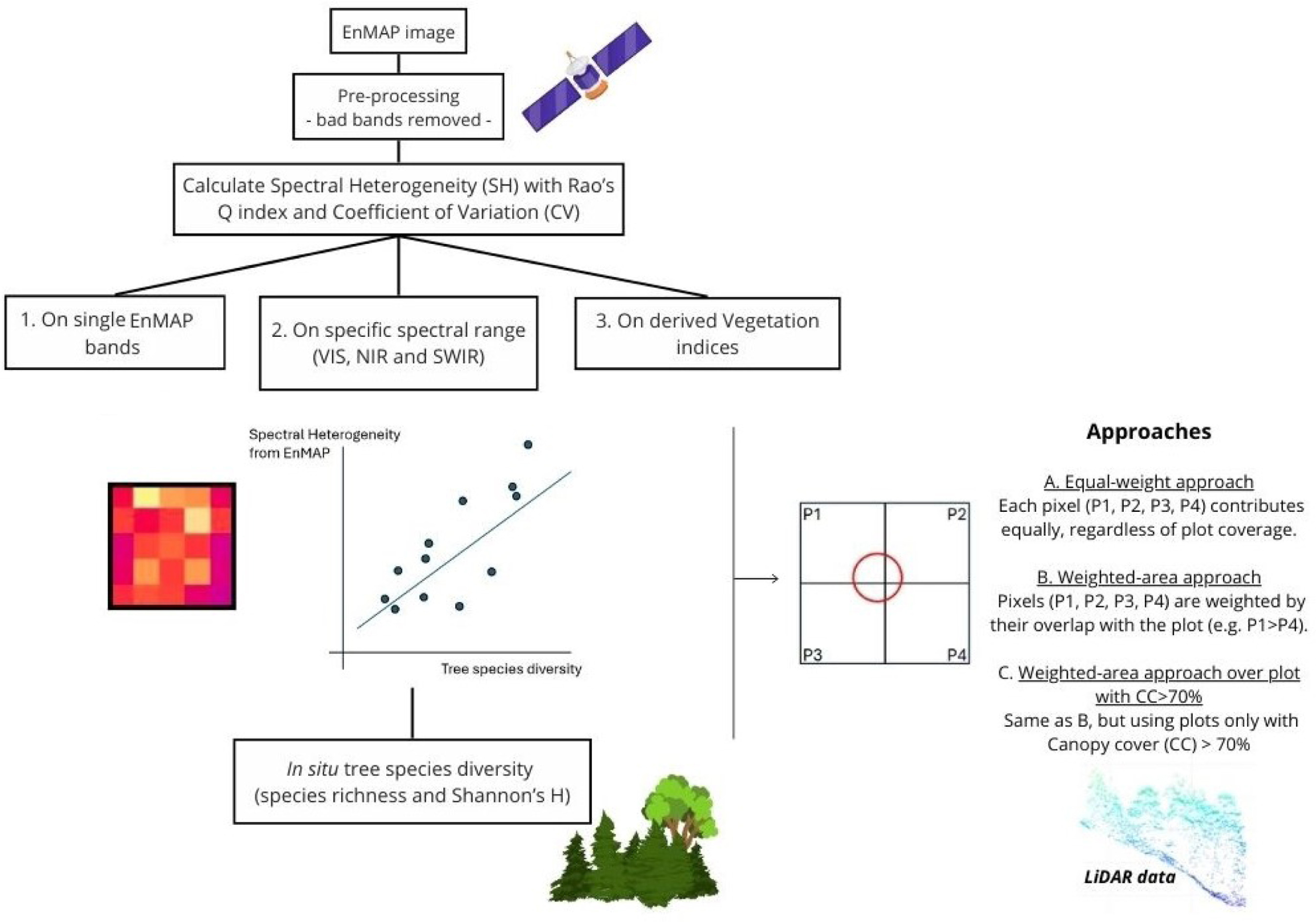
Spectral heterogeneity from the spaceborne imaging spectrometer EnMAP reveals biodiversity patterns in forest ecosystems
Torresani
,
Michele
,
Rossi
,
Christian
,
Mina
,
Marco
,
Menegaldo
,
Irene
,
Cappuccio
,
Matteo
,
Perrone
,
Michela
,
Hakkenberg
,
Christopher R.
,
Rocchini
,
Duccio
,
Puletti
,
Nicola
,
Stendardi
,
Laura
,
Montagnani
,
Leonardo
,
Tognetti
,
Roberto
Mostra abstract
The Spectral Variation Hypothesis (SVH) proposes that spectral heterogeneity (SH), derived from optical data, can serve as a proxy for estimating biodiversity. In this study, we tested the SVH across 42 forest plots in the Italian Alps using imaging spectroscopy data from the EnMAP satellite. We investigated the relationship between SH—quantified using two different metrics, Rao's Q and the coefficient of variation (CV)—and tree species diversity (using Shannon's H index and species richness). We applied three levels of spectral analysis: (1) SH calculated for each individual EnMAP band; (2) SH aggregated across broader spectral ranges (Visible -VIS-, Near Infrared -NIR-, and Shortwave Infrared -SWIR-) and (3) SH derived from vegetation indices (VIs). These analyses were performed under three spatial approaches: (A) a normal approach assigning equal weight to all four EnMAP pixels intersecting a plot; (B) a weighted approach based on the proportional overlap of each pixel with the plot area; and (C) a weighted canopy cover (CC)>70% approach, which included only plots with CC greater than 70% as derived from airborne laser scanning (ALS) LiDAR data. Weak to moderate correlations were observed when SH was derived from single bands, with the strongest relationships in the NIR (R<sup>2</sup> approaching 0.4), followed by the VIS and SWIR regions. A similar trend emerged when SH was aggregated across broader spectral ranges, with the highest correlations again found in the NIR (R<sup>2</sup> up to 0.35). In contrast, lower R<sup>2</sup> values were obtained when SH was computed from specific VIs. The weighted approaches, especially when restricted to plots with CC >70%, consistently yielded higher R<sup>2</sup> values than the equal-weight approach in all three the spectral analysis. Results were consistent across both SH metrics (Rao's Q and CV), with stronger correlations when species richness was used as the biodiversity metric. This work highlights how EnMAP hyperspectral data, despite inherent constraints, can provide valuable insights into forest biodiversity monitoring. © 2025 The Author(s)

Quantifying the effect of sampling plot size on the estimation of structural indicators in old-growth forest stands
Lombardi
,
Fabio
,
Marchetti
,
Marco
,
Corona
,
P.
,
Merlini
,
Paolo
,
Chirici
,
Gherardo
,
Tognetti
,
Roberto
,
Burrascano
,
Sabina
,
Alivernini
,
Alessandro
,
Puletti
,
Nicola
Mostra abstract
There is increasing awareness that structure-based indicators should be considered for assessing the biological value of late successional forests. In order to increase the unique habitat features critical for old-growth associated species, it is important to identify and rank candidate potential forest sites on the basis of their distinctive structural features. Data on living and deadwood components for the identification of old-growth condition are usually acquired in the considered forest stands by two sampling survey: (i) census performed in relatively large monitoring sites; (ii) network of small sampling units, on which inventory practices are usually based. Several authors argued that choosing between these survey strategies might have substantial effects on the values of common indicators of old-growth condition. Our study aims at (i) assessing the total estimate differences among old-growth structural indicators measured in field plots with different sizes, and (ii) defining the optimal sample size for the reliable assessment of such indicators. The study was carried out in six beech dominated forest stands on the Apennines range in Italy. In each stand, living and deadwood components were surveyed and geocoded in 1-ha square areas. Based on these dataset, circular plots with radii ranging from 4m up to 20m were then considered in order to quantify the effect of sampling plot size on the estimation of four structural indicators: (1) number of living trees; (2) number of large trees (dbh≥50cm); (3) total deadwood volume; (4) number of deadwood elements (snags, dead standing trees; lying dead trees, lying deadwood) with dbh (or average diameter for lying deadwood) ≥ 30cm. We found that the size of the sampling plots should be at least 500 m<sup>2</sup> in order to establish a database for the assessment of the investigated indicators. The census approach should be preferred to the sampling plot approach for old-growth forest stands smaller than 3-5ha. The achieved results contribute to define assessment protocols for characterizing and ranking the degree to which forest stands approximate old-growth condition based on standardized indicators. © 2015 Elsevier B.V.
What Is Known About the Management of European Beech Forests Facing Climate Change? A Review
Antonucci
,
Serena
,
Santopuoli
,
Giovanni
,
Marchetti
,
Marco
,
Tognetti
,
Roberto
,
Chiavetta
,
U.
,
Garfì
,
Vittorio
Mostra abstract
Purpose of Review: This paper aims to retrace the most significant management strategies adopted across European beech forests over the last 25 years, highlighting those that are most efficient and promising. We investigate five main topics including forest management, forest models, species mixture, genetic, and regeneration. Recent Findings: European beech is one of the most widespread and important tree species for the European forest sector. In the light of the ongoing climate crisis, understanding the growth dynamics and the response of beech forests to climate change is crucial to identify advantageous management strategies. Ecology, growth, management, distribution, interaction with other species, genetic, and regeneration aspects of European beech were investigated in different geographical areas of Europe. Despite recent researches focusing on climate change issues, how adaptation and mitigation measures can be integrated into silvicultural guidelines to improve the resilience of European beech forests remains unclear. Summary: To answer this question, we collected and reviewed articles about the management of European beech facing climate change, which were published in peer-reviewed journals over the last 25 years. Articles were grouped into five geographic European areas, according to the classification used by the State of Europe’s forests. Obtained articles were further clustered into five main topics: management, mixed forest, modelling, genetic, and regeneration. The review highlighted the importance of using long-term monitoring plots to understand the effect of climate change on the stability of European beech forests, suggesting climate-smart measures that would help these forests adapt to climate change. © 2021, The Author(s), under exclusive licence to Springer Nature Switzerland AG.
Assessment of potential bioenergy from coppice forests trough the integration of remote sensing and field surveys
Lasserre
,
Bruno
,
Chirici
,
Gherardo
,
Chiavetta
,
U.
,
Garfì
,
Vittorio
,
Tognetti
,
Roberto
,
Drigo
,
Rudi
,
Di Martino
,
P.
,
Marchetti
,
Marco
remote sensing
forest inventory
sustainable forest management
coppice
firewood biomass
k-nearest neighbours
Mostra abstract
A spatially explicit knowledge of forest resources is essential to support the sustainable use of wood as a fuel for producing energy (firewood).This paper describes the integrated use of remotely sensed data and sample based forest inventories to derive a biomass map for coppice forest, resulted estimated potential biomass available is contrasted with local domestic consumptions at the municipality level. The test was carried out in an environmentally and socially homogeneous district of Apennine Mountains (Alto Molise, south-central Italy) coupling multispectral high resolution Landsat 7 ETM+ satellite imagery and a local forest inventory trough the application of the non-parametric estimation procedure k-Nearest Neighbours (k-NN). Several forest management scenarios were applied in order to evaluate their impact on the potential availability of firewood from coppice forests.The paper introduces data and methods used and presents the achieved results both in terms of the accuracy of the biomass map produced by k-NN and of the relationship between the potential availability and demand for firewood.These results demonstrated that k-NN is able to estimate the biomass of coppice forest in the test area with an accuracy level comparable with recent similar application of k-NN carried out in Boreal regions (RMSE of 25.6%).The application of different forest management scenarios have a significant impact on local estimated firewood balance between potential supply from coppice forests and demand for domestic consumption, depending of the scenarios the net balance changed up to 84%. © 2010 Elsevier Ltd.
Ecological portrayal of old-growth forests and persistent woodlands in the cilento and vallo di Diano National Park (southern Italy)
Marchetti
,
Marco
,
Tognetti
,
Roberto
,
Lombardi
,
Fabio
,
Chiavetta
,
U.
,
Palumbo
,
Giuseppe
,
Sellitto
,
Vincenzo Michele
,
Colombo
,
C. Massimo
,
Iovieno
,
Paola
,
Alfani
,
Anna
,
Baldantoni
,
Daniela
,
Barbati
,
Anna
,
Ferrari
,
Barbara
,
Bonacquisti
,
Sandro
,
Capotorti
,
Giulia
,
Copiz
,
Riccardo
,
Blasi
,
Carlo
biodiversity
mediterranean region
ecological characterization
managed stands
old-growth forests
persistent woodlands
soil
Mostra abstract
The maintenance of certain levels of old forest represents a cornerstone of the EU's biodiversity management strategy. A consensus on a single general ecological definition of old-growth is particularly difficult in Mediterranean Europe. The present paper deals with old-growth forests and persistent woodlands in the Cilento and Vallo di Diano National Park (PNCVD) to give an ecological understanding of forest complexity and dynamics under a multiscale and multidisciplinary perspective. The multiscale approach ranged from the identification and mapping of potential old-growth stands at landscape scale to a two-level field review of forest stand features. Field sampling involved a multidisciplinary team of researchers in forest structure, pedologic environment, soil microbial activity, flora and vegetation and deadwood components. The research provided sound knowledge about old-growthness features in the PNCVD that constitutes a unique case study in the whole Mediterranean basin. The integration of results allowed to: identify main ecosystem functions and the related services of the old-growth forests in the study area; distinguish persistent woodlands, multi-aged stands with old trees deriving from nineteenth-century management practices, from old-growth forests sensu strictu; recognize indicators of direct and indirect impacts of human activities; suggest effective practices for sustainable management in the Mediterranean context. © 2010 Società Botanica Italiana.