
Loading...
Pubblicazioni Scientifiche
Filtri di ricerca 2 risultati
Pubblicazioni per anno
CrowNet: a trail-camera canopy monitoring system
Chianucci
,
Francesco
,
Lenzi
,
Alice
,
Minari
,
Emma
,
Guasti
,
Matteo
,
Gisondi
,
Silvia
,
Gonnelli
,
Marco
,
Innocenti
,
Simone
,
Ferrara
,
Carlotta
,
Campanaro
,
Alessandro
,
Ciampelli
,
Paola
,
Cutini
,
Andrea
,
Puletti
,
Nicola
Mostra abstract
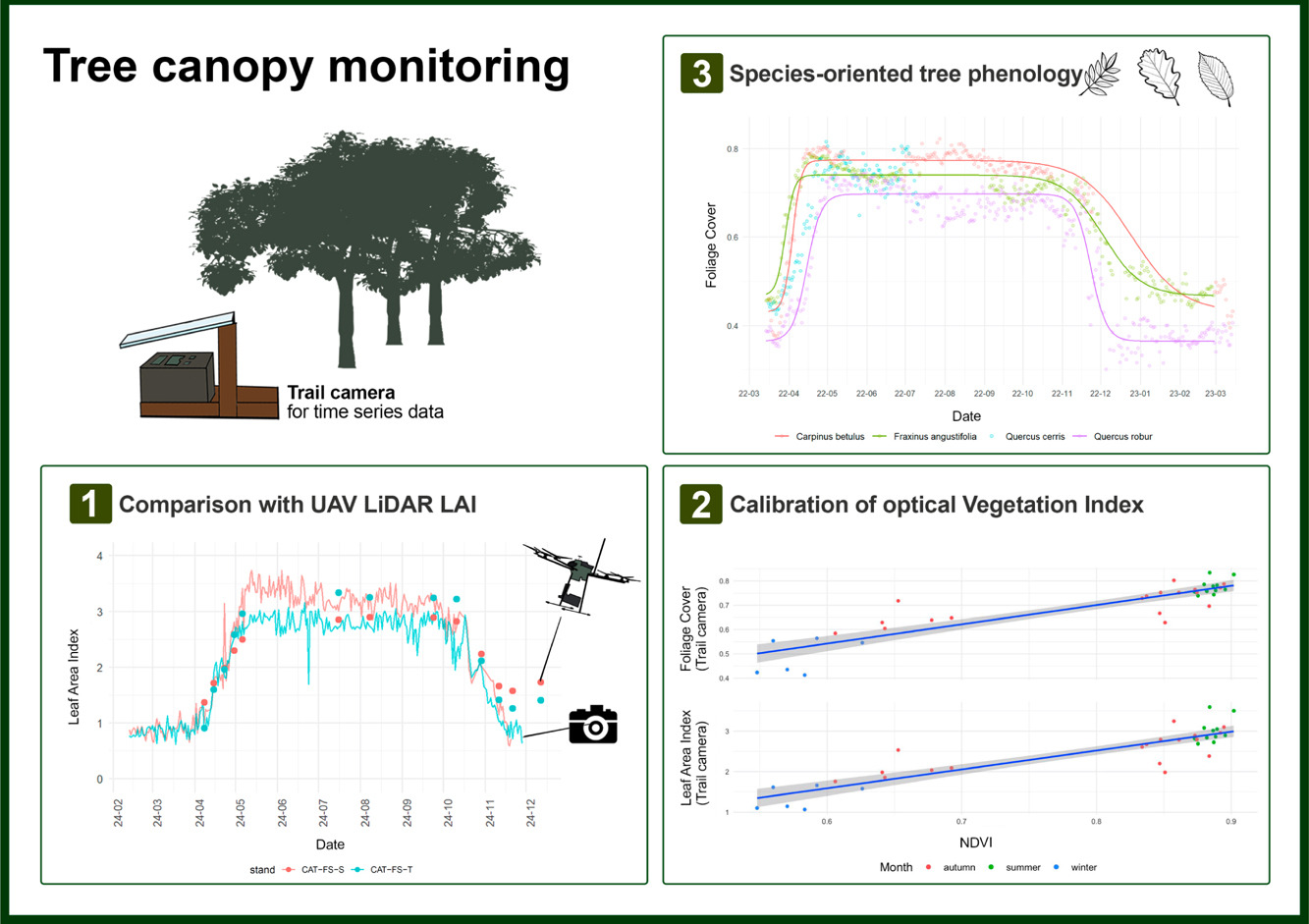
Continuous monitoring of forest canopy structure and phenology is pivotal for the assessment of ecosystem responses to environmental variability and changes. The present study evaluated the use of repeat digital trail cameras as a low-cost, flexible, and accessible in situ monitoring solution for quantifying daily canopy attributes, including effective leaf area index (Le) and canopy cover. A trial camera monitoring network (CrowNet) was established encompassing 20 forest stands in Italy, under different management and environmental conditions, resulting in over 44,000 daily images collected over three years. We demonstrated that taking the mean daily canopy attribute allowed to obtain smooth time series from trail cameras, from which phenological transition dates can be inferred. Daily canopy attributes were validated against manual digital cover photography measurement. To further explore the applicability of this monitoring solution, we performed a comparison between daily Le time series derived from a subset of trail cameras located in beech forests and data collected by multitemporal UAV LiDAR. Results demonstrated the close agreement between the two methods across the entire phenological period (start and end of season). We also illustrated use of continuous trail camera estimates to calibrate a vegetation index (NDVI) to infer leaf area and canopy cover from optical multi-temporal UAV data. We further investigated use of trail camera to detect species-specific differences in tree phenology from time series acquired in a mixed oak-hornbeam forest. We found different canopy structure and phenological transition dates in three broadleaved species (oak, ash, hornbeam), supporting the effectiveness of trail cameras for species-oriented phenology monitoring. We conclude that trail cameras provide a reliable solution for daily canopy monitoring, offering a significant cost-effective and flexible alternative to traditional field methods and providing potential to calibrate, validate or integrate remotely-sensed information. However, camera failures during adverse weather, and the need for more efficient image data quality checking procedures, still represent open challenges. Future improvements, such as weatherproof housing and automated pre-processing screening procedures, are therefore recommended for making trail camera fully operational in ground canopy and phenology monitoring. © 2025 Elsevier B.V.

Ecological portrayal of old-growth forests and persistent woodlands in the cilento and vallo di Diano National Park (southern Italy)
Marchetti
,
Marco
,
Tognetti
,
Roberto
,
Lombardi
,
Fabio
,
Chiavetta
,
U.
,
Palumbo
,
Giuseppe
,
Sellitto
,
Vincenzo Michele
,
Colombo
,
C. Massimo
,
Iovieno
,
Paola
,
Alfani
,
Anna
,
Baldantoni
,
Daniela
,
Barbati
,
Anna
,
Ferrari
,
Barbara
,
Bonacquisti
,
Sandro
,
Capotorti
,
Giulia
,
Copiz
,
Riccardo
,
Blasi
,
Carlo
biodiversity
mediterranean region
ecological characterization
managed stands
old-growth forests
persistent woodlands
soil
Mostra abstract
The maintenance of certain levels of old forest represents a cornerstone of the EU's biodiversity management strategy. A consensus on a single general ecological definition of old-growth is particularly difficult in Mediterranean Europe. The present paper deals with old-growth forests and persistent woodlands in the Cilento and Vallo di Diano National Park (PNCVD) to give an ecological understanding of forest complexity and dynamics under a multiscale and multidisciplinary perspective. The multiscale approach ranged from the identification and mapping of potential old-growth stands at landscape scale to a two-level field review of forest stand features. Field sampling involved a multidisciplinary team of researchers in forest structure, pedologic environment, soil microbial activity, flora and vegetation and deadwood components. The research provided sound knowledge about old-growthness features in the PNCVD that constitutes a unique case study in the whole Mediterranean basin. The integration of results allowed to: identify main ecosystem functions and the related services of the old-growth forests in the study area; distinguish persistent woodlands, multi-aged stands with old trees deriving from nineteenth-century management practices, from old-growth forests sensu strictu; recognize indicators of direct and indirect impacts of human activities; suggest effective practices for sustainable management in the Mediterranean context. © 2010 Società Botanica Italiana.