
Loading...
Pubblicazioni Scientifiche
Filtri di ricerca 3 risultati
Pubblicazioni per anno
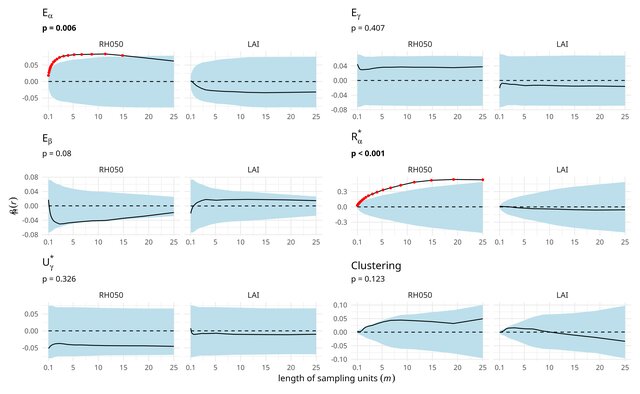
Forest structure and understory functional diversity at multiple scales: The importance of median tree height
de Benedictis
,
Luciano Ludovico Maria
,
Chelli
,
Stefano
,
Zhu
,
Zhengxue
,
Cervellini
,
Marco
,
Canullo
,
R.
,
Chianucci
,
Francesco
,
Puletti
,
Nicola
,
Tsakalos
,
James L.
,
Bartha
,
Sándor
,
Campetella
,
Giandiego

Multiple drivers of functional diversity in temperate forest understories: Climate, soil, and forest structure effects
Chelli
,
Stefano
,
Bricca
,
Alessandro
,
Tsakalos
,
James L.
,
Andreetta
,
Anna
,
Bonari
,
Gianmaria
,
Campetella
,
Giandiego
,
Carnicelli
,
Stefano
,
Cervellini
,
Marco
,
Puletti
,
Nicola
,
Wellstein
,
Camilla
,
Canullo
,
R.
climate change
functional diversity
bud bank
forest management
plant height
seed mass
specific leaf area
Mostra abstract
In macroecology, shifting from coarse- to local-scale explanatory factors is crucial for understanding how global change impacts functional diversity (FD). Plants possess diverse traits allowing them to differentially respond across a spectrum of environmental conditions. We aim to assess how macro- to microclimate, stand-scale measured soil properties, forest structure, and management type, influence forest understorey FD at the macroecological scale. Our study covers Italian forests, using thirteen predictors categorized into climate, soil, forest structure, and management. We analyzed five traits (i.e., specific leaf area, plant size, seed mass, belowground bud bank size, and clonal lateral spread) capturing independent functional dimensions to calculate the standardized effect size of functional diversity (SES-FD) for all traits (multi-trait) and for single traits. Multiple regression models were applied to assess the effect of predictors on SES-FD. We revealed that climate, soil, and forest structure significantly drive SES-FD of specific leaf area, plant size, seed mass, and bud bank. Forest management had a limited effect. However, differences emerged between herbaceous and woody growth forms of the understorey layer, with herbaceous species mainly responding to climate and soil features, while woody species were mainly affected by forest structure. Future warmer and more seasonal climate could reduce the diversity of resource economics, plant size, and persistence strategies of the forest understorey. Soil eutrophication and acidification may impact the diversity of regeneration strategies; canopy closure affects the diversity of above- and belowground traits, with a larger effect on woody species. Multifunctional approaches are vital to disentangle the effect of global changes on functional diversity since independent functional specialization axes are modulated by different drivers. © 2024 The Authors
Spatio-temporal variability in structure and diversity in a semi-natural mixed oak-hornbeam floodplain forest
Grotti
,
Mirko
,
Chianucci
,
Francesco
,
Puletti
,
Nicola
,
Fardusi
,
Most Jannatul
,
Castaldi
,
Cristiano
,
Corona
,
P.
Mostra abstract
Mixed forests are particularly interesting for forest structure and diversity analyses, as higher complexity and diversity can be expected in these forests compared to pure ones. Integrating different approaches in the analyses of structure and diversity in these forests can provide complementary information on non-spatial, spatial and functional diversity patterns. The study aimed at evaluating the spatio-temporal dynamics in forest structure and diversity in a semi-natural mixed oak-hornbeam floodplain forest. All standing trees were mapped and inventoried in 1995, 2005 and 2016 in three 1-ha mixed forest stands, with different soil moisture regime (xeric, mesic, moist conditions). Traditional, non-spatial structure and diversity measures were coupled with spatially-explicit and functional diversity measures. Results indicated that the three stands showed limited variation in stand structure and similar non-spatial diversity attributes, despite the different species composition. Only the extension to spatial and functional analyses was able to reveal more pronounced differences of diversity patterns, as higher complexity, species mingling, and functional tree complementarity was observed in the moister stand. These findings support use of spatially-explicit measurements in traditional inventory measurement protocols to allow more refined analysis of diversity patterns. On the other hand, functional diversity can be easily implemented in diversity analyses, as it requires species abundance information (which is traditionally collected in forest inventory) and species-specific tree traits which can be inferred from literature. © 2019 Elsevier Ltd