
Loading...
Pubblicazioni Scientifiche
Filtri di ricerca 9 risultati
Pubblicazioni per anno
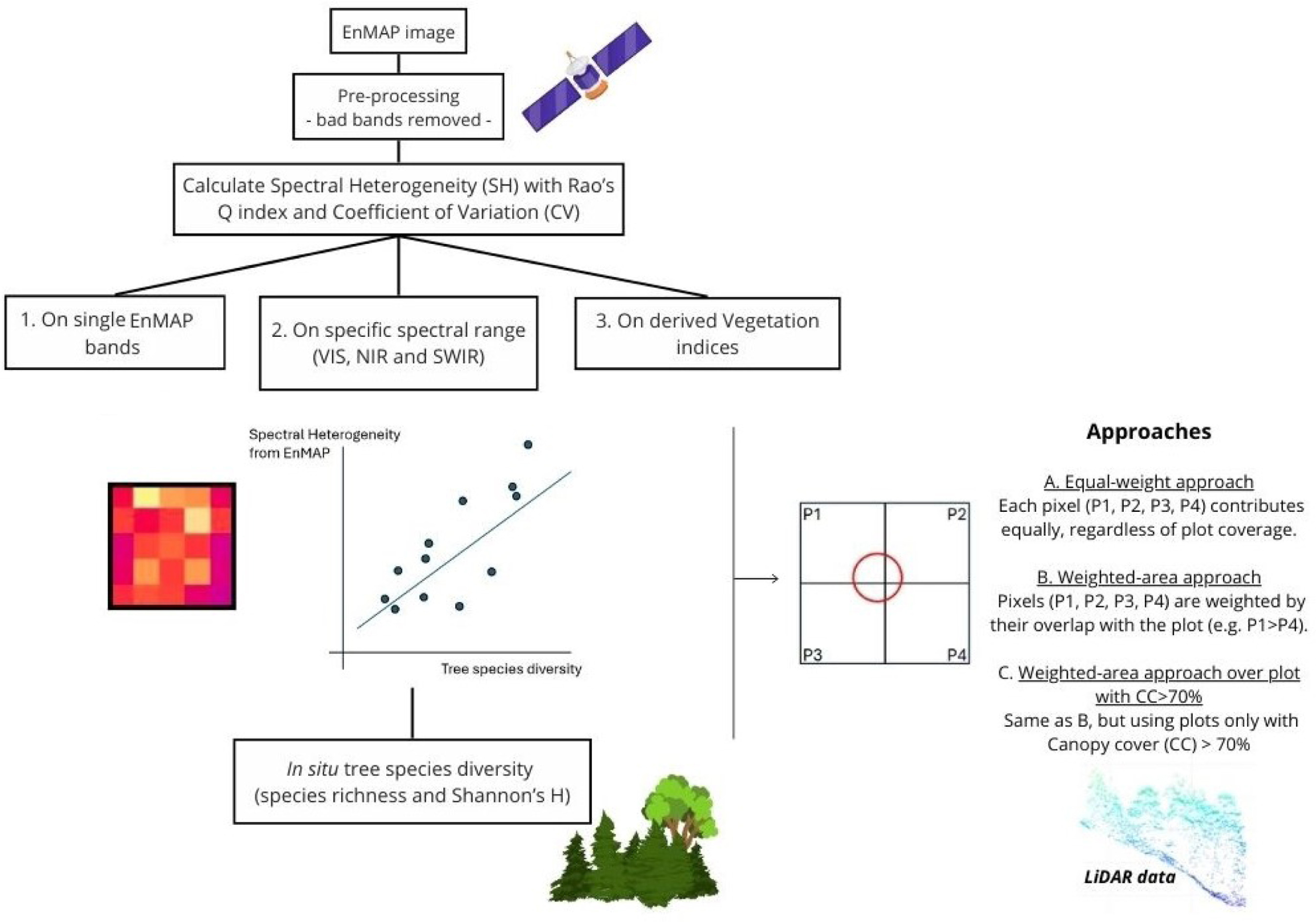
Spectral heterogeneity from the spaceborne imaging spectrometer EnMAP reveals biodiversity patterns in forest ecosystems
Torresani
,
Michele
,
Rossi
,
Christian
,
Mina
,
Marco
,
Menegaldo
,
Irene
,
Cappuccio
,
Matteo
,
Perrone
,
Michela
,
Hakkenberg
,
Christopher R.
,
Rocchini
,
Duccio
,
Puletti
,
Nicola
,
Stendardi
,
Laura
,
Montagnani
,
Leonardo
,
Tognetti
,
Roberto
Mostra abstract
The Spectral Variation Hypothesis (SVH) proposes that spectral heterogeneity (SH), derived from optical data, can serve as a proxy for estimating biodiversity. In this study, we tested the SVH across 42 forest plots in the Italian Alps using imaging spectroscopy data from the EnMAP satellite. We investigated the relationship between SH—quantified using two different metrics, Rao's Q and the coefficient of variation (CV)—and tree species diversity (using Shannon's H index and species richness). We applied three levels of spectral analysis: (1) SH calculated for each individual EnMAP band; (2) SH aggregated across broader spectral ranges (Visible -VIS-, Near Infrared -NIR-, and Shortwave Infrared -SWIR-) and (3) SH derived from vegetation indices (VIs). These analyses were performed under three spatial approaches: (A) a normal approach assigning equal weight to all four EnMAP pixels intersecting a plot; (B) a weighted approach based on the proportional overlap of each pixel with the plot area; and (C) a weighted canopy cover (CC)>70% approach, which included only plots with CC greater than 70% as derived from airborne laser scanning (ALS) LiDAR data. Weak to moderate correlations were observed when SH was derived from single bands, with the strongest relationships in the NIR (R<sup>2</sup> approaching 0.4), followed by the VIS and SWIR regions. A similar trend emerged when SH was aggregated across broader spectral ranges, with the highest correlations again found in the NIR (R<sup>2</sup> up to 0.35). In contrast, lower R<sup>2</sup> values were obtained when SH was computed from specific VIs. The weighted approaches, especially when restricted to plots with CC >70%, consistently yielded higher R<sup>2</sup> values than the equal-weight approach in all three the spectral analysis. Results were consistent across both SH metrics (Rao's Q and CV), with stronger correlations when species richness was used as the biodiversity metric. This work highlights how EnMAP hyperspectral data, despite inherent constraints, can provide valuable insights into forest biodiversity monitoring. © 2025 The Author(s)

Global airborne laser scanning data providers database (GlobALS)-A new tool for monitoring ecosystems and biodiversity
Stereńczak
,
Krzysztof Jan
,
Vaglio Laurin
,
Gaia
,
Chirici
,
Gherardo
,
Coomes
,
David Anthony
,
Dalponte
,
Michele
,
Latifi
,
Hooman
,
Puletti
,
Nicola
Mostra abstract
Protection and recovery of natural resource and biodiversity requires accurate monitoring at multiple scales. Airborne Laser Scanning (ALS) provides high-resolution imagery that is valuable for monitoring structural changes to vegetation, providing a reliable reference for ecological analyses and comparison purposes, especially if used in conjunction with other remote-sensing and field products. However, the potential of ALS data has not been fully exploited, due to limits in data availability and validation. To bridge this gap, the global network for airborne laser scanner data (GlobALS) has been established as a worldwide network of ALS data providers that aims at linking those interested in research and applications related to natural resources and biodiversity monitoring. The network does not collect data itself but collects metadata and facilitates networking and collaborative research amongst the end-users and data providers. This letter describes this facility, with the aim of broadening participation in GlobALS. © 2020 by the authors.
A PLOT SAMPLING STRATEGY FOR ESTIMATING THE AREA OF OLIVE TREE CROPS AND OLIVE TREE ABUNDANCE IN A MEDITERRANEAN ENVIRONMENT
Grotti
,
Mirko
,
Puletti
,
Nicola
,
Chianucci
,
Francesco
,
Mattioli
,
Walter
,
Floris
,
Antonio
,
Clementel
,
Fabrizio
,
Torresan
,
C.
,
Marchi
,
Maurizio
,
Gentile
,
Alessandra
,
Pisante
,
Michele
,
Marcelli
,
Agnese
,
Corona
,
P.
Mostra abstract
Accurate inventory and mapping of olive (Olea europaea L.) tree attributes represents a central issue to support the olive production system. With reference to the cultivation, there is a high heterogeneity and complexity in the cultivation of olive trees, which is reflected in the large variability in olive grove surfaces. This poses some challenge in accurately estimating olive tree attributes via traditional inventory approaches, as commonly adopted in national forest inventory. From a methodological point of view, the complexity and heterogeneity of olive tree groves can be comparable to the problem of accurately estimating tree outside forests (TOF) attributes. In this study, we tested whether a plot sampling approach formerly developed for TOF is suitable for estimating olive tree attributes at large scale. We tested this approach in a case study where the census of the olive crop area and the number of olive groves was conducted from photo-interpretation of high resolution aerial orthoimagery, used as benchmark to test the effectiveness of the plot sampling approach. The main result of this study is that the plot sampling method can be applied for estimating olive tree attributes. Our obtained RSEs were below 20%, with a limited sampling effort of about 6% of the studied population; the obtained RSEs were below 6% when increasing sampling up to about 21% the studied population. Using robust statistical procedures among countries, should allow obtaining harmonized and comparable information, which can increase the knowledge of olive geographical distribution and structure at its relevant Mediterranean scale. © 2019, Italian Society of Remote Sensing. All rights reserved.
Influence of Root Reinforcement on Shallow Landslide Distribution: A Case Study in Garfagnana (Northern Tuscany, Italy)
Marzini
,
Lorenzo
,
D’Addario
,
Enrico
,
Papasidero
,
Michele Pio
,
Chianucci
,
Francesco
,
Disperati
,
L.
Mostra abstract
In this work, we evaluated the influence of root structure on shallow landslide distribution. Root density measurements were acquired in the field and the corresponding root cohesion was estimated. Data were acquired from 150 hillslope deposit trenches dug in areas either devoid or affected by shallow landslides within the Garfagnana Valley (northern Tuscany, Italy). Results highlighted a correlation between the root reinforcement and the location of measurement sites. Namely, lower root density was detected within shallow landslides, with respect to neighboring areas. Root area ratio (RAR) data allowed us to estimate root cohesion by the application of the revised version of the Wu and Waldron Model. Then, we propose a new method for the assimilation of the lateral root reinforcement into the infinite slope model and the limit equilibrium approach by introducing the equivalent root cohesion parameter. The results fall within the range of root cohesion values adopted in most of the physically based shallow landslide susceptibility models known in the literature (mean values ranging between ca. 2 and 3 kPa). Moreover, the results are in line with the scientific literature that has demonstrated the link between root mechanical properties, spatial variability of root reinforcement, and shallow landslide locations. © 2023 by the authors.
Where are we now with European forest multi-taxon biodiversity and where can we head to?
Burrascano
,
Sabina
,
Chianucci
,
Francesco
,
Trentanovi
,
Giovanni
,
Kepfer-Rojas
,
Sebastian
,
Sitzia
,
Tommaso
,
Tinya
,
Flóra
,
Doerfler
,
Inken
,
Paillet
,
Yoan
,
Nagel
,
Thomas A.
,
Mitić
,
Božena
,
Morillas
,
Lourdes
,
Munzi
,
Silvana
,
Van Der Sluis
,
Theo
,
Alterio
,
Edoardo
,
Balducci
,
Lorenzo
,
de Andrade
,
Rafael Barreto
,
Bouget
,
Christophe
,
Giordani
,
P.
,
Lachat
,
Thibault
,
Matošević
,
Dinka
,
Napoleone
,
Francesca
,
Nascimbene
,
Juri
,
Paniccia
,
Chiara
,
Roth
,
Nicolas
,
Aszalós
,
Réka
,
Brazaitis
,
Gediminas
,
Cutini
,
Andrea
,
D'Andrea
,
Ettore
,
de Smedt
,
Pallieter
,
Heilmann-Clausen
,
Jacob
,
Janssen
,
Philippe
,
Kozák
,
Daniel
,
Mårell
,
Anders
,
Mikoláš
,
Martin
,
Nordén
,
Björn
,
Matula
,
Radim
,
Schall
,
Peter
,
Svoboda
,
Miroslav
,
Ujházyová
,
Mariana
,
Vandekerkhove
,
Kris
,
Wohlwend
,
Michael Rudolf
,
Xystrakis
,
Fotios
,
Aleffi
,
Michele
,
Ammer
,
Christian
,
Archaux
,
Frédéric
,
Asbeck
,
Thomas
,
N Avtzis
,
Dimitrios N.
,
Ayasse
,
Manfred
,
Bagella
,
Simonetta
,
Balestrieri
,
Rosario
,
Barbati
,
Anna
,
Basile
,
Marco
,
Bergamini
,
Ariel
,
Bertini
,
Giada
,
Biscaccianti
,
Alessandro Bruno
,
Boch
,
Steffen
,
Bölöni
,
János
,
Bombi
,
Pierluigi
,
Boscardin
,
Yves
,
Brunialti
,
Giorgio
,
Bruun
,
Hans Henrik
,
Buscot
,
François
,
Byriel
,
David Bille
,
Campagnaro
,
Thomas
,
Campanaro
,
Alessandro
,
Chauvat
,
Matthieu
,
Ciach
,
Michał
,
Čiliak
,
Marek
,
Cistrone
,
Luca
,
Pereira
,
Joaò Manuel Cordeiro
,
Daniel
,
Rolf
,
de Cinti
,
Bruno
,
de Filippo
,
Gabriele
,
Dekoninck
,
Wouter
,
Di Salvatore
,
Umberto
,
Dumas
,
Yann
,
Elek
,
Zoltán
,
Ferretti
,
Fabrizio
,
Fotakis
,
Dimitrios G.
,
Frank
,
Tamás
,
Frey
,
Julian
,
Giancola
,
Carmen
,
Gömöryová
,
Erika
,
Gosselin
,
Marion
,
Gosselin
,
Frédéric
,
Goßner
,
Martin M.
,
Götmark
,
Frank
,
Haeler
,
Elena
,
Hansen
,
Aslak Kappel
,
Hertzog
,
Lionel R.
,
Hofmeister
,
Jeňýk
,
Hošek
,
Jan
,
Johannsen
,
Vivian Kvist
,
Justensen
,
Mathias Just
,
Korboulewsky
,
Nathalie
,
Kovács
,
Bence
,
Lakatos
,
Ferenc
,
Landivar
,
Carlos Miguel
,
Lens
,
Luc
,
Lingua
,
Emanuele
forest biodiversity
biodiversity conservation
forest stand structure
multi-taxon
sustainable management
Mostra abstract
The European biodiversity and forest strategies rely on forest sustainable management (SFM) to conserve forest biodiversity. However, current sustainability assessments hardly account for direct biodiversity indicators. We focused on forest multi-taxon biodiversity to: i) gather and map the existing information; ii) identify knowledge and research gaps; iii) discuss its research potential. We established a research network to fit data on species, standing trees, lying deadwood and sampling unit description from 34 local datasets across 3591 sampling units. A total of 8724 species were represented, with the share of common and rare species varying across taxonomic classes: some included many species with several rare ones (e.g., Insecta); others (e.g., Bryopsida) were represented by few common species. Tree-related structural attributes were sampled in a subset of sampling units (2889; 2356; 2309 and 1388 respectively for diameter, height, deadwood and microhabitats). Overall, multi-taxon studies are biased towards mature forests and may underrepresent the species related to other developmental phases. European forest compositional categories were all represented, but beech forests were over-represented as compared to thermophilous and boreal forests. Most sampling units (94%) were referred to a habitat type of conservation concern. Existing information may support European conservation and SFM strategies in: (i) methodological harmonization and coordinated monitoring; (ii) definition and testing of SFM indicators and thresholds; (iii) data-driven assessment of the effects of environmental and management drivers on multi-taxon forest biological and functional diversity, (iv) multi-scale forest monitoring integrating in-situ and remotely sensed information. © 2023 The Authors
Evaluating sampling schemes for quantifying seed production in beech (Fagus sylvatica) forests using ground quadrats
Chianucci
,
Francesco
,
Tattoni
,
Clara
,
Ferrara
,
Carlotta
,
Ciolli
,
Marco
,
Brogi
,
Rudy
,
Zanni
,
Michele
,
Apollonio
,
Marco
,
Cutini
,
Andrea
Mostra abstract
Accurate estimates of seed production are central for understanding mast seeding mechanisms at tree and forest scales, and for designing sustainable management strategies. As trees are long-lived organisms, a long-term perspective is required to understand how reproduction acts during the life cycle of a tree. However, long-term series of seed production are challenging to obtain, as the available seed count procedures strictly rely on field methods, which are cost- and time-consuming, inherently limiting their widespread use at extensive spatial and temporal scales. In this study, we proposed a simple, rapid and flexible field method based on counting the seed in mobile ground quadrats (GQ), which was tested in beech forests. Quadrat measurements were first validated against reference measurements obtained from litter traps (LT) in three permanent plots. Results indicated that GQ provides robust and reliable estimates of seeds, which are not affected by seed predation occurring at the forest floor. Additional quadrat measurements were performed to evaluate the influence of sampling schemes (random, regular, systematic) on the estimation of mean seed production at the plot scale. One hundred quadrats were collected in 0.25 ha beech plots and considered as a reference for evaluating the different sampling schemes and sampling sizes. Measurements were performed in October (three plots), which represented the peak of seed fall, and November (two plots). Results indicate that about 25 randomly located measurements allowed to characterize plot-level mean seed production with an acceptable error below 20%, regardless of the different mean seed production observed between the studied plots and the sampling periods. If the 25 sampling points are arranged in a grid, the obtained mean estimates are within the confidence interval of the reference plot-level values. © 2021 Elsevier B.V.
A comparison of ground-based count methods for quantifying seed production in temperate broadleaved tree species
Tattoni
,
Clara
,
Chianucci
,
Francesco
,
Ciolli
,
Marco
,
Ferrara
,
Carlotta
,
Marchino
,
Luca
,
Zanni
,
Michele
,
Zatelli
,
Paolo
,
Cutini
,
Andrea
Mostra abstract
• Key message: Litter trap is considered the most effective method to quantify seed production, but it is expensive and time-consuming. Counting fallen seeds using a quadrat placed on the ground yields comparable estimates to the litter traps. Ground quadrat estimates derived from either visual counting in the field or image counting from quadrat photographs are comparable, with the latter being also robust in terms of user sensitivity. • Context: Accurate estimates of forest seed production are central for a wide range of ecological studies. As reference methods such as litter traps (LT) are cost- and time-consuming, there is a need of fast, reliable, and low-cost tools to quantify this variable in the field. • Aims: To test two indirect methods, which consist of counting the seeds fallen in quadrats. • Methods: The trial was performed in three broadleaved (beech, chestnut, and Turkey oak) tree species. Seeds are either manually counted in quadrats placed at the ground (GQ) or from images acquired in the same quadrats (IQ) and then compared against LT measurements. • Results: GQ and IQ provide fast and reliable estimates of seeds in both oak and chestnut. In particular, IQ is robust in terms of user sensitivity and potentially enables automation in the process of seed monitoring. A null-mast year in beech hindered validation of quadrats in beech. • Conclusion: Quadrat counting is a powerful tool to estimate forest seed production. We recommend using quadrats and LT to cross-calibrate the two methods in case of estimating seed biomass. Quadrats could then be used more routinely on account of their faster and simpler procedure to obtain measurements at more spatially extensive scales. © 2021, The Author(s).
Multi-taxon and forest structure sampling for identification of indicators and monitoring of old-growth forest
Blasi
,
Carlo
,
Marchetti
,
Marco
,
Chiavetta
,
U.
,
Aleffi
,
Michele
,
Audisio
,
P. Aldo
,
Azzella
,
Mattia Martin
,
Brunialti
,
Giorgio
,
Capotorti
,
Giulia
,
Del Vico
,
Eva
,
Lattanzi
,
Edda
,
Persiani
,
Anna Maria
,
Ravera
,
Sonia
,
Tilia
,
Agnese
,
Burrascano
,
Sabina
structural attributes
multi-taxon species lists
species co-occurrence
structure-based indicators
taxon-based indicators
Mostra abstract
The most commonly used old-growth forest indicators are structural attributes; nevertheless, they do not necessarily represent the biodiversity value of old-growth forests. The aim of this study is to analyse the relationships between species richness data of different taxa and structural indicators of old-growth and to identify taxonomic/functional groups, species and structural attributes that may be used as indicators of old growth. To achieve this goal we sampled forest structure, vascular plants, lichens, bryophytes, fungi, saproxylic beetles and birds in mature and old-growth stands in southern Italy. We calculated Spearman's correlation coefficients between species richness data and structural attributes. Analyses of indicator species, co-occurrences and two-way clusters were performed on the multi-taxonomic list. The group of vascular plants most significantly correlated with other groups in terms of species richness; furthermore, it displays the highest proportion of between-group co-occurrences. The resulting multi-taxonomic list of potential indicators may serve as an effective means of detecting and monitoring forest ecosystems; however, for this goal, structure-based indicators, such as forest structural attributes and vascular plant species composition, are of primary importance. © 2010 Società Botanica Italiana.
Ecological portrayal of old-growth forests and persistent woodlands in the cilento and vallo di Diano National Park (southern Italy)
Marchetti
,
Marco
,
Tognetti
,
Roberto
,
Lombardi
,
Fabio
,
Chiavetta
,
U.
,
Palumbo
,
Giuseppe
,
Sellitto
,
Vincenzo Michele
,
Colombo
,
C. Massimo
,
Iovieno
,
Paola
,
Alfani
,
Anna
,
Baldantoni
,
Daniela
,
Barbati
,
Anna
,
Ferrari
,
Barbara
,
Bonacquisti
,
Sandro
,
Capotorti
,
Giulia
,
Copiz
,
Riccardo
,
Blasi
,
Carlo
biodiversity
mediterranean region
ecological characterization
managed stands
old-growth forests
persistent woodlands
soil
Mostra abstract
The maintenance of certain levels of old forest represents a cornerstone of the EU's biodiversity management strategy. A consensus on a single general ecological definition of old-growth is particularly difficult in Mediterranean Europe. The present paper deals with old-growth forests and persistent woodlands in the Cilento and Vallo di Diano National Park (PNCVD) to give an ecological understanding of forest complexity and dynamics under a multiscale and multidisciplinary perspective. The multiscale approach ranged from the identification and mapping of potential old-growth stands at landscape scale to a two-level field review of forest stand features. Field sampling involved a multidisciplinary team of researchers in forest structure, pedologic environment, soil microbial activity, flora and vegetation and deadwood components. The research provided sound knowledge about old-growthness features in the PNCVD that constitutes a unique case study in the whole Mediterranean basin. The integration of results allowed to: identify main ecosystem functions and the related services of the old-growth forests in the study area; distinguish persistent woodlands, multi-aged stands with old trees deriving from nineteenth-century management practices, from old-growth forests sensu strictu; recognize indicators of direct and indirect impacts of human activities; suggest effective practices for sustainable management in the Mediterranean context. © 2010 Società Botanica Italiana.