
Loading...
Pubblicazioni Scientifiche
Filtri di ricerca 11 risultati
Pubblicazioni per anno
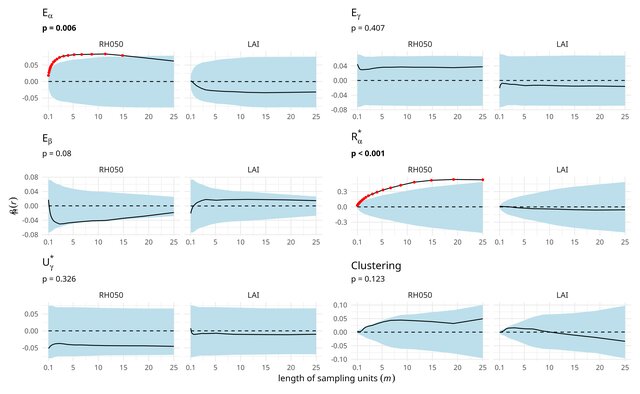
Forest structure and understory functional diversity at multiple scales: The importance of median tree height
de Benedictis
,
Luciano Ludovico Maria
,
Chelli
,
Stefano
,
Zhu
,
Zhengxue
,
Cervellini
,
Marco
,
Canullo
,
R.
,
Chianucci
,
Francesco
,
Puletti
,
Nicola
,
Tsakalos
,
James L.
,
Bartha
,
Sándor
,
Campetella
,
Giandiego

Multiple drivers of functional diversity in temperate forest understories: Climate, soil, and forest structure effects
Chelli
,
Stefano
,
Bricca
,
Alessandro
,
Tsakalos
,
James L.
,
Andreetta
,
Anna
,
Bonari
,
Gianmaria
,
Campetella
,
Giandiego
,
Carnicelli
,
Stefano
,
Cervellini
,
Marco
,
Puletti
,
Nicola
,
Wellstein
,
Camilla
,
Canullo
,
R.
climate change
functional diversity
bud bank
forest management
plant height
seed mass
specific leaf area
Mostra abstract
In macroecology, shifting from coarse- to local-scale explanatory factors is crucial for understanding how global change impacts functional diversity (FD). Plants possess diverse traits allowing them to differentially respond across a spectrum of environmental conditions. We aim to assess how macro- to microclimate, stand-scale measured soil properties, forest structure, and management type, influence forest understorey FD at the macroecological scale. Our study covers Italian forests, using thirteen predictors categorized into climate, soil, forest structure, and management. We analyzed five traits (i.e., specific leaf area, plant size, seed mass, belowground bud bank size, and clonal lateral spread) capturing independent functional dimensions to calculate the standardized effect size of functional diversity (SES-FD) for all traits (multi-trait) and for single traits. Multiple regression models were applied to assess the effect of predictors on SES-FD. We revealed that climate, soil, and forest structure significantly drive SES-FD of specific leaf area, plant size, seed mass, and bud bank. Forest management had a limited effect. However, differences emerged between herbaceous and woody growth forms of the understorey layer, with herbaceous species mainly responding to climate and soil features, while woody species were mainly affected by forest structure. Future warmer and more seasonal climate could reduce the diversity of resource economics, plant size, and persistence strategies of the forest understorey. Soil eutrophication and acidification may impact the diversity of regeneration strategies; canopy closure affects the diversity of above- and belowground traits, with a larger effect on woody species. Multifunctional approaches are vital to disentangle the effect of global changes on functional diversity since independent functional specialization axes are modulated by different drivers. © 2024 The Authors
Exportability of options and results to other forests
F. Ferretti
,
M. Čater
,
P. Cantiani
,
U. Di Salvatore
,
U. Chiavetta
,
C. Becagli
,
F. Mason
,
L. Zapponi
,
G. Fabbio
TRY plant trait database – enhanced coverage and open access
Kattge
,
Jens
,
Bönisch
,
Gerhard
,
Díaz
,
Sandra M.
,
Lavorel
,
Sandra
,
Prentice
,
Iain Colin
,
Leadley
,
Paul W.
,
Tautenhahn
,
Susanne
,
Werner
,
Gijsbert
,
Aakala
,
Tuomas
,
Abedi
,
Mehdi
,
Acosta
,
Alicia Teresa Rosario
,
Adamidis
,
George C.
,
Adamson
,
Kairi
,
Aiba
,
Masahiro
,
Albert
,
Cécile Hélène
,
Alcántara
,
Julio M.
,
Alcázar C
,
Carolina
,
Aleixo
,
Izabela
,
Ali
,
Hamada E.
,
Amiaud
,
Bernard
,
Ammer
,
Christian
,
Amoroso
,
Mariano Martín
,
Anand
,
Madhur
,
Anderson
,
Carolyn G.
,
Anten
,
Niels P.R.
,
Antos
,
Joseph A.
,
Apgaua
,
Deborah Mattos Guimarães
,
Ashman
,
Tia Lynn
,
Asmara
,
Degi Harja
,
Asner
,
Gregory P.
,
Aspinwall
,
Michael J.
,
Atkin
,
Owen K.
,
Aubin
,
Isabelle
,
Baastrup-Spohr
,
Lars
,
Bahalkeh
,
Khadijeh
,
Bahn
,
Michael
,
Baker
,
Timothy R.
,
Baker
,
William J.
,
Bakker
,
Jan P.
,
Baldocchi
,
Dennis D.
,
Baltzer
,
Jennifer L.
,
Banerjee
,
Arindam
,
Baranger
,
Anne
,
Barlow
,
Jos B.
,
Barneche
,
Diego R.
,
Baruch
,
Zdravko
,
Bastianelli
,
Denis
,
Battles
,
John J.
,
Bauerle
,
William L.
,
Bauters
,
Marijn
,
Bazzato
,
Erika
,
Beckmann
,
Michael
,
Beeckman
,
Hans
,
Beierkuhnlein
,
Carl
,
Bekker
,
Renée M.
,
Belfry
,
Gavin
,
Belluau
,
Michaël
,
Beloiu Schwenke
,
Mirela
,
Benavides
,
Raquel
,
Benomar
,
Lahcen
,
Berdugo-Lattke
,
Mary Lee
,
Berenguer
,
Erika
,
Bergamin
,
Rodrigo Scarton
,
Bergmann
,
Joana
,
Carlucci
,
Marcos B.
,
Berner
,
Logan T.
,
Bernhardt-Römermann
,
Markus
,
Bigler
,
Christof
,
Bjorkman
,
Anne D.
,
Blackman
,
Chris J.
,
Blanco
,
Carolina Casagrande
,
Blonder
,
Benjamin Wong
,
Blumenthal
,
Dana M.
,
Bocanegra-González
,
Kelly Tatiana
,
Boeckx
,
Pascal
,
Bohlman
,
Stephanie Ann
,
Böhning-Gaese
,
Katrin
,
Boisvert-Marsh
,
Laura
,
Bond
,
William J.
,
Bond-Lamberty
,
Ben P.
,
Boom
,
Arnoud
,
Boonman
,
Coline C.F.
,
Bordin
,
Kauane Maiara
,
Boughton
,
Elizabeth H.
,
Boukili
,
Vanessa K.S.
,
Bowman
,
David M.J.S.
,
Bravo
,
Sandra Josefina
,
Brendel
,
Marco R.
,
Broadley
,
Martin R.
,
Brown
,
Kerry A.
,
Bruelheide
,
Helge
,
Brumnich
,
Federico
,
Bruun
,
Hans Henrik
,
Bruy
,
David
,
Buchanan
,
Serra Willow
,
Bucher
,
Solveig Franziska
,
Buchmann
,
Nina
,
Buitenwerf
,
Robert
,
Bunker
,
Daniel E.
,
Bürger
,
Jana
functional diversity
data coverage
data integration
data representativeness
plant traits
try plant trait database
Mostra abstract
Plant traits—the morphological, anatomical, physiological, biochemical and phenological characteristics of plants—determine how plants respond to environmental factors, affect other trophic levels, and influence ecosystem properties and their benefits and detriments to people. Plant trait data thus represent the basis for a vast area of research spanning from evolutionary biology, community and functional ecology, to biodiversity conservation, ecosystem and landscape management, restoration, biogeography and earth system modelling. Since its foundation in 2007, the TRY database of plant traits has grown continuously. It now provides unprecedented data coverage under an open access data policy and is the main plant trait database used by the research community worldwide. Increasingly, the TRY database also supports new frontiers of trait-based plant research, including the identification of data gaps and the subsequent mobilization or measurement of new data. To support this development, in this article we evaluate the extent of the trait data compiled in TRY and analyse emerging patterns of data coverage and representativeness. Best species coverage is achieved for categorical traits—almost complete coverage for ‘plant growth form’. However, most traits relevant for ecology and vegetation modelling are characterized by continuous intraspecific variation and trait–environmental relationships. These traits have to be measured on individual plants in their respective environment. Despite unprecedented data coverage, we observe a humbling lack of completeness and representativeness of these continuous traits in many aspects. We, therefore, conclude that reducing data gaps and biases in the TRY database remains a key challenge and requires a coordinated approach to data mobilization and trait measurements. This can only be achieved in collaboration with other initiatives. © 2019 The Authors. Global Change Biology published by John Wiley & Sons Ltd
The Relationship Between Maturation Size and Maximum Tree Size From Tropical to Boreal Climates
Journé
,
Valentin
,
Bogdziewicz
,
Michał
,
Courbaud
,
Benoít
,
Kunstler
,
Georges
,
Qiu
,
Tong
,
Aravena Acuña
,
Marie Claire
,
Ascoli
,
Davide
,
Bergeron
,
Yves
,
Berveiller
,
Daniel
,
Boivin
,
Thomas
,
Bonal
,
Raúl
,
Caignard
,
Thomas
,
Cailleret
,
Maxime
,
Calama
,
Rafael A.
,
Camarero
,
Jesús Julio
,
Chang-Yang
,
Chia Hao
,
Chave
,
Jérôme
,
Chianucci
,
Francesco
,
Curt
,
Thomas
,
Cutini
,
Andrea
,
Das
,
Adrian J.
,
Daskalakou
,
Evangelia N.
,
Davi
,
Hendrik
,
Delpierre
,
Nicolas
,
Delzon
,
Sylvain
,
Dietze
,
Michael C.
,
Calderon
,
Sergio Donoso
,
Dormont
,
Laurent
,
Espelta
,
Josep Maria
,
Farfan-Rios
,
William R.
,
Fenner
,
Michael
,
Franklin
,
Jerry F.
,
Gehring
,
Catherine A.
,
Gilbert
,
Gregory S.
,
Gratzer
,
Georg
,
Greenberg
,
Cathryn H.
,
Guignabert
,
Arthur
,
Guo
,
Qinfeng
,
Hacket-Pain
,
Andrew J.
,
Hampe
,
Arndt
,
Han
,
Qingmin
,
Hanley
,
Mick E.
,
Hille Ris Lambers
,
Janneke
,
Holik
,
Jan
,
Hoshizaki
,
K.
,
Ibáñez
,
Inés
,
Johnstone
,
Jill F.
,
Knops
,
Johannes Michael Hubertus
,
Kobe
,
Richard K.
,
Kurokawa
,
Hiroko
,
Lageard
,
Jonathan G.A.
,
LaMontagne
,
Jalene M.
,
Ledwoń
,
Mateusz
,
Lefèvre
,
François
,
Leininger
,
Theodor D.
,
Limousin
,
Jean Marc
,
Lutz
,
James A.
,
Macias
,
Diana S.
,
Mårell
,
Anders
,
McIntire
,
Eliot J.B.
,
Moran
,
Emily V.
,
Motta
,
Renzo
,
Myers
,
Jonathan A.
,
Nagel
,
Thomas A.
,
Naoe
,
Shoji
,
Noguchi
,
Mahoko
,
Norghauer
,
Julian M.
,
Oguro
,
Michio
,
Ourcival
,
Jean Marc
,
Parmenter
,
Robert R.
,
Pearse
,
Ian S.
,
Pérez-Ramos
,
Ignacio M.
,
Piechnik
,
Łukasz
,
Podgórski
,
Tomasz
,
Poulsen
,
John R.
,
Redmond
,
Miranda D.
,
Reid
,
Chantal D.
,
Šamonil
,
Pavel
,
Scher
,
C. Lane
,
Schlesinger
,
William H.
,
Seget
,
Barbara
,
Sharma
,
Shubhi
,
Shibata
,
Mitsue
,
Silman
,
Miles R.
,
Steele
,
Michael A.
,
Stephenson
,
Nathan L.
,
Straub
,
Jacob N.
,
Sutton
,
Samantha
,
Swenson
,
Jennifer J.
,
Swift
,
Margaret
,
Thomas
,
Peter A.
,
Uríarte
,
María
,
Vacchiano
,
Giorgio
,
Whipple
,
Amy Vaughn
,
Whitham
,
Thomas G.
,
Wright
,
Stuart Joseph
,
Zhu
,
Kai
,
Zimmerman
,
Jess K.
,
Żywiec
,
Magdalena
,
Clark
,
James S.
Mostra abstract
The fundamental trade-off between current and future reproduction has long been considered to result in a tendency for species that can grow large to begin reproduction at a larger size. Due to the prolonged time required to reach maturity, estimates of tree maturation size remain very rare and we lack a global view on the generality and the shape of this trade-off. Using seed production from five continents, we estimate tree maturation sizes for 486 tree species spanning tropical to boreal climates. Results show that a species' maturation size increases with maximum size, but in a non-proportional way: the largest species begin reproduction at smaller sizes than would be expected if maturation were simply proportional to maximum size. Furthermore, the decrease in relative maturation size is steepest in cold climates. These findings on maturation size drivers are key to accurately represent forests' responses to disturbance and climate change. © 2024 John Wiley & Sons Ltd.
Influence of Root Reinforcement on Shallow Landslide Distribution: A Case Study in Garfagnana (Northern Tuscany, Italy)
Marzini
,
Lorenzo
,
D’Addario
,
Enrico
,
Papasidero
,
Michele Pio
,
Chianucci
,
Francesco
,
Disperati
,
L.
Mostra abstract
In this work, we evaluated the influence of root structure on shallow landslide distribution. Root density measurements were acquired in the field and the corresponding root cohesion was estimated. Data were acquired from 150 hillslope deposit trenches dug in areas either devoid or affected by shallow landslides within the Garfagnana Valley (northern Tuscany, Italy). Results highlighted a correlation between the root reinforcement and the location of measurement sites. Namely, lower root density was detected within shallow landslides, with respect to neighboring areas. Root area ratio (RAR) data allowed us to estimate root cohesion by the application of the revised version of the Wu and Waldron Model. Then, we propose a new method for the assimilation of the lateral root reinforcement into the infinite slope model and the limit equilibrium approach by introducing the equivalent root cohesion parameter. The results fall within the range of root cohesion values adopted in most of the physically based shallow landslide susceptibility models known in the literature (mean values ranging between ca. 2 and 3 kPa). Moreover, the results are in line with the scientific literature that has demonstrated the link between root mechanical properties, spatial variability of root reinforcement, and shallow landslide locations. © 2023 by the authors.
Masting is uncommon in trees that depend on mutualist dispersers in the context of global climate and fertility gradients
Qiu
,
Tong
,
Aravena Acuña
,
Marie Claire
,
Ascoli
,
Davide
,
Bergeron
,
Yves
,
Bogdziewicz
,
Michał
,
Boivin
,
Thomas
,
Bonal
,
Raúl
,
Caignard
,
Thomas
,
Cailleret
,
Maxime
,
Calama
,
Rafael A.
,
Calderon
,
Sergio Donoso
,
Camarero
,
Jesús Julio
,
Chang-Yang
,
Chia Hao
,
Chave
,
Jérôme
,
Chianucci
,
Francesco
,
Courbaud
,
Benoít
,
Cutini
,
Andrea
,
Das
,
Adrian J.
,
Delpierre
,
Nicolas
,
Delzon
,
Sylvain
,
Dietze
,
Michael C.
,
Dormont
,
Laurent
,
Espelta
,
Josep Maria
,
Fahey
,
Timothy J.
,
Farfan-Rios
,
William R.
,
Franklin
,
Jerry F.
,
Gehring
,
Catherine A.
,
Gilbert
,
Gregory S.
,
Gratzer
,
Georg
,
Greenberg
,
Cathryn H.
,
Guignabert
,
Arthur
,
Guo
,
Qinfeng
,
Hacket-Pain
,
Andrew J.
,
Hampe
,
Arndt
,
Han
,
Qingmin
,
Holik
,
Jan
,
Hoshizaki
,
K.
,
Ibáñez
,
Inés
,
Johnstone
,
Jill F.
,
Journé
,
Valentin
,
Kitzberger
,
Thomas A.
,
Knops
,
Johannes Michael Hubertus
,
Kunstler
,
Georges
,
Kurokawa
,
Hiroko
,
Lageard
,
Jonathan G.A.
,
LaMontagne
,
Jalene M.
,
Lefèvre
,
François
,
Leininger
,
Theodor D.
,
Limousin
,
Jean Marc
,
Lutz
,
James A.
,
Macias
,
Diana S.
,
Mårell
,
Anders
,
McIntire
,
Eliot J.B.
,
Moore
,
Christopher M.
,
Moran
,
Emily V.
,
Motta
,
Renzo
,
Myers
,
Jonathan A.
,
Nagel
,
Thomas A.
,
Naoe
,
Shoji
,
Noguchi
,
Mahoko
,
Oguro
,
Michio
,
Parmenter
,
Robert R.
,
Pearse
,
Ian S.
,
Pérez-Ramos
,
Ignacio M.
,
Piechnik
,
Łukasz
,
Podgórski
,
Tomasz
,
Poulsen
,
John R.
,
Redmond
,
Miranda D.
,
Reid
,
Chantal D.
,
Rodman
,
Kyle C.
,
Rodríguez-Sánchez
,
Francisco
,
Šamonil
,
Pavel
,
Sanguinetti
,
Javier D.
,
Scher
,
C. Lane
,
Seget
,
Barbara
,
Sharma
,
Shubhi
,
Shibata
,
Mitsue
,
Silman
,
Miles R.
,
Steele
,
Michael A.
,
Stephenson
,
Nathan L.
,
Straub
,
Jacob N.
,
Sutton
,
Samantha
,
Swenson
,
Jennifer J.
,
Swift
,
Margaret
,
Thomas
,
Peter A.
,
Uríarte
,
María
,
Vacchiano
,
Giorgio
,
Whipple
,
Amy Vaughn
,
Whitham
,
Thomas G.
,
Wion
,
Andreas P.
,
Wright
,
Stuart Joseph
,
Zhu
,
Kai
,
Zimmerman
,
Jess K.
,
Żywiec
,
Magdalena
,
Clark
,
James S.
Mostra abstract
The benefits of masting (volatile, quasi-synchronous seed production at lagged intervals) include satiation of seed predators, but these benefits come with a cost to mutualist pollen and seed dispersers. If the evolution of masting represents a balance between these benefits and costs, we expect mast avoidance in species that are heavily reliant on mutualist dispersers. These effects play out in the context of variable climate and site fertility among species that vary widely in nutrient demand. Meta-analyses of published data have focused on variation at the population scale, thus omitting periodicity within trees and synchronicity between trees. From raw data on 12 million tree-years worldwide, we quantified three components of masting that have not previously been analysed together: (i) volatility, defined as the frequency-weighted year-to-year variation; (ii) periodicity, representing the lag between high-seed years; and (iii) synchronicity, indicating the tree-to-tree correlation. Results show that mast avoidance (low volatility and low synchronicity) by species dependent on mutualist dispersers explains more variation than any other effect. Nutrient-demanding species have low volatility, and species that are most common on nutrient-rich and warm/wet sites exhibit short periods. The prevalence of masting in cold/dry sites coincides with climatic conditions where dependence on vertebrate dispersers is less common than in the wet tropics. Mutualist dispersers neutralize the benefits of masting for predator satiation, further balancing the effects of climate, site fertility and nutrient demands. © 2023, The Author(s), under exclusive licence to Springer Nature Limited.
Linking seed size and number to trait syndromes in trees
Bogdziewicz
,
Michał
,
Aravena Acuña
,
Marie Claire
,
Andrus
,
Robert A.
,
Ascoli
,
Davide
,
Bergeron
,
Yves
,
Brveiller
,
Daniel
,
Boivin
,
Thomas
,
Bonal
,
Raúl
,
Caignard
,
Thomas
,
Cailleret
,
Maxime
,
Calama
,
Rafael A.
,
Calderon
,
Sergio Donoso
,
Camarero
,
Jesús Julio
,
Chang-Yang
,
Chia Hao
,
Chave
,
Jérôme
,
Chianucci
,
Francesco
,
Cleavitt
,
Natalie L.
,
Courbaud
,
Benoít
,
Cutini
,
Andrea
,
Curt
,
Thomas
,
Das
,
Adrian J.
,
Davi
,
Hendrik
,
Delpierre
,
Nicolas
,
Delzon
,
Sylvain
,
Dietze
,
Michael C.
,
Dormont
,
Laurent
,
Farfan-Rios
,
William R.
,
Gehring
,
Catherine A.
,
Gilbert
,
Gregory S.
,
Gratzer
,
Georg
,
Greenberg
,
Cathryn H.
,
Guignabert
,
Arthur
,
Guo
,
Qinfeng
,
Hacket-Pain
,
Andrew J.
,
Hampe
,
Arndt
,
Han
,
Qingmin
,
Hoshizaki
,
K.
,
Ibáñez
,
Inés
,
Johnstone
,
Jill F.
,
Journé
,
Valentin
,
Kitzberger
,
Thomas A.
,
Knops
,
Johannes Michael Hubertus
,
Kunstler
,
Georges
,
Kobe
,
Richard K.
,
Lageard
,
Jonathan G.A.
,
LaMontagne
,
Jalene M.
,
Ledwoń
,
Mateusz
,
Leininger
,
Theodor D.
,
Limousin
,
Jean Marc
,
Lutz
,
James A.
,
Macias
,
Diana S.
,
Mårell
,
Anders
,
McIntire
,
Eliot J.B.
,
Moran
,
Emily V.
,
Motta
,
Renzo
,
Myers
,
Jonathan A.
,
Nagel
,
Thomas A.
,
Naoe
,
Shoji
,
Noguchi
,
Mahoko
,
Oguro
,
Michio
,
Kurokawa
,
Hiroko
,
Ourcival
,
Jean Marc
,
Parmenter
,
Robert R.
,
Pérez-Ramos
,
Ignacio M.
,
Piechnik
,
Łukasz
,
Podgórski
,
Tomasz
,
Poulsen
,
John R.
,
Qiu
,
Tong
,
Redmond
,
Miranda D.
,
Reid
,
Chantal D.
,
Rodman
,
Kyle C.
,
Šamonil
,
Pavel
,
Holik
,
Jan
,
Scher
,
C. Lane
,
van Marle
,
Harald Schmidt
,
Seget
,
Barbara
,
Shibata
,
Mitsue
,
Sharma
,
Shubhi
,
Silman
,
Miles R.
,
Steele
,
Michael A.
,
Straub
,
Jacob N.
,
Sun
,
I. Fang
,
Sutton
,
Samantha
,
Swenson
,
Jennifer J.
,
Thomas
,
Peter A.
,
Uríarte
,
María
,
Vacchiano
,
Giorgio
,
Veblen
,
Thomas Thorstein
,
Wright
,
Boyd R.
,
Wright
,
Stuart Joseph
,
Whitham
,
Thomas G.
,
Zhu
,
Kai
,
Zimmerman
,
Jess K.
,
Żywiec
,
Magdalena
,
Clark
,
James S.
Mostra abstract
Aim: Our understanding of the mechanisms that maintain forest diversity under changing climate can benefit from knowledge about traits that are closely linked to fitness. We tested whether the link between traits and seed number and seed size is consistent with two hypotheses, termed the leaf economics spectrum and the plant size syndrome, or whether reproduction represents an independent dimension related to a seed size–seed number trade-off. Location: Most of the data come from Europe, North and Central America and East Asia. A minority of the data come from South America, Africa and Australia. Time period: 1960–2022. Major taxa studied: Trees. Methods: We gathered 12 million observations of the number of seeds produced in 784 tree species. We estimated the number of seeds produced by individual trees and scaled it up to the species level. Next, we used principal components analysis and generalized joint attribute modelling (GJAM) to map seed number and size on the tree traits spectrum. Results: Incorporating seed size and number into trait analysis while controlling for environment and phylogeny with GJAM exposes relationships in trees that might otherwise remain hidden. Production of the large total biomass of seeds [product of seed number and seed size; hereafter, species seed productivity (SSP)] is associated with high leaf area, low foliar nitrogen, low specific leaf area (SLA) and dense wood. Production of high seed numbers is associated with small seeds produced by nutrient-demanding species with softwood, small leaves and high SLA. Trait covariation is consistent with opposing strategies: one fast-growing, early successional, with high dispersal, and the other slow-growing, stress-tolerant, that recruit in shaded conditions. Main conclusions: Earth system models currently assume that reproductive allocation is indifferent among plant functional types. Easily measurable seed size is a strong predictor of the seed number and species seed productivity. The connection of SSP with the functional traits can form the first basis of improved fecundity prediction across global forests. © 2023 John Wiley & Sons Ltd.
MASTREE+: Time-series of plant reproductive effort from six continents
Hacket-Pain
,
Andrew J.
,
Foest
,
Jessie J.
,
Pearse
,
Ian S.
,
LaMontagne
,
Jalene M.
,
Koenig
,
Walter D.
,
Vacchiano
,
Giorgio
,
Bogdziewicz
,
Michał
,
Caignard
,
Thomas
,
Celebias
,
Paulina
,
van Dormolen
,
Joep
,
Fernández-Martínez
,
Marcos
,
Moris
,
Jose V.
,
Palaghianu
,
Ciprian
,
Pesendorfer
,
Mario B.
,
Satake
,
Akiko
,
Schermer
,
Éliane
,
Tanentzap
,
Andrew J.
,
Thomas
,
Peter A.
,
Vecchio
,
Davide
,
Wion
,
Andreas P.
,
Wohlgemuth
,
Thomas
,
Xue
,
Tingting
,
Abernethy
,
Katharine A.
,
Aravena Acuña
,
Marie Claire
,
Barrera
,
Marcelo Daniel
,
Barton
,
Jessica H.
,
Boutin
,
Stan A.
,
Bush
,
Emma R.
,
Donoso Calderón
,
Sergio R.
,
Carevic
,
Felipe S.
,
Castilho
,
Carolina V.
,
Manuel Cellini
,
Juan
,
Chapman
,
Colin A.
,
Chapman
,
H. M.
,
Chianucci
,
Francesco
,
Costa
,
Patricia Da
,
Croisé
,
Luc
,
Cutini
,
Andrea
,
Dantzer
,
Ben J.
,
DeRose
,
Robert Justin
,
Dikangadissi
,
Jean Thoussaint
,
Dimoto
,
Edmond
,
da Fonseca
,
Fernanda Lopes
,
Gallo
,
Leonardo Ariel
,
Gratzer
,
Georg
,
Greene
,
David F.
,
Hadad
,
Martín Ariel
,
Huertas Herrera
,
Alejandro
,
Jeffery
,
Kathryn J.
,
Johnstone
,
Jill F.
,
Kalbitzer
,
Urs
,
Kantorowicz
,
Władysław
,
Klimas
,
Christie Ann
,
Lageard
,
Jonathan G.A.
,
Lane
,
Jeffrey E.
,
Lapin
,
Katharina
,
Ledwoń
,
Mateusz
,
Leeper
,
Abigail C.
,
Lencinas
,
María Vanessa
,
Lira-Guedes
,
Ana Cláudia
,
Lordon
,
Michael C.
,
Marchelli
,
Paula
,
Marino
,
Shealyn
,
Schmidt van Marle
,
Harald
,
McAdam
,
Andrew G.
,
Momont
,
Ludovic R.W.
,
Nicolas
,
Manuel
,
de Oliveira Wadt
,
Lúcia Helena
,
Panahi
,
Parisa
,
Martínez Pastur
,
Guillermo J.
,
Patterson
,
Thomas W.
,
Luis Peri
,
Pablo
,
Piechnik
,
Łukasz
,
Pourhashemi
,
Mehdi
,
Espinoza Quezada
,
Claudia
,
Roig
,
Fidel Alejandro
,
Peña-Rojas
,
Karen A.
,
Rosas
,
Yamina Micaela
,
Schueler
,
Silvio
,
Seget
,
Barbara
,
Soler
,
Rosina M.
,
Steele
,
Michael A.
,
Toro Manríquez
,
Mónica Del Rosario
,
Tutin
,
Caroline E.G.
,
Ukizintambara
,
Tharcisse
,
White
,
Lee J.T.
,
Yadok
,
Biplang Godwill
,
Willis
,
John L.
,
Zolles
,
Anita
,
Żywiec
,
Magdalena
,
Ascoli
,
Davide
Mostra abstract
Significant gaps remain in understanding the response of plant reproduction to environmental change. This is partly because measuring reproduction in long-lived plants requires direct observation over many years and such datasets have rarely been made publicly available. Here we introduce MASTREE+, a data set that collates reproductive time-series data from across the globe and makes these data freely available to the community. MASTREE+ includes 73,828 georeferenced observations of annual reproduction (e.g. seed and fruit counts) in perennial plant populations worldwide. These observations consist of 5971 population-level time-series from 974 species in 66 countries. The mean and median time-series length is 12.4 and 10 years respectively, and the data set includes 1122 series that extend over at least two decades (≥20 years of observations). For a subset of well-studied species, MASTREE+ includes extensive replication of time-series across geographical and climatic gradients. Here we describe the open-access data set, available as a.csv file, and we introduce an associated web-based app for data exploration. MASTREE+ will provide the basis for improved understanding of the response of long-lived plant reproduction to environmental change. Additionally, MASTREE+ will enable investigation of the ecology and evolution of reproductive strategies in perennial plants, and the role of plant reproduction as a driver of ecosystem dynamics. © 2022 The Authors. Global Change Biology published by John Wiley & Sons Ltd.
Estimation of canopy attributes in beech forests using true colour digital images from a small fixed-wing UAV
Chianucci
,
Francesco
,
Disperati
,
L.
,
Guzzi
,
Donatella
,
Bianchini
,
Daniele
,
Nardino
,
Vanni
,
Lastri
,
Cinzia
,
Rindinella
,
Andrea
,
Corona
,
P.
Mostra abstract
Accurate estimates of forest canopy are essential for the characterization of forest ecosystems. Remotely-sensed techniques provide a unique way to obtain estimates over spatially extensive areas, but their application is limited by the spectral and temporal resolution available from these systems, which is often not suited to meet regional or local objectives. The use of unmanned aerial vehicles (UAV) as remote sensing platforms has recently gained increasing attention, but their applications in forestry are still at an experimental stage. In this study we described a methodology to obtain rapid and reliable estimates of forest canopy from a small UAV equipped with a commercial RGB camera. The red, green and blue digital numbers were converted to the green leaf algorithm (GLA) and to the CIE L<sup>*</sup>a<sup>*</sup>b<sup>*</sup> colour space to obtain estimates of canopy cover, foliage clumping and leaf area index (L) from aerial images. Canopy attributes were compared with in situ estimates obtained from two digital canopy photographic techniques (cover and fisheye photography). The method was tested in beech forests. UAV images accurately quantified canopy cover even in very dense stand conditions, despite a tendency to not detecting small within-crown gaps in aerial images, leading to a measurement of a quantity much closer to crown cover estimated from in situ cover photography. Estimates of L from UAV images significantly agreed with that obtained from fisheye images, but the accuracy of UAV estimates is influenced by the appropriate assumption of leaf angle distribution. We concluded that true colour UAV images can be effectively used to obtain rapid, cheap and meaningful estimates of forest canopy attributes at medium-large scales. UAV can combine the advantage of high resolution imagery with quick turnaround series, being therefore suitable for routine forest stand monitoring and real-time applications. © 2015 Elsevier B.V.
A Multidimensional Statistical Framework to Explore Seasonal Profile, Severity and Land-Use Preferences of Wildfires in a Mediterranean Country
Salvati
,
Luca
,
Ferrara
,
Agostino Maria Silvio
,
Mancino
,
Giuseppe
,
Kelly
,
Claire L.
,
Chianucci
,
Francesco
,
Corona
,
P.
Mostra abstract
This study analyses spatio-temporal patterns of wildfires in Greece using a multidimensional statistical framework based on non-parametric correlations, principal component analysis, clustering and stepwise discriminant analysis. Specifically, we assess the frequency, seasonal profile, severity and land-use type of 135 178 wildfires which occurred between 2000-2012 in Greece, one of the countries most affected by fire in Europe. Our results show that both the number of fires and the average size of the area covered by fire show a specific seasonal pattern with a marked increase during the dry season. Principal component analysis identifies three dimensions linked with the main type of land-use affected by the fires: (i) medium and large fires primarily affected landscapes composed of forests, mixed woodlands/shrublands and croplands; (ii) small fires mainly affected fragmented landscapes, i.e. those with mosaics of different crops, market gardens and non-vegetated, abandoned or marginal areas; (iii) fires affecting wetlands and pastures occurred particularly in late summer and showing medium-low severity. Hierarchical clustering highlights similarities in spatio-temporal patterns between fire indicators (ignition date, burnt land cover classes, fire size, fire density). K-means clustering allows us to distinguish between low-severity fires occurring in the wet season from intense and frequent fires occurring in the dry season but with distinct land-use selectivity. The research reported here contributes insight into the complexity of wild fires in the Mediterranean region and supports the design of more effective fire prevention measures including sustainable forest management practices and careful regional planning to minimise risk factors.