
Loading...
Pubblicazioni Scientifiche
Filtri di ricerca 3 risultati
Pubblicazioni per anno
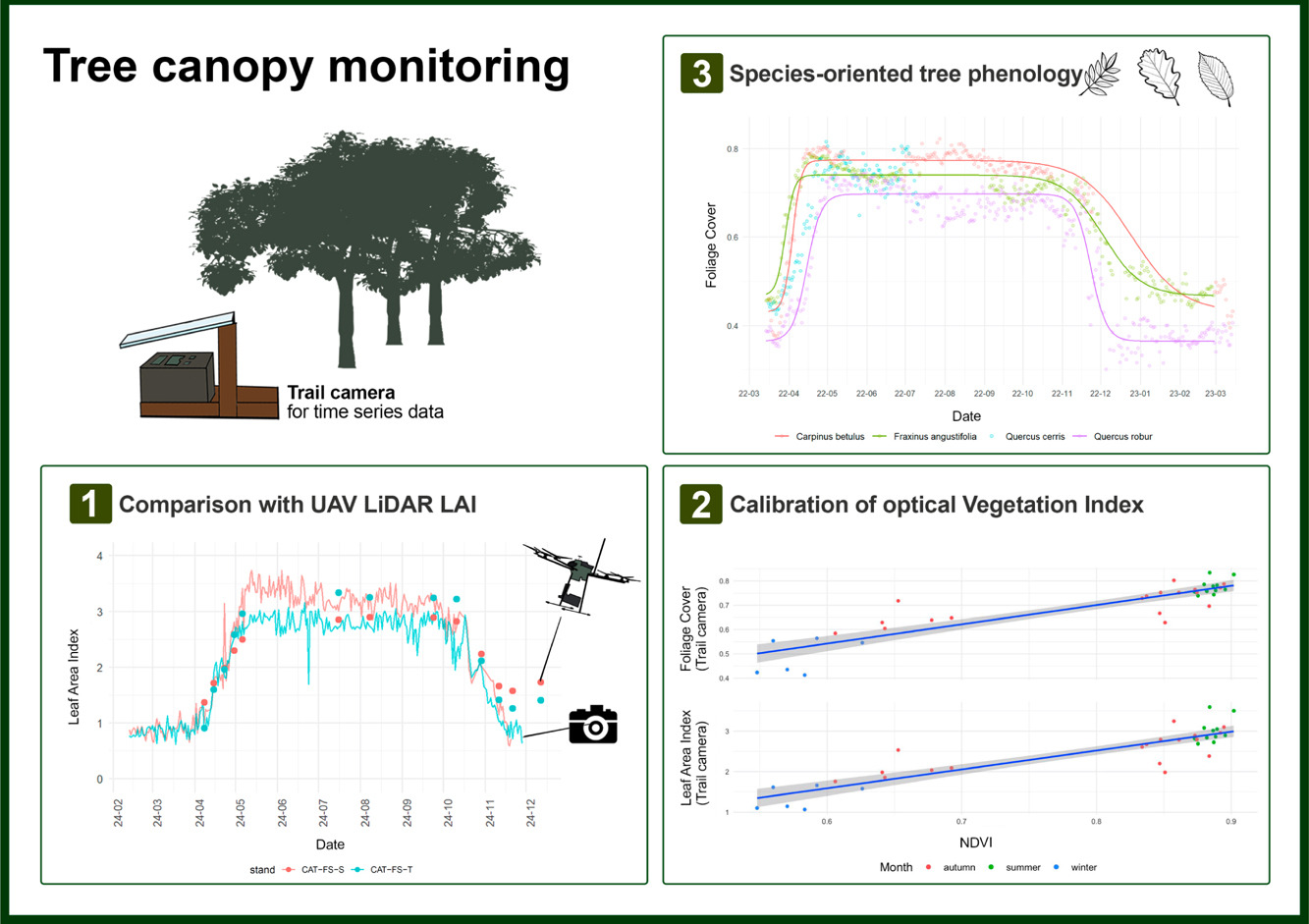
CrowNet: a trail-camera canopy monitoring system
Chianucci
,
Francesco
,
Lenzi
,
Alice
,
Minari
,
Emma
,
Guasti
,
Matteo
,
Gisondi
,
Silvia
,
Gonnelli
,
Marco
,
Innocenti
,
Simone
,
Ferrara
,
Carlotta
,
Campanaro
,
Alessandro
,
Ciampelli
,
Paola
,
Cutini
,
Andrea
,
Puletti
,
Nicola
Mostra abstract
Continuous monitoring of forest canopy structure and phenology is pivotal for the assessment of ecosystem responses to environmental variability and changes. The present study evaluated the use of repeat digital trail cameras as a low-cost, flexible, and accessible in situ monitoring solution for quantifying daily canopy attributes, including effective leaf area index (Le) and canopy cover. A trial camera monitoring network (CrowNet) was established encompassing 20 forest stands in Italy, under different management and environmental conditions, resulting in over 44,000 daily images collected over three years. We demonstrated that taking the mean daily canopy attribute allowed to obtain smooth time series from trail cameras, from which phenological transition dates can be inferred. Daily canopy attributes were validated against manual digital cover photography measurement. To further explore the applicability of this monitoring solution, we performed a comparison between daily Le time series derived from a subset of trail cameras located in beech forests and data collected by multitemporal UAV LiDAR. Results demonstrated the close agreement between the two methods across the entire phenological period (start and end of season). We also illustrated use of continuous trail camera estimates to calibrate a vegetation index (NDVI) to infer leaf area and canopy cover from optical multi-temporal UAV data. We further investigated use of trail camera to detect species-specific differences in tree phenology from time series acquired in a mixed oak-hornbeam forest. We found different canopy structure and phenological transition dates in three broadleaved species (oak, ash, hornbeam), supporting the effectiveness of trail cameras for species-oriented phenology monitoring. We conclude that trail cameras provide a reliable solution for daily canopy monitoring, offering a significant cost-effective and flexible alternative to traditional field methods and providing potential to calibrate, validate or integrate remotely-sensed information. However, camera failures during adverse weather, and the need for more efficient image data quality checking procedures, still represent open challenges. Future improvements, such as weatherproof housing and automated pre-processing screening procedures, are therefore recommended for making trail camera fully operational in ground canopy and phenology monitoring. © 2025 Elsevier B.V.

Continuous observations of forest canopy structure using low-cost digital camera traps
Mostra abstract
Assessing forest canopy dynamics is crucial for understanding the response of vegetation to environmental variability and change. While digital repeat photography is gaining increased attention for obtaining field phenology observations, colour indices derived from this method are often affected by leaf colour and actual canopy structure, complicating the physical interpretation of results. In addition, repeated photography requires power, storage capacity and remote data transfer, which are often limited in forest conditions. As an alternative, we tested a simple, cheap and fast solution to derive daily canopy structure observation from digital camera traps (CTs). Formerly deployed for wildlife monitoring, CTs are low-cost digital cameras designed for outdoor conditions and have low battery consumption, enable repeat acquisition, and often feature remote data transfer protocols. The trial was performed in a deciduous oak stand, where continuous images were acquired over a 1-year period using the time-lapse feature of the CT. Daily time series of canopy structure attributes were derived from the collected images using simple and automated procedures. Results were validated against reference manual cover photography measurements. The daily time series of foliage cover and leaf area index were then used to derive phenological transition dates, which were compared against phenological observations obtained from satellite Sentinel-2 data. Results indicated that field and satellite data provided comparable accuracy in determining the start of season (SOS). Larger discrepancies were found in determining the end of season (EOS), which can be attributed to the low number of good quality autumn images available from the satellite data. We concluded that CT is a robust method, which is ideally suited for routine, continuous field monitoring of canopy attributes and phenology. While this method can be used for evaluating remote sensing observations, the combination of CTs with satellite data holds great potential for greater spatiotemporal coverage, from field to landscape scales. © 2021
The estimation of canopy attributes from digital cover photography by two different image analysis methods
Mostra abstract
Proximal sensing methods using digital photography have gained wide acceptance for describing and quantifying canopy properties. Digital hemispherical photography (DHP) is the most widely used photographic technique for canopy description. However, the main drawbacks of DHP have been the tedious and time-consuming image processing required and the sensitivity of the results to the image analysis methods. Recently, an alternative approach using vertical photography has been proposed, namely, digital cover photography (DCP). The method captures detailed vertical canopy gaps and performs canopy analysis by dividing gap fractions into large between-crown gaps and small withincrown gaps. Although DCP is a rapid, simple and readily available method, the processing steps involved in gap fraction analysis have a large subjective component by default. In this contribution, we propose an alternative simple, more objective and easily implemented procedure to perform gap fraction analysis of DCP images. We compared the performance of the two image analysis methods in dense deciduous forests. Leaf area index (LAI) estimates from the two image analysis methods were compared with reference LAI measurements obtained through the use of litter traps to measure leaf fall. Both methods provided accurate estimates of the total gap fraction and, thus, accurate estimates of the LAI. The new proposed procedure is recommended for dense canopies because the subjective classification of large gaps is most error-prone in stands with dense canopy cover. © SISEF.