
Loading...
Pubblicazioni Scientifiche
Filtri di ricerca 37 risultati
Pubblicazioni per anno
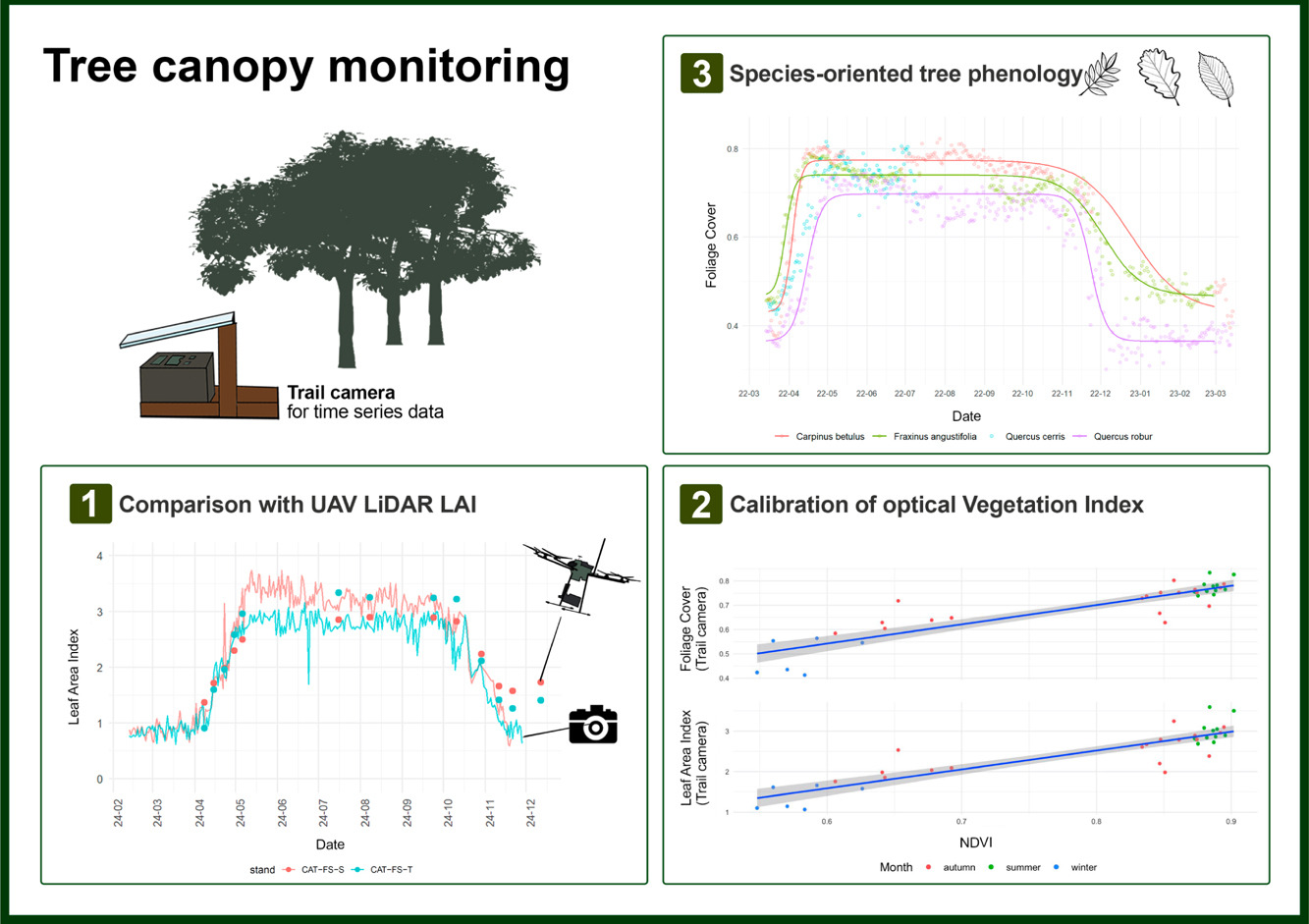
CrowNet: a trail-camera canopy monitoring system
Chianucci
,
Francesco
,
Lenzi
,
Alice
,
Minari
,
Emma
,
Guasti
,
Matteo
,
Gisondi
,
Silvia
,
Gonnelli
,
Marco
,
Innocenti
,
Simone
,
Ferrara
,
Carlotta
,
Campanaro
,
Alessandro
,
Ciampelli
,
Paola
,
Cutini
,
Andrea
,
Puletti
,
Nicola
Mostra abstract
Continuous monitoring of forest canopy structure and phenology is pivotal for the assessment of ecosystem responses to environmental variability and changes. The present study evaluated the use of repeat digital trail cameras as a low-cost, flexible, and accessible in situ monitoring solution for quantifying daily canopy attributes, including effective leaf area index (Le) and canopy cover. A trial camera monitoring network (CrowNet) was established encompassing 20 forest stands in Italy, under different management and environmental conditions, resulting in over 44,000 daily images collected over three years. We demonstrated that taking the mean daily canopy attribute allowed to obtain smooth time series from trail cameras, from which phenological transition dates can be inferred. Daily canopy attributes were validated against manual digital cover photography measurement. To further explore the applicability of this monitoring solution, we performed a comparison between daily Le time series derived from a subset of trail cameras located in beech forests and data collected by multitemporal UAV LiDAR. Results demonstrated the close agreement between the two methods across the entire phenological period (start and end of season). We also illustrated use of continuous trail camera estimates to calibrate a vegetation index (NDVI) to infer leaf area and canopy cover from optical multi-temporal UAV data. We further investigated use of trail camera to detect species-specific differences in tree phenology from time series acquired in a mixed oak-hornbeam forest. We found different canopy structure and phenological transition dates in three broadleaved species (oak, ash, hornbeam), supporting the effectiveness of trail cameras for species-oriented phenology monitoring. We conclude that trail cameras provide a reliable solution for daily canopy monitoring, offering a significant cost-effective and flexible alternative to traditional field methods and providing potential to calibrate, validate or integrate remotely-sensed information. However, camera failures during adverse weather, and the need for more efficient image data quality checking procedures, still represent open challenges. Future improvements, such as weatherproof housing and automated pre-processing screening procedures, are therefore recommended for making trail camera fully operational in ground canopy and phenology monitoring. © 2025 Elsevier B.V.

Estimation of leaf area index in isolated trees with digital photography and its application to urban forestry
Mostra abstract
Accurate estimates of leaf area index (L) are strongly required for modelling ecophysiological processes within urban forests. The majority of methods available for estimating L is ideally applicable at stand scale and is therefore poorly suitable in urban settings, where trees are typically sparse and isolated. In addition, accurate measurements in urban settings are hindered by proximity of trees to infrastructure elements, which can strongly affect the accuracy of tree canopy analysis.In this study we tested whether digital photography can be used to obtain indirect estimate of L of isolated trees. The sampled species were Platanus orientalis, Liquidambar styraciflua and Juglans regia. Upward-facing photography was used to estimate gap fraction and foliage clumping from images collected in unobstructed (open areas) and obstructed (nearby buildings) settings; two image classification methods provided accurate estimates of gap fraction, based on comparison with measurements obtained from a high quality quantum sensor (LAI-2000). Leveled photography was used to characterize the leaf angle distribution of the examined tree species. L estimates obtained combining the two photographic methods agreed well with direct L measurements obtained from harvesting. We conclude that digital photography is suitable for estimating leaf area in isolated urban trees, due to its simple, fast and cost-effective procedures. Use of vegetation indices allows extending significantly the applicability of the photographic method in urban settings, including green roofs and vertical greenery systems. © 2015 Elsevier GmbH.
Estimation of leaf area index in understory deciduous trees using digital photography
foliage cover
digital nadir photography
foliage projection coefficient
leaf angle distribution
leveled camera
Mostra abstract
Fast and accurate estimates of understory leaf area are essential to a wide range of ecological applications. Indirect methods have mainly been used to estimate leaf area of overstory but their application in understory remains largely unexplored. In this study we described a combination of digital photographic methods to obtain rapid, reliable and non-destructive estimate of leaf area index of understory deciduous trees. Nadir photography was used to estimate foliage cover, vertical gap fraction and foliage clumping index. Leveled photography was used to characterize the leaf angle distribution of the examined tree species. Leaf area index estimates obtained combining the two photographic methods were compared with direct measurements obtained from harvesting (. L).We applied these methods in Quercus cerris, Carpinus betulus and Fagus sylvatica stands. Foliage cover estimates derived from two nadir image classification methods were significantly correlated with leaf area index measurements obtained from harvesting. The leveled digital photographic method, previously tested in tall trees and field crops, provided reliable leaf angle measurements in understory tree species. Digital photography provided good indirect estimates of L. We conclude that digital photography is suitable for routine estimate and monitoring of understory leaf area, on account of its fast and cost-effective procedure. © 2014 Elsevier B.V.
Photographic assessment of overstory and understory leaf area index in beech forests under different management regimes in Central Italy: Short communication
Mostra abstract
Forest understory may be strongly affected by silvicultural practices such as thinning, which simultaneously modulates the overstory canopy cover and influences the availability of light. However, the understory layer is rarely considered in management decisions, partly because methods to estimate understory leaf area index are poorly developed. In this study we used two different restricted view angle photographic methods to estimate overstory plant area index L<inf>O</inf> (zenith cover photography), understory leaf area index L<inf>U</inf> (nadir cover photography) and their related canopy attributes (foliage clumping, foliage cover, crown cover, crown porosity). These measurements were performed in beech stands under different management regime. Results from photography indicated that not only overstory but also understory canopy attributes were significantly influenced by forest management. In addition, a significant negative correlation was found between L<inf>O</inf> and L<inf>U</inf>. We conclude that the photographic methods are effective for monitoring (overstory and understory) canopy status in managed stands, on account of their rapid and not destructive procedures, which allows large scale implementation of the methods. © 2014 Estonian University of Life Sciences. All rights reserved.
Indicators for the assessment and certification of cork oak management sustainability in Italy
Pollastrini
,
M.
,
Chiavetta
,
U.
,
Cutini
,
Andrea
,
Casula
,
Antonio
,
Maltoni
,
Sara
,
Dettori
,
Sandro
,
Corona
,
P.
italy
forest management planning
non-wood forest products
quercus suber
sardinia
sustainable forest management
Mostra abstract
Sustainable forest management (SFM) is crucial for forest ecosystem productivity and conservation, especially in systems such as cork oak (Quercus suber L.) threatened by human activities and biotic and abiotic factors. In this study SFM indicators with particular reference to cork oak forests in the region of Sardinia (Italy) are proposed and tested. Sustainable and responsible management options specifically aimed at cork oak forest management and chain of custody certification are also provided. A set of ten indicators was proposed and assessed by an expert panel in cork oak management. Five indicators were also tested against data on structure, origin, health condition and management in 285 forest compartments managed by FoReSTAS (Regional Forest Agency for Land and Environment of Sardinia, Italy), including 361 sampling plots and 5345 trees. In order to investigate the priorities and perceptions of SFM experts and stakeholders, a survey was also carried out by completion of a questionnaire on the technical issues of cork oak woodland management. The survey results highlighted a need to improve environmental and economic performance by means of SFM and certification. The indicators tested in Sardinian cork oak woodlands showed that about 80% of the stands fulfilled management sustainability requirements. The suggested SFM indicators can effectively support proactive management and conservation measures, representing a valuable tool in the current context of growing environmental and socioeconomic awareness. © SISEF.
Forest-food nexus: A topical opportunity for human well-being and silviculture
Mostra abstract
As population will reach over 9 billion by 2050, interest in the forest-food nexus is rising. Forests play an important role in food production and nutrition. Forests can provide nutritionally-balanced diets, woodfuel for cooking and a broad set of ecosystem services. A large body of evidence recommends multi-functional and integrated landscape approaches to reimagine forestry and agriculture systems. Here, after an in-depth commented discussion of the literature produced in the last decade about the role for forests with respect to the food security global emergency, we summarize the state of the art in Italy as a country-case-study. This commentary aims to increase awareness about the potential of silviculture in Italy for combining ecological resilience with economic resilience, and for reasonably increasing non-wood products supply by means of a sustainable intensification of forest management at national level. Chain-supply fragmentation, landowner inertia, and lack of governance and cooperation may hamper an effective exploitation of non-wood products. The strategies to guarantee an effective supply of non-wood products require appropriate business skills and the presence of a structured business service. A transparent market is also essential; therefore, the introduction of standards (e.g. grading rules and forest certification schemes) is important since they can add value to products and services, and emphasize the importance and complexity of the forest sector. However, the implementation of sustainable forest management for an effective supply of non-wood products is affected by the availability of appropriate planning tools, and the public officers need a new mindset to stimulate and support the business capacity of forest owners.
Epiphytic lichen diversity and sustainable forest management criteria and indicators: A multivariate and modelling approach in coppice forests of Italy
Brunialti
,
Giorgio
,
Frati
,
Luisa
,
Calderisi
,
Marco
,
Giorgolo
,
Francesca
,
Bagella
,
Simonetta
,
Bertini
,
Giada
,
Chianucci
,
Francesco
,
Fratini
,
Roberto
,
Gottardini
,
Elena
,
Cutini
,
Andrea
Mostra abstract
Epiphytic lichens represent one of the most suitable indicators of forest continuity and management, especially in the context of ancient and old-growth forests. Nevertheless, they have not yet been included among Sustainable Forest Management (SFM) indicators to which Pan-European forest policy and governance refer. In addition, currently adopted SFM indicators are mainly designed for high forests rather than coppice forests, despite the fact that today this management system covers more than 10% of the total European forests. In this study we investigated these two issues by examining epiphytic lichen diversity in three coppice forest stands, located in the two Italian regions of Tuscany and Sardinia. In particular, we addressed: i) the role of lichen diversity as SFM indicator and ii) its relationship with consolidated and new SFM indicators dealing with structural, health, biodiversity, protective and socioeconomic functions. Multivariate Factor Analysis and Generalised Linear Models were adopted for data analysis. We found that lichen diversity and the frequency of single sensitive species were mainly related to the biodiversity of plants and fungi (Criterion 4), the health and vitality of the forests (Criterion 2) and their protective functions (Criterion 5). Furthermore, our results show that the lichen species highlighted by the models may represent suitable indicators in long-term studies, especially in relation to complex and interconnected aspects of sustainable forest management. Although our findings represent a first contribute to this issue, more in-depth researches will be needed to clarify further aspects of the complex interactions among SFM indicators in the context of coppice forests. © 2020 Elsevier Ltd
Silvicultural regime shapes understory functional structure in European forests
Chianucci
,
Francesco
,
Napoleone
,
Francesca
,
Ricotta
,
Carlo
,
Ferrara
,
Carlotta
,
Fusaro
,
Lina
,
Balducci
,
Lorenzo
,
Trentanovi
,
Giovanni
,
Bradley
,
Owen
,
Kovács
,
Bence
,
Mina
,
Marco
,
Cerabolini
,
Bruno Enrico Leone
,
Vandekerkhove
,
Kris
,
de Smedt
,
Pallieter
,
Lens
,
Luc
,
Hertzog
,
Lionel R.
,
Verheyen
,
Kris
,
Hofmeister
,
Jeňýk
,
Hošek
,
Jan
,
Matula
,
Radim
,
Doerfler
,
Inken
,
Müller
,
Jörg C. C.
,
Weisser
,
Wolfgang W.
,
Helback
,
Jan
,
Schall
,
Peter
,
Fischer
,
Markus
,
Heilmann-Clausen
,
Jacob
,
Riis-Hansen
,
Rasmus
,
Goldberg
,
Irina
,
Aude
,
Erik
,
Kepfer-Rojas
,
Sebastian
,
Kappel Schmidt
,
Inger
,
Riis-Nielsen
,
Torben
,
Mårell
,
Anders
,
Dumas
,
Yann
,
Janssen
,
Philippe
,
Paillet
,
Yoan
,
Archaux
,
Frédéric
,
Xystrakis
,
Fotios
,
Tinya
,
Flóra
,
Ódor
,
Péter
,
Aszalós
,
Réka
,
Bölöni
,
János
,
Cutini
,
Andrea
,
Bagella
,
Simonetta
,
Sitzia
,
Tommaso
,
Brazaitis
,
Gediminas
,
Marozas
,
Vitas
,
Ujházyová
,
Mariana
,
Ujházy
,
Karol
,
Máliš
,
František
,
Nordén
,
Björn
,
Burrascano
,
Sabina
functional diversity
functional redundancy
forest understory
sustainable forest management
unmanaged forests
ecosystem resilience
silvicultural regime
Mostra abstract
Managing forests to sustain their diversity and functioning is a major challenge in a changing world. Despite the key role of understory vegetation in driving forest biodiversity, regeneration and functioning, few studies address the functional dimensions of understory vegetation response to silvicultural management. We assessed the influence of the silvicultural regimes on the functional diversity and redundancy of European forest understory. We gathered vascular plant abundance data from more than 2000 plots in European forests, each associated with one out of the five most widespread silvicultural regimes. We used generalized linear mixed models to assess the effect of different silvicultural regimes on understory functional diversity (Rao's quadratic entropy) and functional redundancy, while accounting for climate and soil conditions, and explored the reciprocal relationship between three diversity components (functional diversity, redundancy and dominance) across silvicultural regimes through a ternary diversity diagram. Intensive silvicultural regimes are associated with a decrease in functional diversity and an increase in functional redundancy, compared with unmanaged conditions. This means that although intensive management may buffer communities' functions against species or functional losses, it also limits the range of understory response to environmental changes. Policy implications. Different silvicultural regimes influence different facets of understory functional features. While unmanaged forests can be used as a reference to design silvicultural practices in compliance with biodiversity conservation targets, different silvicultural options should be balanced at landscape scale to sustain the multiple forest functions that human societies are increasingly demanding. © 2024 The Author(s). Journal of Applied Ecology published by John Wiley & Sons Ltd on behalf of British Ecological Society.
The Relationship Between Maturation Size and Maximum Tree Size From Tropical to Boreal Climates
Journé
,
Valentin
,
Bogdziewicz
,
Michał
,
Courbaud
,
Benoít
,
Kunstler
,
Georges
,
Qiu
,
Tong
,
Aravena Acuña
,
Marie Claire
,
Ascoli
,
Davide
,
Bergeron
,
Yves
,
Berveiller
,
Daniel
,
Boivin
,
Thomas
,
Bonal
,
Raúl
,
Caignard
,
Thomas
,
Cailleret
,
Maxime
,
Calama
,
Rafael A.
,
Camarero
,
Jesús Julio
,
Chang-Yang
,
Chia Hao
,
Chave
,
Jérôme
,
Chianucci
,
Francesco
,
Curt
,
Thomas
,
Cutini
,
Andrea
,
Das
,
Adrian J.
,
Daskalakou
,
Evangelia N.
,
Davi
,
Hendrik
,
Delpierre
,
Nicolas
,
Delzon
,
Sylvain
,
Dietze
,
Michael C.
,
Calderon
,
Sergio Donoso
,
Dormont
,
Laurent
,
Espelta
,
Josep Maria
,
Farfan-Rios
,
William R.
,
Fenner
,
Michael
,
Franklin
,
Jerry F.
,
Gehring
,
Catherine A.
,
Gilbert
,
Gregory S.
,
Gratzer
,
Georg
,
Greenberg
,
Cathryn H.
,
Guignabert
,
Arthur
,
Guo
,
Qinfeng
,
Hacket-Pain
,
Andrew J.
,
Hampe
,
Arndt
,
Han
,
Qingmin
,
Hanley
,
Mick E.
,
Hille Ris Lambers
,
Janneke
,
Holik
,
Jan
,
Hoshizaki
,
K.
,
Ibáñez
,
Inés
,
Johnstone
,
Jill F.
,
Knops
,
Johannes Michael Hubertus
,
Kobe
,
Richard K.
,
Kurokawa
,
Hiroko
,
Lageard
,
Jonathan G.A.
,
LaMontagne
,
Jalene M.
,
Ledwoń
,
Mateusz
,
Lefèvre
,
François
,
Leininger
,
Theodor D.
,
Limousin
,
Jean Marc
,
Lutz
,
James A.
,
Macias
,
Diana S.
,
Mårell
,
Anders
,
McIntire
,
Eliot J.B.
,
Moran
,
Emily V.
,
Motta
,
Renzo
,
Myers
,
Jonathan A.
,
Nagel
,
Thomas A.
,
Naoe
,
Shoji
,
Noguchi
,
Mahoko
,
Norghauer
,
Julian M.
,
Oguro
,
Michio
,
Ourcival
,
Jean Marc
,
Parmenter
,
Robert R.
,
Pearse
,
Ian S.
,
Pérez-Ramos
,
Ignacio M.
,
Piechnik
,
Łukasz
,
Podgórski
,
Tomasz
,
Poulsen
,
John R.
,
Redmond
,
Miranda D.
,
Reid
,
Chantal D.
,
Šamonil
,
Pavel
,
Scher
,
C. Lane
,
Schlesinger
,
William H.
,
Seget
,
Barbara
,
Sharma
,
Shubhi
,
Shibata
,
Mitsue
,
Silman
,
Miles R.
,
Steele
,
Michael A.
,
Stephenson
,
Nathan L.
,
Straub
,
Jacob N.
,
Sutton
,
Samantha
,
Swenson
,
Jennifer J.
,
Swift
,
Margaret
,
Thomas
,
Peter A.
,
Uríarte
,
María
,
Vacchiano
,
Giorgio
,
Whipple
,
Amy Vaughn
,
Whitham
,
Thomas G.
,
Wright
,
Stuart Joseph
,
Zhu
,
Kai
,
Zimmerman
,
Jess K.
,
Żywiec
,
Magdalena
,
Clark
,
James S.
Mostra abstract
The fundamental trade-off between current and future reproduction has long been considered to result in a tendency for species that can grow large to begin reproduction at a larger size. Due to the prolonged time required to reach maturity, estimates of tree maturation size remain very rare and we lack a global view on the generality and the shape of this trade-off. Using seed production from five continents, we estimate tree maturation sizes for 486 tree species spanning tropical to boreal climates. Results show that a species' maturation size increases with maximum size, but in a non-proportional way: the largest species begin reproduction at smaller sizes than would be expected if maturation were simply proportional to maximum size. Furthermore, the decrease in relative maturation size is steepest in cold climates. These findings on maturation size drivers are key to accurately represent forests' responses to disturbance and climate change. © 2024 John Wiley & Sons Ltd.
Widespread breakdown in masting in European beech due to rising summer temperatures
Foest
,
Jessie J.
,
Bogdziewicz
,
Michał
,
Pesendorfer
,
Mario B.
,
Ascoli
,
Davide
,
Cutini
,
Andrea
,
Nussbaumer
,
Anita
,
Verstraeten
,
Arne
,
Beudert
,
Burkhard
,
Chianucci
,
Francesco
,
Mezzavilla
,
Francesco
,
Gratzer
,
Georg
,
Kunstler
,
Georges
,
Meesenburg
,
H.
,
Wagner
,
Markus
,
Mund
,
Martina
,
Cools
,
Nathalie
,
Vacek
,
Stanislav
,
Schmidt
,
Wolfgang
,
Vacek
,
Zdeněk Ck
,
Hacket-Pain
,
Andrew J.
Mostra abstract
Climate change effects on tree reproduction are poorly understood, even though the resilience of populations relies on sufficient regeneration to balance increasing rates of mortality. Forest-forming tree species often mast, i.e. reproduce through synchronised year-to-year variation in seed production, which improves pollination and reduces seed predation. Recent observations in European beech show, however, that current climate change can dampen interannual variation and synchrony of seed production and that this masting breakdown drastically reduces the viability of seed crops. Importantly, it is unclear under which conditions masting breakdown occurs and how widespread breakdown is in this pan-European species. Here, we analysed 50 long-term datasets of population-level seed production, sampled across the distribution of European beech, and identified increasing summer temperatures as the general driver of masting breakdown. Specifically, increases in site-specific mean maximum temperatures during June and July were observed across most of the species range, while the interannual variability of population-level seed production (CVp) decreased. The declines in CVp were greatest, where temperatures increased most rapidly. Additionally, the occurrence of crop failures and low seed years has decreased during the last four decades, signalling altered starvation effects of masting on seed predators. Notably, CVp did not vary among sites according to site mean summer temperature. Instead, masting breakdown occurs in response to warming local temperatures (i.e. increasing relative temperatures), such that the risk is not restricted to populations growing in warm average conditions. As lowered CVp can reduce viable seed production despite the overall increase in seed count, our results warn that a covert mechanism is underway that may hinder the regeneration potential of European beech under climate change, with great potential to alter forest functioning and community dynamics. © 2024 The Authors. Global Change Biology published by John Wiley & Sons Ltd.
Where are we now with European forest multi-taxon biodiversity and where can we head to?
Burrascano
,
Sabina
,
Chianucci
,
Francesco
,
Trentanovi
,
Giovanni
,
Kepfer-Rojas
,
Sebastian
,
Sitzia
,
Tommaso
,
Tinya
,
Flóra
,
Doerfler
,
Inken
,
Paillet
,
Yoan
,
Nagel
,
Thomas A.
,
Mitić
,
Božena
,
Morillas
,
Lourdes
,
Munzi
,
Silvana
,
Van Der Sluis
,
Theo
,
Alterio
,
Edoardo
,
Balducci
,
Lorenzo
,
de Andrade
,
Rafael Barreto
,
Bouget
,
Christophe
,
Giordani
,
P.
,
Lachat
,
Thibault
,
Matošević
,
Dinka
,
Napoleone
,
Francesca
,
Nascimbene
,
Juri
,
Paniccia
,
Chiara
,
Roth
,
Nicolas
,
Aszalós
,
Réka
,
Brazaitis
,
Gediminas
,
Cutini
,
Andrea
,
D'Andrea
,
Ettore
,
de Smedt
,
Pallieter
,
Heilmann-Clausen
,
Jacob
,
Janssen
,
Philippe
,
Kozák
,
Daniel
,
Mårell
,
Anders
,
Mikoláš
,
Martin
,
Nordén
,
Björn
,
Matula
,
Radim
,
Schall
,
Peter
,
Svoboda
,
Miroslav
,
Ujházyová
,
Mariana
,
Vandekerkhove
,
Kris
,
Wohlwend
,
Michael Rudolf
,
Xystrakis
,
Fotios
,
Aleffi
,
Michele
,
Ammer
,
Christian
,
Archaux
,
Frédéric
,
Asbeck
,
Thomas
,
N Avtzis
,
Dimitrios N.
,
Ayasse
,
Manfred
,
Bagella
,
Simonetta
,
Balestrieri
,
Rosario
,
Barbati
,
Anna
,
Basile
,
Marco
,
Bergamini
,
Ariel
,
Bertini
,
Giada
,
Biscaccianti
,
Alessandro Bruno
,
Boch
,
Steffen
,
Bölöni
,
János
,
Bombi
,
Pierluigi
,
Boscardin
,
Yves
,
Brunialti
,
Giorgio
,
Bruun
,
Hans Henrik
,
Buscot
,
François
,
Byriel
,
David Bille
,
Campagnaro
,
Thomas
,
Campanaro
,
Alessandro
,
Chauvat
,
Matthieu
,
Ciach
,
Michał
,
Čiliak
,
Marek
,
Cistrone
,
Luca
,
Pereira
,
Joaò Manuel Cordeiro
,
Daniel
,
Rolf
,
de Cinti
,
Bruno
,
de Filippo
,
Gabriele
,
Dekoninck
,
Wouter
,
Di Salvatore
,
Umberto
,
Dumas
,
Yann
,
Elek
,
Zoltán
,
Ferretti
,
Fabrizio
,
Fotakis
,
Dimitrios G.
,
Frank
,
Tamás
,
Frey
,
Julian
,
Giancola
,
Carmen
,
Gömöryová
,
Erika
,
Gosselin
,
Marion
,
Gosselin
,
Frédéric
,
Goßner
,
Martin M.
,
Götmark
,
Frank
,
Haeler
,
Elena
,
Hansen
,
Aslak Kappel
,
Hertzog
,
Lionel R.
,
Hofmeister
,
Jeňýk
,
Hošek
,
Jan
,
Johannsen
,
Vivian Kvist
,
Justensen
,
Mathias Just
,
Korboulewsky
,
Nathalie
,
Kovács
,
Bence
,
Lakatos
,
Ferenc
,
Landivar
,
Carlos Miguel
,
Lens
,
Luc
,
Lingua
,
Emanuele
forest biodiversity
biodiversity conservation
forest stand structure
multi-taxon
sustainable management
Mostra abstract
The European biodiversity and forest strategies rely on forest sustainable management (SFM) to conserve forest biodiversity. However, current sustainability assessments hardly account for direct biodiversity indicators. We focused on forest multi-taxon biodiversity to: i) gather and map the existing information; ii) identify knowledge and research gaps; iii) discuss its research potential. We established a research network to fit data on species, standing trees, lying deadwood and sampling unit description from 34 local datasets across 3591 sampling units. A total of 8724 species were represented, with the share of common and rare species varying across taxonomic classes: some included many species with several rare ones (e.g., Insecta); others (e.g., Bryopsida) were represented by few common species. Tree-related structural attributes were sampled in a subset of sampling units (2889; 2356; 2309 and 1388 respectively for diameter, height, deadwood and microhabitats). Overall, multi-taxon studies are biased towards mature forests and may underrepresent the species related to other developmental phases. European forest compositional categories were all represented, but beech forests were over-represented as compared to thermophilous and boreal forests. Most sampling units (94%) were referred to a habitat type of conservation concern. Existing information may support European conservation and SFM strategies in: (i) methodological harmonization and coordinated monitoring; (ii) definition and testing of SFM indicators and thresholds; (iii) data-driven assessment of the effects of environmental and management drivers on multi-taxon forest biological and functional diversity, (iv) multi-scale forest monitoring integrating in-situ and remotely sensed information. © 2023 The Authors
Masting is uncommon in trees that depend on mutualist dispersers in the context of global climate and fertility gradients
Qiu
,
Tong
,
Aravena Acuña
,
Marie Claire
,
Ascoli
,
Davide
,
Bergeron
,
Yves
,
Bogdziewicz
,
Michał
,
Boivin
,
Thomas
,
Bonal
,
Raúl
,
Caignard
,
Thomas
,
Cailleret
,
Maxime
,
Calama
,
Rafael A.
,
Calderon
,
Sergio Donoso
,
Camarero
,
Jesús Julio
,
Chang-Yang
,
Chia Hao
,
Chave
,
Jérôme
,
Chianucci
,
Francesco
,
Courbaud
,
Benoít
,
Cutini
,
Andrea
,
Das
,
Adrian J.
,
Delpierre
,
Nicolas
,
Delzon
,
Sylvain
,
Dietze
,
Michael C.
,
Dormont
,
Laurent
,
Espelta
,
Josep Maria
,
Fahey
,
Timothy J.
,
Farfan-Rios
,
William R.
,
Franklin
,
Jerry F.
,
Gehring
,
Catherine A.
,
Gilbert
,
Gregory S.
,
Gratzer
,
Georg
,
Greenberg
,
Cathryn H.
,
Guignabert
,
Arthur
,
Guo
,
Qinfeng
,
Hacket-Pain
,
Andrew J.
,
Hampe
,
Arndt
,
Han
,
Qingmin
,
Holik
,
Jan
,
Hoshizaki
,
K.
,
Ibáñez
,
Inés
,
Johnstone
,
Jill F.
,
Journé
,
Valentin
,
Kitzberger
,
Thomas A.
,
Knops
,
Johannes Michael Hubertus
,
Kunstler
,
Georges
,
Kurokawa
,
Hiroko
,
Lageard
,
Jonathan G.A.
,
LaMontagne
,
Jalene M.
,
Lefèvre
,
François
,
Leininger
,
Theodor D.
,
Limousin
,
Jean Marc
,
Lutz
,
James A.
,
Macias
,
Diana S.
,
Mårell
,
Anders
,
McIntire
,
Eliot J.B.
,
Moore
,
Christopher M.
,
Moran
,
Emily V.
,
Motta
,
Renzo
,
Myers
,
Jonathan A.
,
Nagel
,
Thomas A.
,
Naoe
,
Shoji
,
Noguchi
,
Mahoko
,
Oguro
,
Michio
,
Parmenter
,
Robert R.
,
Pearse
,
Ian S.
,
Pérez-Ramos
,
Ignacio M.
,
Piechnik
,
Łukasz
,
Podgórski
,
Tomasz
,
Poulsen
,
John R.
,
Redmond
,
Miranda D.
,
Reid
,
Chantal D.
,
Rodman
,
Kyle C.
,
Rodríguez-Sánchez
,
Francisco
,
Šamonil
,
Pavel
,
Sanguinetti
,
Javier D.
,
Scher
,
C. Lane
,
Seget
,
Barbara
,
Sharma
,
Shubhi
,
Shibata
,
Mitsue
,
Silman
,
Miles R.
,
Steele
,
Michael A.
,
Stephenson
,
Nathan L.
,
Straub
,
Jacob N.
,
Sutton
,
Samantha
,
Swenson
,
Jennifer J.
,
Swift
,
Margaret
,
Thomas
,
Peter A.
,
Uríarte
,
María
,
Vacchiano
,
Giorgio
,
Whipple
,
Amy Vaughn
,
Whitham
,
Thomas G.
,
Wion
,
Andreas P.
,
Wright
,
Stuart Joseph
,
Zhu
,
Kai
,
Zimmerman
,
Jess K.
,
Żywiec
,
Magdalena
,
Clark
,
James S.
Mostra abstract
The benefits of masting (volatile, quasi-synchronous seed production at lagged intervals) include satiation of seed predators, but these benefits come with a cost to mutualist pollen and seed dispersers. If the evolution of masting represents a balance between these benefits and costs, we expect mast avoidance in species that are heavily reliant on mutualist dispersers. These effects play out in the context of variable climate and site fertility among species that vary widely in nutrient demand. Meta-analyses of published data have focused on variation at the population scale, thus omitting periodicity within trees and synchronicity between trees. From raw data on 12 million tree-years worldwide, we quantified three components of masting that have not previously been analysed together: (i) volatility, defined as the frequency-weighted year-to-year variation; (ii) periodicity, representing the lag between high-seed years; and (iii) synchronicity, indicating the tree-to-tree correlation. Results show that mast avoidance (low volatility and low synchronicity) by species dependent on mutualist dispersers explains more variation than any other effect. Nutrient-demanding species have low volatility, and species that are most common on nutrient-rich and warm/wet sites exhibit short periods. The prevalence of masting in cold/dry sites coincides with climatic conditions where dependence on vertebrate dispersers is less common than in the wet tropics. Mutualist dispersers neutralize the benefits of masting for predator satiation, further balancing the effects of climate, site fertility and nutrient demands. © 2023, The Author(s), under exclusive licence to Springer Nature Limited.
Linking seed size and number to trait syndromes in trees
Bogdziewicz
,
Michał
,
Aravena Acuña
,
Marie Claire
,
Andrus
,
Robert A.
,
Ascoli
,
Davide
,
Bergeron
,
Yves
,
Brveiller
,
Daniel
,
Boivin
,
Thomas
,
Bonal
,
Raúl
,
Caignard
,
Thomas
,
Cailleret
,
Maxime
,
Calama
,
Rafael A.
,
Calderon
,
Sergio Donoso
,
Camarero
,
Jesús Julio
,
Chang-Yang
,
Chia Hao
,
Chave
,
Jérôme
,
Chianucci
,
Francesco
,
Cleavitt
,
Natalie L.
,
Courbaud
,
Benoít
,
Cutini
,
Andrea
,
Curt
,
Thomas
,
Das
,
Adrian J.
,
Davi
,
Hendrik
,
Delpierre
,
Nicolas
,
Delzon
,
Sylvain
,
Dietze
,
Michael C.
,
Dormont
,
Laurent
,
Farfan-Rios
,
William R.
,
Gehring
,
Catherine A.
,
Gilbert
,
Gregory S.
,
Gratzer
,
Georg
,
Greenberg
,
Cathryn H.
,
Guignabert
,
Arthur
,
Guo
,
Qinfeng
,
Hacket-Pain
,
Andrew J.
,
Hampe
,
Arndt
,
Han
,
Qingmin
,
Hoshizaki
,
K.
,
Ibáñez
,
Inés
,
Johnstone
,
Jill F.
,
Journé
,
Valentin
,
Kitzberger
,
Thomas A.
,
Knops
,
Johannes Michael Hubertus
,
Kunstler
,
Georges
,
Kobe
,
Richard K.
,
Lageard
,
Jonathan G.A.
,
LaMontagne
,
Jalene M.
,
Ledwoń
,
Mateusz
,
Leininger
,
Theodor D.
,
Limousin
,
Jean Marc
,
Lutz
,
James A.
,
Macias
,
Diana S.
,
Mårell
,
Anders
,
McIntire
,
Eliot J.B.
,
Moran
,
Emily V.
,
Motta
,
Renzo
,
Myers
,
Jonathan A.
,
Nagel
,
Thomas A.
,
Naoe
,
Shoji
,
Noguchi
,
Mahoko
,
Oguro
,
Michio
,
Kurokawa
,
Hiroko
,
Ourcival
,
Jean Marc
,
Parmenter
,
Robert R.
,
Pérez-Ramos
,
Ignacio M.
,
Piechnik
,
Łukasz
,
Podgórski
,
Tomasz
,
Poulsen
,
John R.
,
Qiu
,
Tong
,
Redmond
,
Miranda D.
,
Reid
,
Chantal D.
,
Rodman
,
Kyle C.
,
Šamonil
,
Pavel
,
Holik
,
Jan
,
Scher
,
C. Lane
,
van Marle
,
Harald Schmidt
,
Seget
,
Barbara
,
Shibata
,
Mitsue
,
Sharma
,
Shubhi
,
Silman
,
Miles R.
,
Steele
,
Michael A.
,
Straub
,
Jacob N.
,
Sun
,
I. Fang
,
Sutton
,
Samantha
,
Swenson
,
Jennifer J.
,
Thomas
,
Peter A.
,
Uríarte
,
María
,
Vacchiano
,
Giorgio
,
Veblen
,
Thomas Thorstein
,
Wright
,
Boyd R.
,
Wright
,
Stuart Joseph
,
Whitham
,
Thomas G.
,
Zhu
,
Kai
,
Zimmerman
,
Jess K.
,
Żywiec
,
Magdalena
,
Clark
,
James S.
Mostra abstract
Aim: Our understanding of the mechanisms that maintain forest diversity under changing climate can benefit from knowledge about traits that are closely linked to fitness. We tested whether the link between traits and seed number and seed size is consistent with two hypotheses, termed the leaf economics spectrum and the plant size syndrome, or whether reproduction represents an independent dimension related to a seed size–seed number trade-off. Location: Most of the data come from Europe, North and Central America and East Asia. A minority of the data come from South America, Africa and Australia. Time period: 1960–2022. Major taxa studied: Trees. Methods: We gathered 12 million observations of the number of seeds produced in 784 tree species. We estimated the number of seeds produced by individual trees and scaled it up to the species level. Next, we used principal components analysis and generalized joint attribute modelling (GJAM) to map seed number and size on the tree traits spectrum. Results: Incorporating seed size and number into trait analysis while controlling for environment and phylogeny with GJAM exposes relationships in trees that might otherwise remain hidden. Production of the large total biomass of seeds [product of seed number and seed size; hereafter, species seed productivity (SSP)] is associated with high leaf area, low foliar nitrogen, low specific leaf area (SLA) and dense wood. Production of high seed numbers is associated with small seeds produced by nutrient-demanding species with softwood, small leaves and high SLA. Trait covariation is consistent with opposing strategies: one fast-growing, early successional, with high dispersal, and the other slow-growing, stress-tolerant, that recruit in shaded conditions. Main conclusions: Earth system models currently assume that reproductive allocation is indifferent among plant functional types. Easily measurable seed size is a strong predictor of the seed number and species seed productivity. The connection of SSP with the functional traits can form the first basis of improved fecundity prediction across global forests. © 2023 John Wiley & Sons Ltd.
Words apart: Standardizing forestry terms and definitions across European biodiversity studies
Trentanovi
,
Giovanni
,
Campagnaro
,
Thomas
,
Sitzia
,
Tommaso
,
Chianucci
,
Francesco
,
Vacchiano
,
Giorgio
,
Ammer
,
Christian
,
Ciach
,
Michał
,
Nagel
,
Thomas A.
,
del Río
,
Miren
,
Paillet
,
Yoan
,
Munzi
,
Silvana
,
Vandekerkhove
,
Kris
,
Bravo-Oviedo
,
Andrés
,
Cutini
,
Andrea
,
D'Andrea
,
Ettore
,
de Smedt
,
Pallieter
,
Doerfler
,
Inken
,
Fotakis
,
Dimitrios G.
,
Heilmann-Clausen
,
Jacob
,
Hofmeister
,
Jeňýk
,
Hošek
,
Jan
,
Janssen
,
Philippe
,
Kepfer-Rojas
,
Sebastian
,
Korboulewsky
,
Nathalie
,
Kovács
,
Bence
,
Kozák
,
Daniel
,
Lachat
,
Thibault
,
Mårell
,
Anders
,
Matula
,
Radim
,
Mikoláš
,
Martin
,
Nordén
,
Björn
,
Ódor
,
Péter
,
Perović
,
Marko
,
Pötzelsberger
,
Elisabeth
,
Schall
,
Peter
,
Svoboda
,
Miroslav
,
Tinya
,
Flóra
,
Ujházyová
,
Mariana
,
Burrascano
,
Sabina
Mostra abstract
Forest biodiversity studies conducted across Europe use a multitude of forestry terms, often inconsistently. This hinders the comparability across studies and makes the assessment of the impacts of forest management on biodiversity highly context-dependent. Recent attempts to standardize forestry and stand description terminology mostly used a top-down approach that did not account for the perspectives and approaches of forest biodiversity experts. This work aims to establish common standards for silvicultural and vegetation definitions, creating a shared conceptual framework for a consistent study on the effects of forest management on biodiversity. We have identified both strengths and weaknesses of the silvicultural and vegetation information provided in forest biodiversity studies. While quantitative data on forest biomass and dominant tree species are frequently included, information on silvicultural activities and vegetation composition is often lacking, shallow, or based on broad and heterogeneous classifications. We discuss the existing classifications and their use in European forest biodiversity studies through a novel bottom-up and top-driven review process, and ultimately propose a common framework. This will enhance the comparability of forest biodiversity studies in Europe, and puts the basis for effective implementation and monitoring of sustainable forest management policies. The standards here proposed are potentially adaptable and applicable to other geographical areas and could be extended to other forest interventions. © 2023 The Authors
MASTREE+: Time-series of plant reproductive effort from six continents
Hacket-Pain
,
Andrew J.
,
Foest
,
Jessie J.
,
Pearse
,
Ian S.
,
LaMontagne
,
Jalene M.
,
Koenig
,
Walter D.
,
Vacchiano
,
Giorgio
,
Bogdziewicz
,
Michał
,
Caignard
,
Thomas
,
Celebias
,
Paulina
,
van Dormolen
,
Joep
,
Fernández-Martínez
,
Marcos
,
Moris
,
Jose V.
,
Palaghianu
,
Ciprian
,
Pesendorfer
,
Mario B.
,
Satake
,
Akiko
,
Schermer
,
Éliane
,
Tanentzap
,
Andrew J.
,
Thomas
,
Peter A.
,
Vecchio
,
Davide
,
Wion
,
Andreas P.
,
Wohlgemuth
,
Thomas
,
Xue
,
Tingting
,
Abernethy
,
Katharine A.
,
Aravena Acuña
,
Marie Claire
,
Barrera
,
Marcelo Daniel
,
Barton
,
Jessica H.
,
Boutin
,
Stan A.
,
Bush
,
Emma R.
,
Donoso Calderón
,
Sergio R.
,
Carevic
,
Felipe S.
,
Castilho
,
Carolina V.
,
Manuel Cellini
,
Juan
,
Chapman
,
Colin A.
,
Chapman
,
H. M.
,
Chianucci
,
Francesco
,
Costa
,
Patricia Da
,
Croisé
,
Luc
,
Cutini
,
Andrea
,
Dantzer
,
Ben J.
,
DeRose
,
Robert Justin
,
Dikangadissi
,
Jean Thoussaint
,
Dimoto
,
Edmond
,
da Fonseca
,
Fernanda Lopes
,
Gallo
,
Leonardo Ariel
,
Gratzer
,
Georg
,
Greene
,
David F.
,
Hadad
,
Martín Ariel
,
Huertas Herrera
,
Alejandro
,
Jeffery
,
Kathryn J.
,
Johnstone
,
Jill F.
,
Kalbitzer
,
Urs
,
Kantorowicz
,
Władysław
,
Klimas
,
Christie Ann
,
Lageard
,
Jonathan G.A.
,
Lane
,
Jeffrey E.
,
Lapin
,
Katharina
,
Ledwoń
,
Mateusz
,
Leeper
,
Abigail C.
,
Lencinas
,
María Vanessa
,
Lira-Guedes
,
Ana Cláudia
,
Lordon
,
Michael C.
,
Marchelli
,
Paula
,
Marino
,
Shealyn
,
Schmidt van Marle
,
Harald
,
McAdam
,
Andrew G.
,
Momont
,
Ludovic R.W.
,
Nicolas
,
Manuel
,
de Oliveira Wadt
,
Lúcia Helena
,
Panahi
,
Parisa
,
Martínez Pastur
,
Guillermo J.
,
Patterson
,
Thomas W.
,
Luis Peri
,
Pablo
,
Piechnik
,
Łukasz
,
Pourhashemi
,
Mehdi
,
Espinoza Quezada
,
Claudia
,
Roig
,
Fidel Alejandro
,
Peña-Rojas
,
Karen A.
,
Rosas
,
Yamina Micaela
,
Schueler
,
Silvio
,
Seget
,
Barbara
,
Soler
,
Rosina M.
,
Steele
,
Michael A.
,
Toro Manríquez
,
Mónica Del Rosario
,
Tutin
,
Caroline E.G.
,
Ukizintambara
,
Tharcisse
,
White
,
Lee J.T.
,
Yadok
,
Biplang Godwill
,
Willis
,
John L.
,
Zolles
,
Anita
,
Żywiec
,
Magdalena
,
Ascoli
,
Davide
Mostra abstract
Significant gaps remain in understanding the response of plant reproduction to environmental change. This is partly because measuring reproduction in long-lived plants requires direct observation over many years and such datasets have rarely been made publicly available. Here we introduce MASTREE+, a data set that collates reproductive time-series data from across the globe and makes these data freely available to the community. MASTREE+ includes 73,828 georeferenced observations of annual reproduction (e.g. seed and fruit counts) in perennial plant populations worldwide. These observations consist of 5971 population-level time-series from 974 species in 66 countries. The mean and median time-series length is 12.4 and 10 years respectively, and the data set includes 1122 series that extend over at least two decades (≥20 years of observations). For a subset of well-studied species, MASTREE+ includes extensive replication of time-series across geographical and climatic gradients. Here we describe the open-access data set, available as a.csv file, and we introduce an associated web-based app for data exploration. MASTREE+ will provide the basis for improved understanding of the response of long-lived plant reproduction to environmental change. Additionally, MASTREE+ will enable investigation of the ecology and evolution of reproductive strategies in perennial plants, and the role of plant reproduction as a driver of ecosystem dynamics. © 2022 The Authors. Global Change Biology published by John Wiley & Sons Ltd.
Handbook of field sampling for multi-taxon biodiversity studies in European forests
Burrascano
,
Sabina
,
Trentanovi
,
Giovanni
,
Paillet
,
Yoan
,
Heilmann-Clausen
,
Jacob
,
Giordani
,
P.
,
Bagella
,
Simonetta
,
Bravo-Oviedo
,
Andrés
,
Campagnaro
,
Thomas
,
Campanaro
,
Alessandro
,
Chianucci
,
Francesco
,
de Smedt
,
Pallieter
,
Itziar
,
García Mijangos
,
Matošević
,
Dinka
,
Sitzia
,
Tommaso
,
Aszalós
,
Réka
,
Brazaitis
,
Gediminas
,
Cutini
,
Andrea
,
D'Andrea
,
Ettore
,
Doerfler
,
Inken
,
Hofmeister
,
Jeňýk
,
Hošek
,
Jan
,
Janssen
,
Philippe
,
Kepfer-Rojas
,
Sebastian
,
Korboulewsky
,
Nathalie
,
Kozák
,
Daniel
,
Lachat
,
Thibault
,
Lõhmus
,
Asko
,
López
,
Rosana
,
Mårell
,
Anders
,
Matula
,
Radim
,
Mikoláš
,
Martin
,
Munzi
,
Silvana
,
Nordén
,
Björn
,
Pärtel
,
Meelis
,
Penner
,
Johannes
,
Runnel
,
Kadri
,
Schall
,
Peter
,
Svoboda
,
Miroslav
,
Tinya
,
Flóra
,
Ujházyová
,
Mariana
,
Vandekerkhove
,
Kris
,
Verheyen
,
Kris
,
Xystrakis
,
Fotios
,
Ódor
,
Péter
Mostra abstract
Forests host most terrestrial biodiversity and their sustainable management is crucial to halt biodiversity loss. Although scientific evidence indicates that sustainable forest management (SFM) should be assessed by monitoring multi-taxon biodiversity, most current SFM criteria and indicators account only for trees or consider indirect biodiversity proxies. Several projects performed multi-taxon sampling to investigate the effects of forest management on biodiversity, but the large variability of their sampling approaches hampers the identification of general trends, and limits broad-scale inference for designing SFM. Here we address the need of common sampling protocols for forest structure and multi-taxon biodiversity to be used at broad spatial scales. We established a network of researchers involved in 41 projects on forest multi-taxon biodiversity across 13 European countries. The network data structure comprised the assessment of at least three taxa, and the measurement of forest stand structure in the same plots or stands. We mapped the sampling approaches to multi-taxon biodiversity, standing trees and deadwood, and used this overview to provide operational answers to two simple, yet crucial, questions: what to sample? How to sample? The most commonly sampled taxonomic groups are vascular plants (83% of datasets), beetles (80%), lichens (66%), birds (66%), fungi (61%), bryophytes (49%). They cover different forest structures and habitats, with a limited focus on soil, litter and forest canopy. Notwithstanding the common goal of assessing forest management effects on biodiversity, sampling approaches differed widely within and among taxonomic groups. Differences derive from sampling units (plots size, use of stand vs. plot scale), and from the focus on different substrates or functional groups of organisms. Sampling methods for standing trees and lying deadwood were relatively homogeneous and focused on volume calculations, but with a great variability in sampling units and diameter thresholds. We developed a handbook of sampling methods (SI 3) aimed at the greatest possible comparability across taxonomic groups and studies as a basis for European-wide biodiversity monitoring programs, robust understanding of biodiversity response to forest structure and management, and the identification of direct indicators of SFM. © 2021 The Authors
Testing an expanded set of sustainable forest management indicators in Mediterranean coppice area
Cutini
,
Andrea
,
Ferretti
,
Marco
,
Bertini
,
Giada
,
Brunialti
,
Giorgio
,
Bagella
,
Simonetta
,
Chianucci
,
Francesco
,
Fabbio
,
Gianfranco
,
Fratini
,
Roberto
,
Riccioli
,
Francesco
,
Caddeo
,
C.
,
Calderisi
,
Marco
,
Ciucchi
,
B.
,
Corradini
,
Stefano
,
Cristofolini
,
Fabiana
,
Cristofori
,
Antonella
,
Di Salvatore
,
Umberto
,
Ferrara
,
Carlotta
,
Frati
,
Luisa
,
Landi
,
Sara
,
Marchino
,
Luca
,
Patteri
,
Giacomo
,
Piovosi
,
Maurizio
,
Roggero
,
Pier Paolo
,
Seddaiu
,
Giovanna
,
Gottardini
,
Elena
silviculture
coppice conversion
coppice natural evolution
coppice system
environmental monitoring
sfm criteria
Mostra abstract
Although coppice forests represent a significant part of the European forest area, especially across southern Countries, they received little attention within the Sustainable Forest Management (SFM) processes and scenarios, whose guidelines have been mainly designed to high forests and national scale. In order to obtain “tailored” information on the degree of sustainability of coppices on the scale of the stand, we evaluated (i) whether the main coppice management options result in different responses of the SFM indicators, and (ii) the degree to which the considered SFM indicators were appropriate in their application at stand level. The study considered three different management options (Traditional Coppice TC, coppice under Natural Evolution NE, and coppice under Conversion to high forest by means of periodical thinning CO). In each of the 43 plots considered in the study, which covered three different European Forest Types, we applied a set of eighteen “consolidated” SFM indicators, covering all the six SFM Criteria (FOREST EUROPE, 2020) and, additionally, tested other sixteen novel indicators shaped for agamic forests and/or applicable at stand level. Results confirmed that several consolidated indicators related to resources status (Growing stock and Carbon stock), health (Defoliation and Forest damage), and socio-economic functions (Net revenue, Energy and Accessibility) were highly appropriate for evaluating the sustainability of coppice at stand level. In addition, some novel indicators related to resources status (Total above ground tree biomass), health (Stand growth) and protective functions (Overstorey cover and Understorey cover) proved to be highly appropriate and able to support the information obtained by the consolidated ones. As a consequence, a subset of consolidated SFM indicators, complemented with the most appropriate novel ones, may represent a valid option to support the evaluation of coppice sustainability at stand level. An integrated analysis of the SFM indicators showed that NE and CO display significant higher environmental performances as compared with TC. In addition, CO has positive effects also on socio-economic issues, while TC -which is an important cultural heritage and a silvicultural option that may help to keep local communities engaged in forestry – combines high wood harvesting rates with dense understory cover. Overall, each of the three management options showed specific sustainability values; as a consequence, their coexistence at a local scale and in accordance with the specific environmental conditions and the social-economic context, is greatly recommended since it may fulfill a wider array of sustainability issues. © 2021
Evaluating sampling schemes for quantifying seed production in beech (Fagus sylvatica) forests using ground quadrats
Chianucci
,
Francesco
,
Tattoni
,
Clara
,
Ferrara
,
Carlotta
,
Ciolli
,
Marco
,
Brogi
,
Rudy
,
Zanni
,
Michele
,
Apollonio
,
Marco
,
Cutini
,
Andrea
Mostra abstract
Accurate estimates of seed production are central for understanding mast seeding mechanisms at tree and forest scales, and for designing sustainable management strategies. As trees are long-lived organisms, a long-term perspective is required to understand how reproduction acts during the life cycle of a tree. However, long-term series of seed production are challenging to obtain, as the available seed count procedures strictly rely on field methods, which are cost- and time-consuming, inherently limiting their widespread use at extensive spatial and temporal scales. In this study, we proposed a simple, rapid and flexible field method based on counting the seed in mobile ground quadrats (GQ), which was tested in beech forests. Quadrat measurements were first validated against reference measurements obtained from litter traps (LT) in three permanent plots. Results indicated that GQ provides robust and reliable estimates of seeds, which are not affected by seed predation occurring at the forest floor. Additional quadrat measurements were performed to evaluate the influence of sampling schemes (random, regular, systematic) on the estimation of mean seed production at the plot scale. One hundred quadrats were collected in 0.25 ha beech plots and considered as a reference for evaluating the different sampling schemes and sampling sizes. Measurements were performed in October (three plots), which represented the peak of seed fall, and November (two plots). Results indicate that about 25 randomly located measurements allowed to characterize plot-level mean seed production with an acceptable error below 20%, regardless of the different mean seed production observed between the studied plots and the sampling periods. If the 25 sampling points are arranged in a grid, the obtained mean estimates are within the confidence interval of the reference plot-level values. © 2021 Elsevier B.V.
A comparison of ground-based count methods for quantifying seed production in temperate broadleaved tree species
Tattoni
,
Clara
,
Chianucci
,
Francesco
,
Ciolli
,
Marco
,
Ferrara
,
Carlotta
,
Marchino
,
Luca
,
Zanni
,
Michele
,
Zatelli
,
Paolo
,
Cutini
,
Andrea
Mostra abstract
• Key message: Litter trap is considered the most effective method to quantify seed production, but it is expensive and time-consuming. Counting fallen seeds using a quadrat placed on the ground yields comparable estimates to the litter traps. Ground quadrat estimates derived from either visual counting in the field or image counting from quadrat photographs are comparable, with the latter being also robust in terms of user sensitivity. • Context: Accurate estimates of forest seed production are central for a wide range of ecological studies. As reference methods such as litter traps (LT) are cost- and time-consuming, there is a need of fast, reliable, and low-cost tools to quantify this variable in the field. • Aims: To test two indirect methods, which consist of counting the seeds fallen in quadrats. • Methods: The trial was performed in three broadleaved (beech, chestnut, and Turkey oak) tree species. Seeds are either manually counted in quadrats placed at the ground (GQ) or from images acquired in the same quadrats (IQ) and then compared against LT measurements. • Results: GQ and IQ provide fast and reliable estimates of seeds in both oak and chestnut. In particular, IQ is robust in terms of user sensitivity and potentially enables automation in the process of seed monitoring. A null-mast year in beech hindered validation of quadrats in beech. • Conclusion: Quadrat counting is a powerful tool to estimate forest seed production. We recommend using quadrats and LT to cross-calibrate the two methods in case of estimating seed biomass. Quadrats could then be used more routinely on account of their faster and simpler procedure to obtain measurements at more spatially extensive scales. © 2021, The Author(s).
Characterizing the climatic niche of mast seeding in beech: Evidences of trade-offs between vegetation growth and seed production
Bajocco
,
Sofia
,
Ferrara
,
Carlotta
,
Bascietto
,
Marco
,
Alivernini
,
Alessandro
,
Chirichella
,
Roberta
,
Cutini
,
Andrea
,
Chianucci
,
Francesco
Mostra abstract
Masting is a complex mechanism which is mainly driven by a combination of internal plant resources and climatic conditions. While the driving role of climate in masting is being intensively studied, the interplay among climate, seed production, vegetation growth and phenology still needs further investigation. The objectives of this study were to identify the climatic determinants of different levels of seed production and of NDVI-based vegetation growth and phenology in European beech, and to evaluate if exists a trade-off between these two plant processes. To answer these questions, we used a 25-year-long dataset of beech seed production. We exploited the concept of ecological niche assuming that a mast year can be modeled like a species with variable preferences for different resources, which are the underlying annual climatic conditions; we performed an Ecological Niche Factor Analysis (ENFA), a presence-only modeling tool conventionally used in zoology and botany, and used seasonal (spring, summer, autumn) Standardized Precipitation-Evaporation Index (SPEI) observations, considering the current year (y−0), and up to one (y−1) and two (y−2) years before the masting event. For analyzing the role of vegetation growth and phenology, we used seasonal Normalized Difference Vegetation Index (NDVI) values and associated NDVI-based phenological metrics derived from Landsat imagery. Results indicated the driving role of climate for masting, especially in VHSP years. A moist summer and dry spring at y−2 and a dry summer at y−1 represented the main driving climatic conditions for masting; while a moist spring during the observation year represented the key condition for triggering higher intensities of seed production. Summer NDVI at y−0 and y−1 represented the variables discriminating best between masting and non-masting years and resulted as driven by opposite summer climatic conditions than seed production, thus indicating a trade-off between seed production and vegetation phenology. We concluded that reproduction and vegetation growth act as two different climate-dependent plant responses in beech, in a way that certain conditions through the years promote mast seeding and the opposite conditions favor vegetation growth. The understanding of climate-growth-masting relationships represents indispensable knowledge for providing a holistic view of masting mechanisms and developing adaptive forest management strategies in this species. © 2020
Multi-temporal dataset of stand and canopy structural data in temperate and Mediterranean coppice forests
Chianucci
,
Francesco
,
Ferrara
,
Carlotta
,
Bertini
,
Giada
,
Fabbio
,
Gianfranco
,
Tattoni
,
Clara
,
Rocchini
,
Duccio
,
Corona
,
P.
,
Cutini
,
Andrea
Mostra abstract
Key message: We provided long-term stand and canopy structural data from permanent monitoring plots representative of some most diffuse temperate and Mediterranean forests, under different coppice management regimes. Periodic inventories were performed in the surveyed plots since the 1970s. Annual litterfall production and its partitioning (leaf, woody, reproductive parts) and optical canopy measurements using the LAI-2000 Plant Canopy Analyzer were performed every year in fully equipped plots since the 1990s. These data can be used for evaluating the influence of coppice management in the stand and canopy structure, the parametrization of radiative transfer models that require accurate ground truth data, and the calibration of high to medium resolution remotely sensed data. Dataset access is at https://doi.org/10.17632/z8zm3ytkcx.2. Associated metadata is available at https://agroenvgeo.data.inra.fr/geonetwork/srv/eng/catalog.search#/metadata/2bd2d77f-3cf8-43da-b1b5-9f8196dc017f . © 2019, INRA and Springer-Verlag France SAS, part of Springer Nature.
LONG-TERM COMPARISON OF IN SITU AND REMOTELY-SENSED LEAF AREA INDEX IN TEMPERATE AND MEDITERRANEAN BROADLEAVED FORESTS
Tattoni
,
Clara
,
Chianucci
,
Francesco
,
Grotti
,
Mirko
,
Zorer
,
Roberto
,
Cutini
,
Andrea
,
Rocchini
,
Duccio
Mostra abstract
Monitoring vegetation structure and functioning is critical for modelling terrestrial ecosystems and energy cycles. Leaf area index (LAI) is an important structural property of vegetation used in many land-surface, climate, and forest monitoring applications. Remote sensing provides a unique way to obtain estimates of leaf area index at spatially extensive areas. However, the analysis and extraction of quantitative information from remotely-sensed data require accurate cross-calibration with in situ forest measurements, which are generally spatially-and temporally-limited, thereby limiting the ability to compare the seasonal dynamic patterns between field and remotely-sensed time series. This is particularly relevant in temperate broadleaved forests, which are characterized by high level of complexity, which can complicate the retrieval of vegetation attributes from remotely-sensed data. In this study, we performed a long-term comparison of MODIS LAI products with continuous in situ leaf area index measurements collected monthly in temperate and Mediterranean forests from 2000 to 2016. Results indicated that LAI showed a good correlation between satellite and ground data for most of the stands, and the pattern in seasonal changes were highly overlapping between the time-series. We conclude that MODIS LAI data are suitable for phenological application and for up-scaling LAI from the stand level to larger scales. © 2019, Italian Society of Remote Sensing. All rights reserved.
Generalized biomass equations for Stone pine (Pinus pinea L.) across the Mediterranean basin
Correia
,
A. C.
,
Faias
,
Sónia Pacheco
,
Ruiz-Peinado
,
Ricardo
,
Chianucci
,
Francesco
,
Cutini
,
Andrea
,
Fontes
,
Luís
,
Manetti
,
Maria Chiara
,
Montero
,
Gregorio
,
Soares
,
P.
,
Tomé
,
Margarida
aboveground biomass
allometry
carbon estimation
mixed models
residual analysis
root biomass
simultaneous fitting
Mostra abstract
Accurate estimates of tree biomass are strongly required for forest carbon budget estimates and to understand ecosystem dynamics for a sustainable management. Existing biomass equations for Mediterranean species are scarce, stand- and site-specific and therefore are not suitable for large scale application. In this study, biomass allometric equations were developed for stone pine (Pinus pinea L.), a Mediterranean tree species with relevant ecologic and economic interest. A dataset of 283 harvested trees was compiled with above- and belowground biomass from 16 sites in three countries (Italy, Spain, Portugal) representative of the species’ geographical Mediterranean distribution. A preliminary approach comparing the ordinary least squares method and the mixed model approach was performed in order to evaluate the most appropriate method for nested data in the absence of calibration data. To quantify the sources of error associated with applying biomass equations beyond the geographical range of the data used to develop them, a residual analysis was conducted. The allometric analysis showed low intra-specific variability in aboveground biomass relationships, which was relatively insensitive to the stand and site conditions. Significant differences were found for the crown components (needles and branches), which may be attributed to local geographical adaptation, site conditions and stand management. The root biomass was highly correlated with diameter at breast height irrespective of the geographical origin. Biased estimates were found when using site-specific equations outside the geographical range from where they were developed. The new biomass equations improved the accuracy of biomass estimates, particularly for the aboveground components of higher dimension trees and for the root component, being highly suitable for use in regional and national biomass forest calculations. It is, up to the present, the most complete database of harvested stone pine trees worldwide. © 2018
Climate, tree masting and spatial behaviour in wild boar (Sus scrofa L.): insight from a long-term study
Bisi
,
Francesco
,
Chirichella
,
Roberta
,
Chianucci
,
Francesco
,
von Hardenberg
,
Jost Graf
,
Cutini
,
Andrea
,
Martinoli
,
Adriano
,
Apollonio
,
Marco
Mostra abstract
Key message: Climate factors affect seed biomass production which in turn influences autumn wild boar spatial behaviour. Adaptive management strategies require an understanding of both masting and its influence on the behaviour of pulsed resource consumers like wild boar. Context: Pulsed resources ecosystem could be strongly affected by climate. Disantangling the role of climate on mast seeding allow to understand a seed consumer spatial behaviour to design proper wildlife and forest management strategies. Aims: We investigated the relationship between mast seeding and climatic variables and we evaluated the influence of mast seeding on wild boar home range dynamics. Methods: We analysed mast seeding as seed biomass production of three broadleaf tree species (Fagus sylvatica L., Quercus cerris L., Castanea sativa Mill.) in the northern Apennines. Next, we explored which climatic variables affected tree masting patterns and finally we tested the effect of both climate and seed biomass production on wild boar home range size. Results: Seed biomass production is partially regulated by climate; high precipitation in spring of the current year positively affects seed biomass production while summer precipitation of previous year has an opposite effect. Wild boar home range size is negatively correlated to seed biomass production, and the climate only partially contributes to determine wild boar spatial behaviour. Conclusion: Climate factors influence mast seeding, and the negative correlation between wild boar home range and mast seeding should be taken into account for designing integrated, proactive hunting management. © 2018, INRA and Springer-Verlag France SAS, part of Springer Nature.
Relationships between overstory and understory structure and diversity in semi-natural mixed floodplain forests at Bosco Fontana (Italy)
Chianucci
,
Francesco
,
Minari
,
Emma
,
Fardusi
,
Most Jannatul
,
Merlini
,
Paolo
,
Cutini
,
Andrea
,
Corona
,
P.
,
Mason
,
Franco
Mostra abstract
The "Bosco Fontana" natural reserve includes the last remaining mixed floodplain forest in northern Italy and one of the most endangered ecosystems in Europe. Its effective management is hindered by the complexity of interactions of mixed-tree species and the influence of environmental factors on understory plant diversity. In this study we analyzed the patterns of natural evolution in semi-natural floodplain forest stands at Bosco Fontana with the aim of better understanding its current natural processes and dynamics. Stand structure, taxonomic and functional diversity, species composition, and leaf area index (LAI) of overstory and understory layers were surveyed in permanent plots over two inventory years (1995, 2005). The influence of environmental factors on understory plant diversity was assessed using Ellenberg’s indices for light, soil moisture, soil nutrient and soil reaction. Results indicated that overstory species composition varies according to the soil moisture, with hornbeam prevailing in xeric sites and deciduous oak species in mesic sites. Xeric sites showed high functional dispersion in both drought and shade tolerant traits, while it was significantly lower in both overstory and understory in the moist site. Functional dispersion of drought tolerance in the overstory and understory layers was positively correlated, while species richness was negatively correlated between the two layers. Diversity in the understory was mainly correlated with soil conditions. Understory LAI was positively correlated with overstory LAI in xeric and mesic plots, while no correlations were found in the moist plot. Overall, our results suggest that site conditions (soil conditions and water availability) are the major drivers of understory and overstory dynamics in the study forest. Hence, local site conditions and the understory should be carefully considered in the management of mixed floodplain forests. © SISEF.
Long-term response to thinning in a beech (Fagussylvatica L.) coppice stand under conversion to high forest in central Italy
Chianucci
,
Francesco
,
Salvati
,
Luca
,
Giannini
,
Tessa
,
Chiavetta
,
U.
,
Corona
,
P.
,
Cutini
,
Andrea
Mostra abstract
European beech (Fagus sylvatica L.) forests have a long history of coppicing, but the majority of formerly managed coppices are currently under conversion to high forest. The long time required to achieve conversion requires a long-term perspective to fully understand the implication of the applied conversion practices. In this study, we showed results from a long-term (1992–2014) casestudy comparing two management options (natural evolution and periodic thinning) in a beech coppice in conversion to high forest. Leaf area index, litter production, radiation transmittance and growth efficiency taken as relevant stand descriptors, were estimated using both direct and indirect optical methods. Overall, results indicated that beech coppice showed positive and prompt responses to active conversion practices based on periodic medium-heavy thinning. A growth efficiency index showed that tree growth increased as the cutting intensity increased. Results from the case study supported the effectiveness of active conversion management from an economic (timber harvesting) and ecological (higher growth efficiency) point of view. © 2016, Finnish Society of Forest Science. All rights reserved.
Is anticipated seed cutting an effective option to accelerate transition to high forest in European beech (Fagus sylvatica L.) coppice stands?
Cutini
,
Andrea
,
Chianucci
,
Francesco
,
Giannini
,
Tessa
,
Manetti
,
Maria Chiara
,
Salvati
,
Luca
Mostra abstract
Key message: Traditional coppice conversion to high forest through periodic thinning requires a long period to attain the regeneration stage. We showed that anticipating seed cutting can accelerate the progression of the stands towards more adult stand conditions, compared with traditional management. The application of different active management options in the same landscape can contribute to increase landscape diversity. Context: In southern European beech forests, coppice is a widespread management system, especially due to the past uses. The existence of large areas either abandoned or under protracted transitory stage raises questions concerning environmental and economic revenues related to the different management options. Aims: We evaluated the effectiveness of anticipating seed cutting in beech coppices to accelerate the coppice transition to high forest, compared with traditional management (periodic thinning) and natural evolution pattern (unthinned control). Methods: We used an exploratory analysis of ecological variables related to structure, dynamics, and productivity of the stands (growth efficiency, leaf area index, litter production, transmittance, and canopy heterogeneity), which were monitored during 10 years in beech coppices in Central Italy. Results: Anticipating seed cutting produced stronger modification in canopy structure, improving growth efficiency as a result of higher resource availability, supporting higher seed production which accelerated the progression of the stand towards more adult stand conditions, compared with traditional management and unthinned control. Conclusion: The application of different active management options can increase landscape heterogeneity under the conditions in which increasing landscape diversity represents a priority management issue, while simultaneously allowing environmental and economic revenues. © 2015, INRA and Springer-Verlag France.
Estimation of foliage clumping from the LAI-2000 Plant Canopy Analyzer: effect of view caps
leaf area index
hemispherical photography
apparent clumping index
effective leaf area
logarithm averaging
Mostra abstract
Key message: Foliage clumping can be estimated from logarithm averaging method in LAI-2000. The spatial scaling of clumping effects considered by the instrument is dependent on the sensor’s azimuthal view. Accurate estimates of foliage clumping index (Ω) are required to improve the retrieval of leaf area index (L) from optical instruments like LAI-2000/2200 Plant Canopy Analyzer (PCA) and digital hemispherical photography (DHP). The logarithm averaging method is often used to approximate L because clumping effects are considered at scales larger than the sensor’s field of view. However, the spatial scaling considered for logarithm averaging typically differs between PCA and DHP, resulting in different estimates of foliage clumping. Based on simulation, we demonstrated that applying restricting azimuth view caps (e.g., 45° or 10°) allows reliable estimation of Ω and more accurate estimation of L from PCA. Simulated Ω and L values were comparable to those measured using the PCA, DHP and litter traps. Linear averaging of the gap fractions across readings at a plot or site yields a concurrent estimate of effective leaf area index (L<inf>e</inf>), thus enabling the calculation of L<inf>e</inf>, L, and Ω from a single instrument fitted with view caps. Users need to be aware that the method they use for averaging gap fractions determines whether they are measuring L<inf>e</inf> or L, and PCA users need to be aware that they are applying increasingly large corrections for foliage clumping as they use more restrictive view caps, a fact that they can use to their advantage to improve estimates of L. © 2014, Springer-Verlag Berlin Heidelberg.
Early and long-term impacts of browsing by roe deer in oak coppiced woods along a gradient of population density
Chianucci
,
Francesco
,
Mattioli
,
Luca
,
Amorini
,
Emilio
,
Giannini
,
Tessa
,
Marcon
,
Andrea
,
Chirichella
,
Roberta
,
Apollonio
,
Marco
,
Cutini
,
Andrea
Mostra abstract
Over the last few decades, wild ungulate populations have exhibited relevant geographic and demographic expansion in most European countries; roe deer is amongst the most widespread ungulate species. The increasing roe deer densities have led to strong impact on forest regeneration; the problem has been recently recognized in coppice woods, a silvicultural system which is widespread in Italy, where it amounts to about 56% of the total national forested area. In this study we investigated the effect of roe deer browsing on the vegetative regeneration of Turkey oak few years after coppicing, along a gradient of roe deer density. A browsing index revealed that browsing impact was high at any given roe deer density but increased at higher density, with the browsing rate ranging from 65% to 79%. We also analyzed the long-term impact of browsing six and eleven years after coppicing under a medium roe deer density. Results indicated the early impact are not ephemeral but produced prolonged impacts through time, with an average reduction in volume of-57% and-41% six and eleven years after coppicing, respectively. Based on these results we proposed integrating browsing monitoring with roe deer density estimation to allow identifying ungulate densities which are compatible with silvicultural and forest management objectives. The proposed browsing index can be regarded as an effective management tool, on account of its simplicity and cost-effectiveness, being therefore highly suitable for routine, large scale monitoring of browsing impact.
Reproductive phenology and conception synchrony in a natural wild boar population
Canu
,
Antonio
,
Scandura
,
Massimo
,
Merli
,
Enrico
,
Chirichella
,
Roberta
,
Bottero
,
Elisa
,
Chianucci
,
Francesco
,
Cutini
,
Andrea
,
Apollonio
,
Marco
Mostra abstract
Reproductive synchrony among gregarious mammals has a strong adaptive value and may lead to cooperative behaviors aimed at maximizing offspring survival. Additionally, temporal clustering of estrus has important implications on individual mating tactics and ultimately affects the degree of polygamy in a population. Although several studies have examined the reproductive biology of wild boar (Sus scrofa), much remains to be understood about the patterns of timing and synchrony of reproduction in natural populations. We analyzed the spatiotemporal distribution of conception dates in an Italian wild boar population taking into account the effects of environmental and individual factors, in order to determine the main variables influencing the timing of reproduction and to detect the signs of a socially-driven reproductive synchrony. Specifically, for each litter belonging to 354 pregnant sows culled between 2006 and 2013 in a mountain area of Tuscany, we determined the conception date (CD) from an estimate of the mean fetal age and the culling date. We then investigated which factors drove the variation in CD, by implementing linear mixed models, Mantel tests and spatial autocorrelation analyses. The selected model showed significant effects of rainfall, temperatures, and previous and current productivity on CD, as well as a strong correlation of CDs among sows culled in close spatial and temporal proximity (i.e., in the same hunting ground and hunting season). Likewise, autocorrelation analyses and Mantel tests consistently indicated that closer sows had similar conception dates. Overall, our results confirm the effect of resource availability and climate on wild boar reproductive phenology, and suggest socially-driven reproductive patterns, in spite of a high turn-over in social groups due to hunting. Finally, possible advantages and evolutionary implications of reproductive synchrony in wild boar are discussed. © 2015 Associazione Teriologica Italiana.
The estimation of canopy attributes from digital cover photography by two different image analysis methods
Mostra abstract
Proximal sensing methods using digital photography have gained wide acceptance for describing and quantifying canopy properties. Digital hemispherical photography (DHP) is the most widely used photographic technique for canopy description. However, the main drawbacks of DHP have been the tedious and time-consuming image processing required and the sensitivity of the results to the image analysis methods. Recently, an alternative approach using vertical photography has been proposed, namely, digital cover photography (DCP). The method captures detailed vertical canopy gaps and performs canopy analysis by dividing gap fractions into large between-crown gaps and small withincrown gaps. Although DCP is a rapid, simple and readily available method, the processing steps involved in gap fraction analysis have a large subjective component by default. In this contribution, we propose an alternative simple, more objective and easily implemented procedure to perform gap fraction analysis of DCP images. We compared the performance of the two image analysis methods in dense deciduous forests. Leaf area index (LAI) estimates from the two image analysis methods were compared with reference LAI measurements obtained through the use of litter traps to measure leaf fall. Both methods provided accurate estimates of the total gap fraction and, thus, accurate estimates of the LAI. The new proposed procedure is recommended for dense canopies because the subjective classification of large gaps is most error-prone in stands with dense canopy cover. © SISEF.
Allometric relationships for volume and biomass for stone pine (Pinus pinea L.) in Italian coastal stands
Mostra abstract
Tree biomass plays a key role in sustainable forest management and in determining forest carbon stocks. Accurate estimates based on species-specific empirical data are necessary for regional and national inventories and forest carbon management. In this study, we obtained allometric relationships for volume and aboveground biomass for stone pine (Pinus pinea) based on empirical data collected in four coastal stands in Italy. Root sampling was also performed. The results enabled generalized equations for volume and aboveground biomass to be developed. However, an analysis also showed several differences in biomass allocation in stone pine resulting from different stand characteristics, emphasizing the importance of stand-dependent factors for adjusting regional or national biomass calculations. Biomass expansion factors were also provided. This study provides tools to help forest managers in quantifying volume and biomass, thereby contributing to the accurate estimation of carbon sequestration and stocks in stone pine stands in Italy. © SISEF.
Mast seeding in deciduous forests of the northern Apennines (Italy) and its influence on wild boar population dynamics
Cutini
,
Andrea
,
Chianucci
,
Francesco
,
Chirichella
,
Roberta
,
Donaggio
,
Emanuela
,
Mattioli
,
Luca
,
Apollonio
,
Marco
forest management
forest seed production
game management
pulsed resource
silvicultural treatment
sus scrofa l.
Mostra abstract
Context: Pulsed food resources may strongly affect the population dynamics of several consumer species, with consequences on the ecosystem. One of the most common pulsed resources is forest mast seeding. Aims: We analysed mast seeding in deciduous forests in a mountainous area of northern Apennines and its effect on population dynamics of wild boar (Sus scrofa L.). Methods: We performed a quantitative, 20-year analysis on annual seed production in Turkey oak (Quercus cerris L.), beech (Fagus sylvatica L.) and chestnut (Castanea sativa Mill.) forest stands using litter traps. The wild boar population density was estimated by means of drive censuses and hunting bag records. The role of other biotic (density of predators) and abiotic (climate) factors potentially affecting wild boar mortality was also investigated. Results: Turkey oak and chestnut showed high levels of seed production, whereas lower levels were found in beech. The pulsed resources of chestnut and Turkey oak positively affected piglet density. Analyses also highlighted the influence of snow cover and wolves on wild boar population dynamics. Conclusion: Wild boar can be considered a pulse rate species, the management of which can be improved by annual monitoring of seed production. © 2013 INRA and Springer-Verlag France.
Estimation of canopy properties in deciduous forests with digital hemispherical and cover photography
leaf area index
cover photography
digital hemispherical photography
clumping
light extinction coefficient
Mostra abstract
Rapid, reliable and meaningful estimates of forest canopy are essential to the characterization of forest ecosystems. In this paper the accuracy of digital hemispherical (DHP) and cover (DCP) photography for the estimation of canopy properties in deciduous forests was evaluated. Leaf area index (LAI) estimated from both these photographic methods and from light transmittance data derived from DHP were compared with direct measurements obtained by litter traps (LAI<inf>LT</inf>) and an AccuPAR ceptometer. Also, comparison with different gap fraction methods used to calculate LAI in DHP and LAI-2000 PCA were performed.We applied these methods in four forest stands of Quercus cerris, two stands of Castanea sativa and four stands of Fagus sylvatica, the most common deciduous species in Italy, where LAI<inf>LT</inf> ranged from 3.9 to 7.3. Both photographic methods provided good indirect estimates of LAI<inf>LT</inf>. The DCP method provided estimates of crown porosity, crown cover, foliage cover and the clumping index at the zenith, but required assumptions about the light extinction coefficient at the zenith (k), to accurately estimate LAI. Cover photography provided good indirect estimates of LAI assuming a spherical leaf angle distribution, even though k appeared to decrease as LAI increased, thus affecting the accuracy of LAI estimates in DCP. In contrast, the accuracy of LAI estimates in DHP appeared insensitive to LAI<inf>LT</inf> values, but the method was sensitive to photographic exposure and more time-consuming than DCP.The studied stands were characterized by higher within-crown clumping than between-crowns clumping; only the segmented analysis of gap fraction for each ring of the fisheye images was found to provide reliable and useful clumping index in DHP. The 1-azimuth segment method employed in PCA poorly detected clumping in dense canopies.The correlation between transmittance estimates by DHP with values measured at noon with the AccuPAR ceptometer was linear and significant, although the variability observed in reference measures suggested that results obtained with the ceptometer should be treated with caution.We conclude both photographic methods are suitable for dense deciduous forests. Cover photography holds great promise as a means to quickly obtain inexpensive estimates of LAI over large areas. However, in situations where no direct reference measurements of . k are available, we recommend using both DHP and DCP, in order to cross-calibrate the two methods; DCP could then be used for more routinely indirect measurement and monitoring of LAI. © 2012 Elsevier B.V.
Stand structure and ecological changes in holm oak coppices 25 years later the opening of thinning operations for the conversion into high forest; Cambiamenti strutturali ed ecologici in cedui di leccio in Sardegna a 25 anni dal taglio di avviamento ad altofusto
Manetti
,
Maria Chiara
,
Giannini
,
Tessa
,
Chianucci
,
Francesco
,
Casula
,
Antonio
,
Cutini
,
Andrea
Mostra abstract
Holm oak (Quercus ilex L.) is one of the most diffuse and economically important forest species in Sardinia, where it holds about 40% of holm oak cover in Italy. The forest type has also acquired a high ecological, recreational and landscape value over the last decades. Most of holm oak stands originated from overgrown coppice forests partly undergoing conversion into high forest. This study was set up in 1994 to analyse, as a function of site-index, the effects of conversion thinning on productivity, biodiversity, structural dynamics and canopy characteristics in an holm oak forest located in southern Sardinia. Two experimental permanent plots, differing in site index, stand structure and tree density, were established. The surveys were carried out in 1994-95 and 2010-11. The analysis included growth pattern, dynamics of stand structure and estimation of forest canopy attributes as leaf area index and canopy transmittance. Results pointed out the simplified stand structure, the poor biodiversity, the low LAI and high transmittance values 9 years after thinning implementation. These characteristics were more pronounced in the less productive area, characterised by substantial canopy gaps. 25 years after thinning implementation, both stands showed significant increase in the number of trees, strengthening of the clustered structure and high canopy recovery. Conversely, no significant changes in biodiversity and vertical structure were observed. Overall results contributed to a positive evaluation of the conversion practice based on periodical thinnings, even if the excessive reduction of tree density, mainly in the lower site-index area, did not allow yet the fully achievement of canopy recovery.
Digital hemispherical photography for estimating forest canopy properties: Current controversies and opportunities
Mostra abstract
Hemispherical photography has been used since the 1960s in forest ecology. Nevertheless, specific constraints related to film cameras have progressively prevented widespread adoption of this photographic method. Advances in digital photographic technology hold great promise to overcome the major drawbacks of hemispherical photography, particularly regarding field techniques and image processing aspects. This contribution is aimed to: (i) provide a basic foreground of digital hemispherical photography; (ii) illustrate the major strengths and weakness of the method; (iii) provide an reliable protocol for image acquisition and analysis, to get the most out of using hemispherical photography for canopy properties extraction. © SISEF.
Roe deer (Capreolus capreolus L.) browsing effects and use of chestnut and Turkey oak coppiced areas
Cutini
,
Andrea
,
Bongi
,
Paolo
,
Chianucci
,
Francesco
,
Pagon
,
Nives
,
Grignolio
,
Stefano
,
Amorini
,
Emilio
,
Apollonio
,
Marco
Mostra abstract
Introduction: Roe deer (Capreolus capreolus) browsing pressure on vegetative regeneration of Turkey oak (Quercus cerris) and chestnut (Castanea sativa) and roe deer use of coppiced areas were investigated. Methods: In the Apennines, Central Italy, six experimental areas were chosen, where fenced (ungulate access excluded, protected P) and non-fenced (ungulate influence present, non-protected NP) plots were established after coppicing. From 2002 to 2005, each plot was surveyed twice a year, and number, biomass, collar diameter, and total height of the sprouts were measured. Results:Roe deer had a different effect on the re-growth of Turkey oak and chestnut sprouts. After 4 years, chestnut did not show any browsing-related damage, while in Turkey oak, biomass and height of the sprouts in fenced plots significantly differed from those in non-fenced plots. The results agreed with an experimental browsing index. The outcome is relevant because it represents a quick and reliable field tool to assess the impact on a larger scale, where analytic and quantitative approaches cannot be applied. The locations of 62 adult radiocollared roe deer confirmed an increase in the use of coppiced areas. A utilisation index showed more frequent use of these areas during and after forest work. Contrary to common opinion, logging seemed to attract roe deer in coppiced areas as the vegetation biomass at their disposal increased. © INRA and Springer Science+Business Media B.V. 2011.