
Loading...
Pubblicazioni Scientifiche
Filtri di ricerca 5 risultati
Pubblicazioni per anno
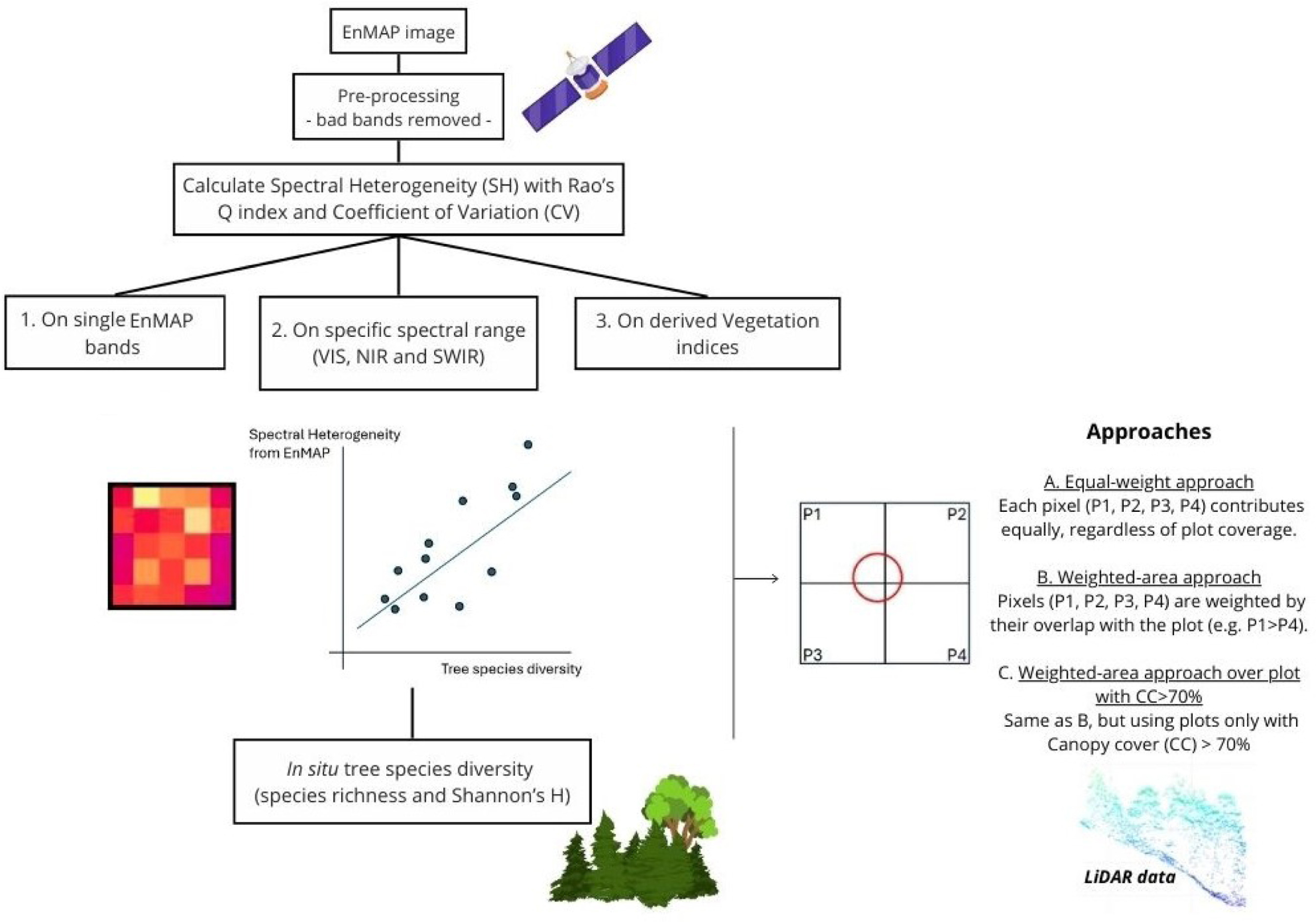
Spectral heterogeneity from the spaceborne imaging spectrometer EnMAP reveals biodiversity patterns in forest ecosystems
Torresani
,
Michele
,
Rossi
,
Christian
,
Mina
,
Marco
,
Menegaldo
,
Irene
,
Cappuccio
,
Matteo
,
Perrone
,
Michela
,
Hakkenberg
,
Christopher R.
,
Rocchini
,
Duccio
,
Puletti
,
Nicola
,
Stendardi
,
Laura
,
Montagnani
,
Leonardo
,
Tognetti
,
Roberto
Mostra abstract
The Spectral Variation Hypothesis (SVH) proposes that spectral heterogeneity (SH), derived from optical data, can serve as a proxy for estimating biodiversity. In this study, we tested the SVH across 42 forest plots in the Italian Alps using imaging spectroscopy data from the EnMAP satellite. We investigated the relationship between SH—quantified using two different metrics, Rao's Q and the coefficient of variation (CV)—and tree species diversity (using Shannon's H index and species richness). We applied three levels of spectral analysis: (1) SH calculated for each individual EnMAP band; (2) SH aggregated across broader spectral ranges (Visible -VIS-, Near Infrared -NIR-, and Shortwave Infrared -SWIR-) and (3) SH derived from vegetation indices (VIs). These analyses were performed under three spatial approaches: (A) a normal approach assigning equal weight to all four EnMAP pixels intersecting a plot; (B) a weighted approach based on the proportional overlap of each pixel with the plot area; and (C) a weighted canopy cover (CC)>70% approach, which included only plots with CC greater than 70% as derived from airborne laser scanning (ALS) LiDAR data. Weak to moderate correlations were observed when SH was derived from single bands, with the strongest relationships in the NIR (R<sup>2</sup> approaching 0.4), followed by the VIS and SWIR regions. A similar trend emerged when SH was aggregated across broader spectral ranges, with the highest correlations again found in the NIR (R<sup>2</sup> up to 0.35). In contrast, lower R<sup>2</sup> values were obtained when SH was computed from specific VIs. The weighted approaches, especially when restricted to plots with CC >70%, consistently yielded higher R<sup>2</sup> values than the equal-weight approach in all three the spectral analysis. Results were consistent across both SH metrics (Rao's Q and CV), with stronger correlations when species richness was used as the biodiversity metric. This work highlights how EnMAP hyperspectral data, despite inherent constraints, can provide valuable insights into forest biodiversity monitoring. © 2025 The Author(s)

Sustainable forest planning: Assessing biodiversity effects of Triad zoning based on empirical data and virtual landscapes
Duflot
,
Rémi
,
Heinrichs
,
Steffi
,
Balducci
,
Lorenzo
,
Chianucci
,
Francesco
,
Hofmeister
,
Jeňýk
,
Paillet
,
Yoan
,
Trentanovi
,
Giovanni
,
Archaux
,
Frédéric
,
Boch
,
Steffen
,
Bouget
,
Christophe
,
Dvořák
,
Daniel
,
Fischer
,
Markus
,
Gosselin
,
Frédéric
,
Gosselin
,
Marion
,
Goßner
,
Martin M.
,
Holá
,
Eva
,
Hošek
,
Jan
,
Jung
,
Kirsten G.
,
Palice
,
Zdeněk
,
Renner
,
Swen C.
,
Weisser
,
Wolfgang W.
,
Nagel
,
Thomas A.
,
Burrascano
,
Sabina
,
Schall
,
Peter
Mostra abstract
The Triad framework seeks to balance the economic and ecological functions in forested landscapes by combining intensively, extensively, and unmanaged areas, assuming a higher support to biodiversity in extensively rather than in intensively managed forests. We quantified the effects of Triad zoning on biodiversity in (sub)montane eutrophic European beech forests. Using a European-wide multitaxon database and a “virtual” landscape approach (i.e., by resampling empirical data), we evaluated how the proportion of Triad management categories affected the landscape-level species diversity of birds, saproxylic beetles, vascular plants, epiphytic bryophytes, lichens, and wood-inhabiting fungi, as well as multitaxonomic diversity. The results varied greatly among taxonomic groups. Multitaxonomic diversity peaked in landscapes composed of 60% unmanaged and 40% intensively managed forests. While intensive management can benefit some taxa through the creation of open habitats, unmanaged forests are the backbone of biodiversity conservation, underlining the need to safeguard the remaining old-growth forests under natural dynamics, and to extend the current area of unmanaged forests in Europe. Extensive forest management, however, did not contribute to biodiversity conservation as expected. As withdrawing such a high proportion of European forest landscapes from management is unfeasible given the increasing demand for timber, efforts are needed to increase the presence of structural features supporting biodiversity into extensively managed forests. © © 2025 the Author(s).
Managed forests are a stronghold of non-native beetles in Europe
Basile
,
Marco
,
Lachat
,
Thibault
,
Balducci
,
Lorenzo
,
Chianucci
,
Francesco
,
Chojnacki
,
Lucas
,
Archaux
,
Frédéric
,
N Avtzis
,
Dimitrios N.
,
Bouget
,
Christophe
,
de Smedt
,
Pallieter
,
Doerfler
,
Inken
,
Dumas
,
Yann
,
Elek
,
Zoltán
,
Gosselin
,
Marion
,
Goßner
,
Martin M.
,
Heilmann-Clausen
,
Jacob
,
Hofmeister
,
Jeňýk
,
Hošek
,
Jan
,
Janssen
,
Philippe
,
Justesen
,
Mathias Just
,
Hansen
,
Aslak Kappel
,
Schmidt
,
Inger Kappel
,
Kepfer-Rojas
,
Sebastian
,
Mårell
,
Anders
,
Matula
,
Radim
,
Müller
,
Jörg C. C.
,
Nordén
,
Björn
,
Ódor
,
Péter
,
Paillet
,
Yoan
,
Ravera
,
Sonia
,
Sitzia
,
Tommaso
,
Tinya
,
Flóra
,
Burrascano
,
Sabina
,
Brockerhoff
,
Eckehard G.
Mostra abstract
The species richness of vascular plants in forests can have contrasting effects on the occurrence of non-native insects. The establishment of non-native insect populations may be facilitated by low plant species richness, which reflects the availability of few but easily accessible resources, or hampered by high plant species richness due to spatial dilution of resources or biotic resistance (i.e., resistance against biological invasions). The relationship between the species richness of plants and non-native insects is likely influenced by disturbance regimes, which, in European forests, mostly consists of timber harvesting. We investigated this relationship considering two major forest attributes: (i) species richness of non-native vascular plants and (ii) forest management. From 1101 forest plots in Europe, we gathered occurrences of 1212 vascular plant species, including 160 non-native species, and of 2404 beetle species, including 29 non-native species. We tested the relationship between the species richness of non-native beetles and plants using non-linear quantile regressions. We disentangled the effect of non-native plant species richness from that of management on the species richness of non-native beetles, while accounting for forest structural variables, using structural equation models. We found clear evidence of a hump-shaped relationship between non-native beetle and plant species richness. The general shape of the relationship persisted when considering only woody or non-woody plants, as well as only non-native plants. The relationship was also similar between managed and unmanaged forests. However, the proportion of non-native beetles in managed forests was higher than in unmanaged forests at the same plant species richness. Management had a direct negative effect on non-native beetle species richness, whereas non-native plant species richness had a direct positive effect. When considering all direct and indirect effects, management facilitated the occurrence of non-native beetles indirectly via non-native plants rather than directly. Synthesis and applications. Species richness of native and non-native vascular plants modulates the species richness of non-native beetles through relationships with opposite signs. The interplay with management regimes and forest structures determines whether non-native beetles are promoted. Forest management aimed at reducing the intensity of disturbance while encouraging native plant species richness could promote the dominance of dilution effects and biotic resistance and could moderate the establishment of non-native insects. © 2025 The Author(s). Journal of Applied Ecology © 2025 British Ecological Society.
Where are we now with European forest multi-taxon biodiversity and where can we head to?
Burrascano
,
Sabina
,
Chianucci
,
Francesco
,
Trentanovi
,
Giovanni
,
Kepfer-Rojas
,
Sebastian
,
Sitzia
,
Tommaso
,
Tinya
,
Flóra
,
Doerfler
,
Inken
,
Paillet
,
Yoan
,
Nagel
,
Thomas A.
,
Mitić
,
Božena
,
Morillas
,
Lourdes
,
Munzi
,
Silvana
,
Van Der Sluis
,
Theo
,
Alterio
,
Edoardo
,
Balducci
,
Lorenzo
,
de Andrade
,
Rafael Barreto
,
Bouget
,
Christophe
,
Giordani
,
P.
,
Lachat
,
Thibault
,
Matošević
,
Dinka
,
Napoleone
,
Francesca
,
Nascimbene
,
Juri
,
Paniccia
,
Chiara
,
Roth
,
Nicolas
,
Aszalós
,
Réka
,
Brazaitis
,
Gediminas
,
Cutini
,
Andrea
,
D'Andrea
,
Ettore
,
de Smedt
,
Pallieter
,
Heilmann-Clausen
,
Jacob
,
Janssen
,
Philippe
,
Kozák
,
Daniel
,
Mårell
,
Anders
,
Mikoláš
,
Martin
,
Nordén
,
Björn
,
Matula
,
Radim
,
Schall
,
Peter
,
Svoboda
,
Miroslav
,
Ujházyová
,
Mariana
,
Vandekerkhove
,
Kris
,
Wohlwend
,
Michael Rudolf
,
Xystrakis
,
Fotios
,
Aleffi
,
Michele
,
Ammer
,
Christian
,
Archaux
,
Frédéric
,
Asbeck
,
Thomas
,
N Avtzis
,
Dimitrios N.
,
Ayasse
,
Manfred
,
Bagella
,
Simonetta
,
Balestrieri
,
Rosario
,
Barbati
,
Anna
,
Basile
,
Marco
,
Bergamini
,
Ariel
,
Bertini
,
Giada
,
Biscaccianti
,
Alessandro Bruno
,
Boch
,
Steffen
,
Bölöni
,
János
,
Bombi
,
Pierluigi
,
Boscardin
,
Yves
,
Brunialti
,
Giorgio
,
Bruun
,
Hans Henrik
,
Buscot
,
François
,
Byriel
,
David Bille
,
Campagnaro
,
Thomas
,
Campanaro
,
Alessandro
,
Chauvat
,
Matthieu
,
Ciach
,
Michał
,
Čiliak
,
Marek
,
Cistrone
,
Luca
,
Pereira
,
Joaò Manuel Cordeiro
,
Daniel
,
Rolf
,
de Cinti
,
Bruno
,
de Filippo
,
Gabriele
,
Dekoninck
,
Wouter
,
Di Salvatore
,
Umberto
,
Dumas
,
Yann
,
Elek
,
Zoltán
,
Ferretti
,
Fabrizio
,
Fotakis
,
Dimitrios G.
,
Frank
,
Tamás
,
Frey
,
Julian
,
Giancola
,
Carmen
,
Gömöryová
,
Erika
,
Gosselin
,
Marion
,
Gosselin
,
Frédéric
,
Goßner
,
Martin M.
,
Götmark
,
Frank
,
Haeler
,
Elena
,
Hansen
,
Aslak Kappel
,
Hertzog
,
Lionel R.
,
Hofmeister
,
Jeňýk
,
Hošek
,
Jan
,
Johannsen
,
Vivian Kvist
,
Justensen
,
Mathias Just
,
Korboulewsky
,
Nathalie
,
Kovács
,
Bence
,
Lakatos
,
Ferenc
,
Landivar
,
Carlos Miguel
,
Lens
,
Luc
,
Lingua
,
Emanuele
forest biodiversity
biodiversity conservation
forest stand structure
multi-taxon
sustainable management
Mostra abstract
The European biodiversity and forest strategies rely on forest sustainable management (SFM) to conserve forest biodiversity. However, current sustainability assessments hardly account for direct biodiversity indicators. We focused on forest multi-taxon biodiversity to: i) gather and map the existing information; ii) identify knowledge and research gaps; iii) discuss its research potential. We established a research network to fit data on species, standing trees, lying deadwood and sampling unit description from 34 local datasets across 3591 sampling units. A total of 8724 species were represented, with the share of common and rare species varying across taxonomic classes: some included many species with several rare ones (e.g., Insecta); others (e.g., Bryopsida) were represented by few common species. Tree-related structural attributes were sampled in a subset of sampling units (2889; 2356; 2309 and 1388 respectively for diameter, height, deadwood and microhabitats). Overall, multi-taxon studies are biased towards mature forests and may underrepresent the species related to other developmental phases. European forest compositional categories were all represented, but beech forests were over-represented as compared to thermophilous and boreal forests. Most sampling units (94%) were referred to a habitat type of conservation concern. Existing information may support European conservation and SFM strategies in: (i) methodological harmonization and coordinated monitoring; (ii) definition and testing of SFM indicators and thresholds; (iii) data-driven assessment of the effects of environmental and management drivers on multi-taxon forest biological and functional diversity, (iv) multi-scale forest monitoring integrating in-situ and remotely sensed information. © 2023 The Authors
Masting is uncommon in trees that depend on mutualist dispersers in the context of global climate and fertility gradients
Qiu
,
Tong
,
Aravena Acuña
,
Marie Claire
,
Ascoli
,
Davide
,
Bergeron
,
Yves
,
Bogdziewicz
,
Michał
,
Boivin
,
Thomas
,
Bonal
,
Raúl
,
Caignard
,
Thomas
,
Cailleret
,
Maxime
,
Calama
,
Rafael A.
,
Calderon
,
Sergio Donoso
,
Camarero
,
Jesús Julio
,
Chang-Yang
,
Chia Hao
,
Chave
,
Jérôme
,
Chianucci
,
Francesco
,
Courbaud
,
Benoít
,
Cutini
,
Andrea
,
Das
,
Adrian J.
,
Delpierre
,
Nicolas
,
Delzon
,
Sylvain
,
Dietze
,
Michael C.
,
Dormont
,
Laurent
,
Espelta
,
Josep Maria
,
Fahey
,
Timothy J.
,
Farfan-Rios
,
William R.
,
Franklin
,
Jerry F.
,
Gehring
,
Catherine A.
,
Gilbert
,
Gregory S.
,
Gratzer
,
Georg
,
Greenberg
,
Cathryn H.
,
Guignabert
,
Arthur
,
Guo
,
Qinfeng
,
Hacket-Pain
,
Andrew J.
,
Hampe
,
Arndt
,
Han
,
Qingmin
,
Holik
,
Jan
,
Hoshizaki
,
K.
,
Ibáñez
,
Inés
,
Johnstone
,
Jill F.
,
Journé
,
Valentin
,
Kitzberger
,
Thomas A.
,
Knops
,
Johannes Michael Hubertus
,
Kunstler
,
Georges
,
Kurokawa
,
Hiroko
,
Lageard
,
Jonathan G.A.
,
LaMontagne
,
Jalene M.
,
Lefèvre
,
François
,
Leininger
,
Theodor D.
,
Limousin
,
Jean Marc
,
Lutz
,
James A.
,
Macias
,
Diana S.
,
Mårell
,
Anders
,
McIntire
,
Eliot J.B.
,
Moore
,
Christopher M.
,
Moran
,
Emily V.
,
Motta
,
Renzo
,
Myers
,
Jonathan A.
,
Nagel
,
Thomas A.
,
Naoe
,
Shoji
,
Noguchi
,
Mahoko
,
Oguro
,
Michio
,
Parmenter
,
Robert R.
,
Pearse
,
Ian S.
,
Pérez-Ramos
,
Ignacio M.
,
Piechnik
,
Łukasz
,
Podgórski
,
Tomasz
,
Poulsen
,
John R.
,
Redmond
,
Miranda D.
,
Reid
,
Chantal D.
,
Rodman
,
Kyle C.
,
Rodríguez-Sánchez
,
Francisco
,
Šamonil
,
Pavel
,
Sanguinetti
,
Javier D.
,
Scher
,
C. Lane
,
Seget
,
Barbara
,
Sharma
,
Shubhi
,
Shibata
,
Mitsue
,
Silman
,
Miles R.
,
Steele
,
Michael A.
,
Stephenson
,
Nathan L.
,
Straub
,
Jacob N.
,
Sutton
,
Samantha
,
Swenson
,
Jennifer J.
,
Swift
,
Margaret
,
Thomas
,
Peter A.
,
Uríarte
,
María
,
Vacchiano
,
Giorgio
,
Whipple
,
Amy Vaughn
,
Whitham
,
Thomas G.
,
Wion
,
Andreas P.
,
Wright
,
Stuart Joseph
,
Zhu
,
Kai
,
Zimmerman
,
Jess K.
,
Żywiec
,
Magdalena
,
Clark
,
James S.
Mostra abstract
The benefits of masting (volatile, quasi-synchronous seed production at lagged intervals) include satiation of seed predators, but these benefits come with a cost to mutualist pollen and seed dispersers. If the evolution of masting represents a balance between these benefits and costs, we expect mast avoidance in species that are heavily reliant on mutualist dispersers. These effects play out in the context of variable climate and site fertility among species that vary widely in nutrient demand. Meta-analyses of published data have focused on variation at the population scale, thus omitting periodicity within trees and synchronicity between trees. From raw data on 12 million tree-years worldwide, we quantified three components of masting that have not previously been analysed together: (i) volatility, defined as the frequency-weighted year-to-year variation; (ii) periodicity, representing the lag between high-seed years; and (iii) synchronicity, indicating the tree-to-tree correlation. Results show that mast avoidance (low volatility and low synchronicity) by species dependent on mutualist dispersers explains more variation than any other effect. Nutrient-demanding species have low volatility, and species that are most common on nutrient-rich and warm/wet sites exhibit short periods. The prevalence of masting in cold/dry sites coincides with climatic conditions where dependence on vertebrate dispersers is less common than in the wet tropics. Mutualist dispersers neutralize the benefits of masting for predator satiation, further balancing the effects of climate, site fertility and nutrient demands. © 2023, The Author(s), under exclusive licence to Springer Nature Limited.