
Loading...
Pubblicazioni Scientifiche
Filtri di ricerca 9 risultati
Pubblicazioni per anno
Forest structure and understory functional diversity at multiple scales: The importance of median tree height
de Benedictis
,
Luciano Ludovico Maria
,
Chelli
,
Stefano
,
Zhu
,
Zhengxue
,
Cervellini
,
Marco
,
Canullo
,
R.
,
Chianucci
,
Francesco
,
Puletti
,
Nicola
,
Tsakalos
,
James L.
,
Bartha
,
Sándor
,
Campetella
,
Giandiego

Multiple drivers of functional diversity in temperate forest understories: Climate, soil, and forest structure effects
Chelli
,
Stefano
,
Bricca
,
Alessandro
,
Tsakalos
,
James L.
,
Andreetta
,
Anna
,
Bonari
,
Gianmaria
,
Campetella
,
Giandiego
,
Carnicelli
,
Stefano
,
Cervellini
,
Marco
,
Puletti
,
Nicola
,
Wellstein
,
Camilla
,
Canullo
,
R.
climate change
functional diversity
bud bank
forest management
plant height
seed mass
specific leaf area
Mostra abstract
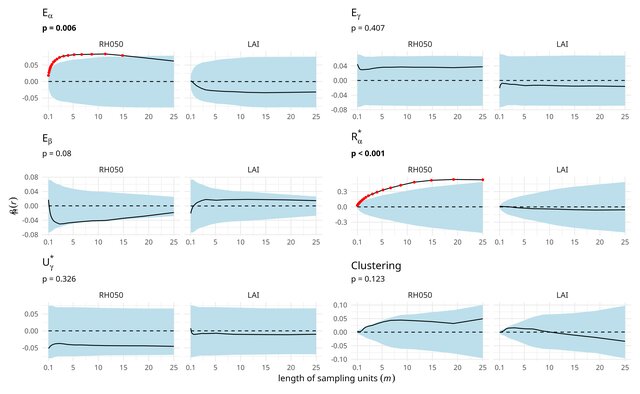
In macroecology, shifting from coarse- to local-scale explanatory factors is crucial for understanding how global change impacts functional diversity (FD). Plants possess diverse traits allowing them to differentially respond across a spectrum of environmental conditions. We aim to assess how macro- to microclimate, stand-scale measured soil properties, forest structure, and management type, influence forest understorey FD at the macroecological scale. Our study covers Italian forests, using thirteen predictors categorized into climate, soil, forest structure, and management. We analyzed five traits (i.e., specific leaf area, plant size, seed mass, belowground bud bank size, and clonal lateral spread) capturing independent functional dimensions to calculate the standardized effect size of functional diversity (SES-FD) for all traits (multi-trait) and for single traits. Multiple regression models were applied to assess the effect of predictors on SES-FD. We revealed that climate, soil, and forest structure significantly drive SES-FD of specific leaf area, plant size, seed mass, and bud bank. Forest management had a limited effect. However, differences emerged between herbaceous and woody growth forms of the understorey layer, with herbaceous species mainly responding to climate and soil features, while woody species were mainly affected by forest structure. Future warmer and more seasonal climate could reduce the diversity of resource economics, plant size, and persistence strategies of the forest understorey. Soil eutrophication and acidification may impact the diversity of regeneration strategies; canopy closure affects the diversity of above- and belowground traits, with a larger effect on woody species. Multifunctional approaches are vital to disentangle the effect of global changes on functional diversity since independent functional specialization axes are modulated by different drivers. © 2024 The Authors
Plant functional traits are correlated with species persistence in the herb layer of old-growth beech forests
Campetella
,
Giandiego
,
Chelli
,
Stefano
,
Simonetti
,
Enrico
,
Damiani
,
Claudia
,
Bartha
,
Sándor
,
Wellstein
,
Camilla
,
Giorgini
,
Daniele
,
Puletti
,
Nicola
,
Mucina
,
Ladislav
,
Cervellini
,
Marco
,
Canullo
,
R.
beech
forest
genetics
plant leaf
plant seed
quantitative trait
fagus
forests
plant leaves
heritable
seeds
Mostra abstract
This paper explores which traits are correlated with fine-scale (0.25 m<sup>2</sup>) species persistence patterns in the herb layer of old-growth forests. Four old-growth beech forests representing different climatic contexts (presence or absence of summer drought period) were selected along a north–south gradient in Italy. Eight surveys were conducted in each of the sites during the period spanning 1999–2011. We found that fine-scale species persistence was correlated with different sets of plant functional traits, depending on local ecological context. Seed mass was found to be as important for the fine-scale species persistence in the northern sites, while clonal and bud-bank traits were markedly correlated with the southern sites characterised by summer drought. Leaf traits appeared to correlate with species persistence in the drier and wetter sites. However, we found that different attributes, i.e. helomorphic vs scleromorphic leaves, were correlated to species persistence in the northernmost and southernmost sites, respectively. These differences appear to be dependent on local trait adaptation rather than plant phylogenetic history. Our findings suggest that the persistent species in the old-growth forests might adopt an acquisitive resource-use strategy (i.e. helomorphic leaves with high SLA) with higher seed mass in sites without summer drought, while under water-stressed conditions persistent species have a conservative resource-use strategy (i.e. scleromorphic leaves with low SLA) with an increased importance of clonal and resprouting ability. © 2020, The Author(s).
Effects of climate, soil, forest structure and land use on the functional composition of the understorey in Italian forests
Chelli
,
Stefano
,
Simonetti
,
Enrico
,
Wellstein
,
Camilla
,
Campetella
,
Giandiego
,
Carnicelli
,
Stefano
,
Andreetta
,
Anna
,
Giorgini
,
Daniele
,
Puletti
,
Nicola
,
Bartha
,
Sándor
,
Canullo
,
R.
plant height
seed mass
specific leaf area
climate–soil interactions
community-weighted mean
functional biogeography
temperature seasonality
trait–environment relationship
Mostra abstract
Question: In functional biogeography studies, generalizable patterns in the relationship between plant traits and the environment have yet to emerge. Local drivers (i.e., soil, land use, vegetation structure) can increase our understanding of the trait–environment relationship. What is the role of climate and local drivers in shaping abundance-weighted trait patterns of forest understories at biogeographic scales?. Location: Italian forests. Methods: We selected 201 sites that are statistically representative for the heterogeneity of Italian forests across three biogeographic regions (alpine, continental, and mediterranean). Understorey vegetation was recorded for each site on an area of 400 m<sup>2</sup>, together with 25 environmental variables related to climate, soil, land use and forest structure. Specific leaf area (SLA), plant height (H) and seed mass (SM) were obtained from databases. Community-weighted mean (CWM) values were calculated. Variance partitioning was used to identify the relative role of groups of environmental variables on the CWM of traits. Generalized Additive Models were used to assess the relationship between traits and single variables. Results: Climate alone and climate–soil interactions explained the largest proportion of the variation of all the traits (13.7% to 22.8%). Temperature-related factors as well as soil N and P availability were the climatic and edaphic explanatory variables most correlated to trait variation. Forest structure and land use accounted for a smaller percentage of the variation in traits. Land-use factors alone were important in explaining only SLA variation. Conclusions: While climate plays a major role in trait–environment relationships in forest understories, our results highlighted the need to integrate at least soil properties as local drivers of trait variation in broad scale functional biogeography studies of these systems. © 2019 International Association for Vegetation Science
Climate is the main driver of clonal and bud bank traits in Italian forest understories
Chelli
,
Stefano
,
Ottaviani
,
Gianluigi
,
Simonetti
,
Enrico
,
Wellstein
,
Camilla
,
Canullo
,
R.
,
Carnicelli
,
Stefano
,
Andreetta
,
Anna
,
Puletti
,
Nicola
,
Bartha
,
Sándor
,
Cervellini
,
Marco
,
Campetella
,
Giandiego
clonality
community weighted mean (cwm)
plant-environment linkages
resprouting
soil properties
trait-based ecology
Mostra abstract
The study of plant trait-environment links is rarely focused on traits that inform on space occupancy and resprouting (both affecting plant persistence), especially in forest understories. Traits that can effectively capture such key functions are associated with clonality and bud banks. We hypothesized that: 1) climate is the main driver of clonal and bud bank traits, 2) traits related to space occupancy (e.g., greater lateral spread) are more important in more mesic, richer soils forests, and 3) traits related to resprouting ability (e.g., larger bud bank) are more important in more intensively and recently managed forests. We addressed these hypotheses by analysing a unique dataset that is statistically representative of Italian forests heterogeneity and includes three biogeographic regions (Alpine, Continental, Mediterranean). We recorded data for sixteen climatic, soil and management variables. We calculated community weighted mean (CWM) values of seven clonal and bud bank traits for the forest understory vegetation. We used i) redundancy analysis to assess trait-environment relations, and ii) variance partitioning analyses to identifying the relative role of different groups of abiotic variables on CWM variation of all traits combined together, as well as clonal and bud bank traits taken separately. Climate alone had a pervasive effect in determining patterns of clonal and bud bank traits in Italian forest understories, mainly related to the effects of temperature extremes and seasonality. Unexpectedly, soil and management factors alone showed marginal effects on clonal and bud bank traits. However, soil features influenced trait patterns when joined with climate. Our results confirmed that, at the biogeographic scale, climate played a lion-share role in determining persistence-related traits of forest-floor plants. At the local-scale, other interplaying factors (e.g., management, soil variables) may come into play in shaping patterns of the studied plant traits. This study stressed the importance of examining functional trait patterns along complex environmental gradients. © 2019 Elsevier GmbH
A plot-level exploratory analysis of European forest based on the results from the BioSoil Forest Biodiversity project
Galluzzi
,
Marta
,
Giannetti
,
Francesca
,
Puletti
,
Nicola
,
Canullo
,
R.
,
Rocchini
,
Duccio
,
Bastrup-Birk
,
Annemarie M.
,
Chirici
,
Gherardo
Mostra abstract
The lack of multi-dimensional data is one of the major gaps which limit the knowledge and the assessment possibilities of European forests. Nowadays, the most extensive and complete data on the European forest statuses are given by National Forest Inventories (NFIs) which provide information about the extent of forest’s resources and their composition and structure. Traditionally, NFIs collect data related to trees, with a limited consideration of other habitat components, such as ground vegetation. This information which goes beyond the mere arboreal component is instead essential for a more complete forest biodiversity assessment. This paper is aimed at introducing the ICP Forests LI-BioDiv database which resulted from BioSoil Forest Biodiversity, a large collaborative European project. This database is organized as a multi-dimensional forest geodatabase that contains forest structure and vegetation records collected in 19 European countries in the period of 2005–2008. The data were acquired from 3311 geocoded plots where several different types of data were gathered: stand-level general information, tree-level data, deadwood, canopy closure and floristic composition. This paper is structured in order to: (1) give a clear overview of the raw data available in the database and to (2) present an elaboration of raw data to calculate simple plot-level forest variables (biomass, deadwood volume, alpha diversity). On the basis of the results we achieved, the LI-BioDiv database appears useful mainly for research purposes aimed at studying cross-relationships between multiple forest variables and not for an operative use for monitoring and assessing European forest. In particular, we hope that this contribution can stimulate scientists to carry out cross-analysis of the database for defining future forest biodiversity indicators that could be introduced into the field protocols of the NFIs in Europe. © 2019, Springer-Verlag GmbH Germany, part of Springer Nature.
A dataset of forest volume deadwood estimates for Europe
Puletti
,
Nicola
,
Canullo
,
R.
,
Mattioli
,
Walter
,
Gawryś
,
Radosław
,
Corona
,
P.
,
Czerepko
,
Janusz
deadwood decay classes
european forest types
icp forests monitoring programme
stand age
stand management
Mostra abstract
Key message: ICP Forests relies on a representative pan-European network based on a 16 × 16 km grid-net covering around 6000 plots. Dead wood volumes for 3243 plots, related to 19 European Countries, are presented in this data paper as a result of harmonised sampling procedure, and under compliance with FAIR Data Principles. Dataset access is at https://zenodo.org/record/1467784. Associated metadata are available athttps://metadata-afs.nancy.inra.fr/geonetwork/srv/fre/catalog.search#/metadata/a27d2a8f-1a2d-4a1c-b932-86ec5f4bd8a6(link to geo-network provided after acceptance). Context: ICP-Forests dataset represents unique opportunity for the assessment of forest resources sustainability and biodiversity in Europe because it monitors the status of forests under a coordinated Pan-European umbrella by standardised methods. Aims: The main goal of this paper is to provide standardized estimates of deadwood volume at European scale for a broader use among forest scientists. Methods: After quality checks, calculations of deadwood volumes distinguished by deadwood types (standing and lying dead trees, snags, coarse woody debris, stumps) have been performed. The obtained plot level data have been joined to available forest stand information (namely: forest type, forest management, and stand age) over 3,243 plots among Europe. Results: The database provides a basis for the evaluation of combined relationships between deadwood volume and forest type, deadwood type, decay status, forest management, and stand age classes at European level. Conclusion: Deadwood volume and quality is recognized as one of the most important source of information for forest biodiversity. Here, first results of a systematic and standardized European survey scheme for assessing deadwood volume are presented. This ICP Forests datasets analysis represents the base for further analysis and relationships. © 2019, INRA and Springer-Verlag France SAS, part of Springer Nature.
Deadwood distribution in European forests
Mostra abstract
National forest inventories are a primary source of data for the assessment of forest resources and lastly more often biodiversity at national scales. The diversity of adopted sampling designs and measurements reduces the prospect for a reliable comparison of generated estimates. The ICP Forest dataset represents a unique opportunity for a standardized approach of forest estimates through Europe. This work aims to provide a distribution map of the mean deadwood volume in European forest. A total of 3243 ICP Forests plots were analysed and presented. The study area extends over 3,664,576 km<sup>2</sup> interesting 19 countries. We observed that the highest percentage of plots show a deadwood volume lower than 50 m<sup>3</sup> ha<sup>-1</sup>, with a few of forests attaining around the maximum of 300 m<sup>3</sup> ha<sup>-1</sup>. Forests with more than 100 m<sup>3</sup> ha<sup>-1</sup> are concentrated in mountainous regions, central Europe and other regions, linked to high-forest management types, while coppices-derived forest systems (part of the Great Britain, Mediterranean region) show lower deadwood content. The map of deadwood volume on European Forests is of interests for scientists, land planners, forest managers and decision-makers, as a reference for further evaluation of changes, stratified sampling, ground reference for model validation, restoration and conservation purposes. © 2017 The Author(s).
Reproductive phenology and conception synchrony in a natural wild boar population
Canu
,
Antonio
,
Scandura
,
Massimo
,
Merli
,
Enrico
,
Chirichella
,
Roberta
,
Bottero
,
Elisa
,
Chianucci
,
Francesco
,
Cutini
,
Andrea
,
Apollonio
,
Marco
Mostra abstract
Reproductive synchrony among gregarious mammals has a strong adaptive value and may lead to cooperative behaviors aimed at maximizing offspring survival. Additionally, temporal clustering of estrus has important implications on individual mating tactics and ultimately affects the degree of polygamy in a population. Although several studies have examined the reproductive biology of wild boar (Sus scrofa), much remains to be understood about the patterns of timing and synchrony of reproduction in natural populations. We analyzed the spatiotemporal distribution of conception dates in an Italian wild boar population taking into account the effects of environmental and individual factors, in order to determine the main variables influencing the timing of reproduction and to detect the signs of a socially-driven reproductive synchrony. Specifically, for each litter belonging to 354 pregnant sows culled between 2006 and 2013 in a mountain area of Tuscany, we determined the conception date (CD) from an estimate of the mean fetal age and the culling date. We then investigated which factors drove the variation in CD, by implementing linear mixed models, Mantel tests and spatial autocorrelation analyses. The selected model showed significant effects of rainfall, temperatures, and previous and current productivity on CD, as well as a strong correlation of CDs among sows culled in close spatial and temporal proximity (i.e., in the same hunting ground and hunting season). Likewise, autocorrelation analyses and Mantel tests consistently indicated that closer sows had similar conception dates. Overall, our results confirm the effect of resource availability and climate on wild boar reproductive phenology, and suggest socially-driven reproductive patterns, in spite of a high turn-over in social groups due to hunting. Finally, possible advantages and evolutionary implications of reproductive synchrony in wild boar are discussed. © 2015 Associazione Teriologica Italiana.