
Loading...
Pubblicazioni Scientifiche
Filtri di ricerca 23 risultati
Pubblicazioni per anno
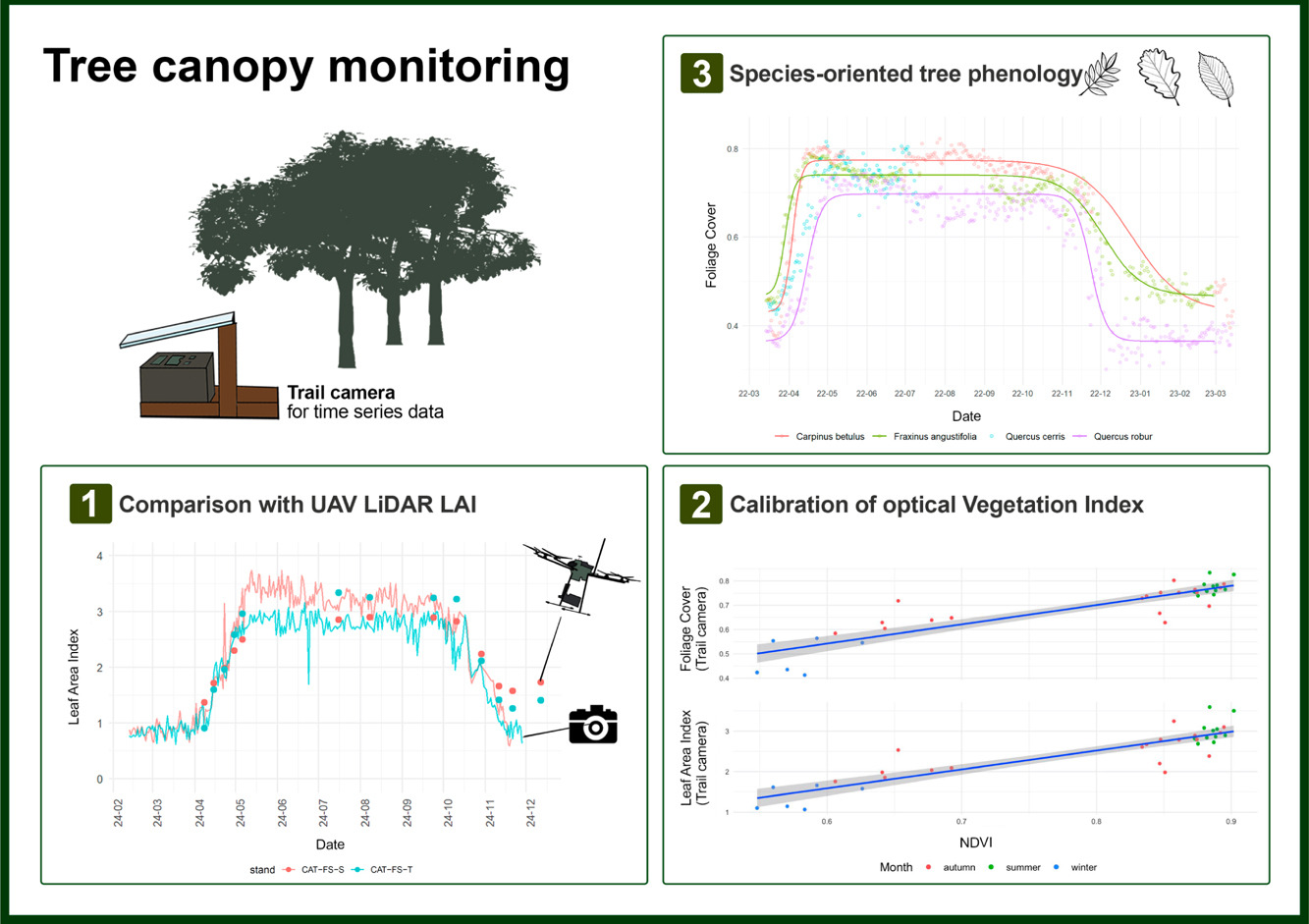
CrowNet: a trail-camera canopy monitoring system
Chianucci
,
Francesco
,
Lenzi
,
Alice
,
Minari
,
Emma
,
Guasti
,
Matteo
,
Gisondi
,
Silvia
,
Gonnelli
,
Marco
,
Innocenti
,
Simone
,
Ferrara
,
Carlotta
,
Campanaro
,
Alessandro
,
Ciampelli
,
Paola
,
Cutini
,
Andrea
,
Puletti
,
Nicola
Mostra abstract
Continuous monitoring of forest canopy structure and phenology is pivotal for the assessment of ecosystem responses to environmental variability and changes. The present study evaluated the use of repeat digital trail cameras as a low-cost, flexible, and accessible in situ monitoring solution for quantifying daily canopy attributes, including effective leaf area index (Le) and canopy cover. A trial camera monitoring network (CrowNet) was established encompassing 20 forest stands in Italy, under different management and environmental conditions, resulting in over 44,000 daily images collected over three years. We demonstrated that taking the mean daily canopy attribute allowed to obtain smooth time series from trail cameras, from which phenological transition dates can be inferred. Daily canopy attributes were validated against manual digital cover photography measurement. To further explore the applicability of this monitoring solution, we performed a comparison between daily Le time series derived from a subset of trail cameras located in beech forests and data collected by multitemporal UAV LiDAR. Results demonstrated the close agreement between the two methods across the entire phenological period (start and end of season). We also illustrated use of continuous trail camera estimates to calibrate a vegetation index (NDVI) to infer leaf area and canopy cover from optical multi-temporal UAV data. We further investigated use of trail camera to detect species-specific differences in tree phenology from time series acquired in a mixed oak-hornbeam forest. We found different canopy structure and phenological transition dates in three broadleaved species (oak, ash, hornbeam), supporting the effectiveness of trail cameras for species-oriented phenology monitoring. We conclude that trail cameras provide a reliable solution for daily canopy monitoring, offering a significant cost-effective and flexible alternative to traditional field methods and providing potential to calibrate, validate or integrate remotely-sensed information. However, camera failures during adverse weather, and the need for more efficient image data quality checking procedures, still represent open challenges. Future improvements, such as weatherproof housing and automated pre-processing screening procedures, are therefore recommended for making trail camera fully operational in ground canopy and phenology monitoring. © 2025 Elsevier B.V.

Benchmarking tree species classification from proximally sensed laser scanning data: Introducing the FOR-species20K dataset
Puliti
,
Stefano
,
Lines
,
Emily R.
,
Müllerová
,
Jana
,
Frey
,
Julian
,
Schindler
,
Zoe
,
Straker
,
Adrian
,
Allen
,
Matthew J.
,
Winiwarter
,
Lukas
,
Rehush
,
Nataliia
,
Hristova
,
Hristina S.
,
Murray
,
Brent A.
,
Calders
,
Kim
,
Coops
,
Nicholas C.
,
Höfle
,
Bernhard
,
Irwin
,
Liam A.K.
,
Junttila
,
Samuli
,
Kruček
,
Martin
,
Krok
,
G.
,
Král
,
Kamil
,
Levick
,
Shaun R.
,
Lück
,
Linda
,
Missarov
,
Azim
,
Mokroš
,
M.
,
Owen
,
Harry Jon Foord
,
Stereńczak
,
Krzysztof Jan
,
Pitkänen
,
Timo P.
,
Puletti
,
Nicola
,
Saarinen
,
Ninni
,
Hopkinson
,
Chris Dennis
,
Terryn
,
Louise
,
Torresan
,
C.
,
Tomelleri
,
Enrico
,
Weiser
,
Hannah
,
Astrup
,
Rasmus
Mostra abstract
Proximally sensed laser scanning presents new opportunities for automated forest ecosystem data capture. However, a gap remains in deriving ecologically pertinent information, such as tree species, without additional ground data. Artificial intelligence approaches, particularly deep learning (DL), have shown promise towards automation. Progress has been limited by the lack of large, diverse, and, most importantly, openly available labelled single-tree point cloud datasets. This has hindered both (1) the robustness of the DL models across varying data types (platforms and sensors) and (2) the ability to effectively track progress, thereby slowing the convergence towards best practice for species classification. To address the above limitations, we compiled the FOR-species20K benchmark dataset, consisting of individual tree point clouds captured using proximally sensed laser scanning data from terrestrial (TLS), mobile (MLS) and drone laser scanning (ULS). Compiled collaboratively, the dataset includes data collected in forests mainly across Europe, covering Mediterranean, temperate and boreal biogeographic regions. It includes scattered tree data from other continents, totaling over 20,000 trees of 33 species and covering a wide range of tree sizes and forms. Alongside the release of FOR-species20K, we benchmarked seven leading DL models for individual tree species classification, including both point cloud (PointNet++, MinkNet, MLP-Mixer, DGCNNs) and multi-view 2D-based methods (SimpleView, DetailView, YOLOv5). 2D Image-based models had, on average, higher overall accuracy (0.77) than 3D point cloud-based models (0.72). Notably, the performance was consistently >0.8 across scanning platforms and sensors, offering versatility in deployment. The top-scoring model, DetailView, demonstrated robustness to training data imbalances and effectively generalized across tree sizes. The FOR-species20K dataset represents an important asset for developing and benchmarking DL models for individual tree species classification using proximally sensed laser scanning data. As such, it serves as a crucial foundation for future efforts to classify accurately and map tree species at various scales using laser scanning technology, as it provides the complete code base, dataset, and an initial baseline representative of the current state-of-the-art of point cloud tree species classification methods. © 2025 The Author(s). Methods in Ecology and Evolution published by John Wiley & Sons Ltd on behalf of British Ecological Society.
An intensity, image-based method to estimate gap fraction, canopy openness and effective leaf area index from phase-shift terrestrial laser scanning
Grotti
,
Mirko
,
Calders
,
Kim
,
Origo
,
Niall
,
Puletti
,
Nicola
,
Alivernini
,
Alessandro
,
Ferrara
,
Carlotta
,
Chianucci
,
Francesco
Mostra abstract
Accurate in situ estimates of leaf area index (LAI) are essential for a wide range of ecological studies and applications. Due to the destructiveness and impracticality of direct measurements, indirect optical methods have mostly been used in the field to derive estimates of LAI from gap fraction measurements. Terrestrial laser scanning (TLS) is strongly supporting use of this active technology, which possesses several advantages compared to passive sensors. However, edge effects and partial beam interceptions are significantly challenges for the accurate retrieval of gap fraction from 3D point cloud data available from TLS, particularly in phase-shift instruments, which in turns require point cloud filtering to correct erroneous point measurements. As the limitations above influences the point cloud, we proposed a new method which is based only on the laser return intensity (LRI) information derived from raw TLS data, which are used to generate 2D intensity images. The intensity image contains all the unfiltered LRI information captured by TLS, which is used to separate gap from non-gap pixels, using a procedure comparable to the standard image analysis processing of digital hemispherical images. This allows a theoretically consistent comparison between active and passive optical measurements of gap fraction across all the zenith angle range. The method was tested in real and simulated forests. Gap fraction, canopy openness and effective leaf area index derived from real and simulated intensity TLS images were compared with those obtained using digital hemispherical photography (DHP). Results indicated that the intensity, image-based method outperformed DHP, as the higher pixel resolution of the intensity images and the larger distance covered by TLS allowed detection of many small canopy elements, particularly at higher zenith angles (longer optical distance), which are not detected in DHP. The main findings support the reliability of the intensity, image-based method to standardize protocols for TLS phase-shift scan data processing and use of the produced canopy estimates as a benchmark for passive optical measurements. © 2019 Elsevier B.V.
Integrating terrestrial and airborne laser scanning for the assessment of single-tree attributes in Mediterranean forest stands
Giannetti
,
Francesca
,
Puletti
,
Nicola
,
Quatrini
,
Valerio
,
Travaglini
,
Davide
,
Bottalico
,
Francesca
,
Corona
,
P.
,
Chirici
,
Gherardo
Mostra abstract
The development of laser scanning technologies has gradually modified methods for forest mensuration and inventory. The main objective of this study is to assess the potential of integrating ALS and TLS data in a complex mixed Mediterranean forest for assessing a set of five single-tree attributes: tree position (TP), stem diameter at breast height (DBH), tree height (TH), crown base height (CBH) and crown projection area radii (CPAR). Four different point clouds were used: from ZEB1, a hand-held mobile laser scanner (HMLS), and from FARO® FOCUS 3D, a static terrestrial laser scanner (TLS), both alone or in combination with ALS. The precision of single-tree predictions, in terms of bias and root mean square error, was evaluated against data recorded manually in the field with traditional instruments. We found that: (i) TLS and HMLS have excellent comparable performances for the estimation of TP, DBH and CPAR; (ii) TH was correctly assessed by TLS, while the accuracy by HMLS was lower; (iii) CBH was the most difficult attribute to be reliably assessed and (iv) the integration with ALS increased the performance of the assessment of TH and CPAR with both HMLS and TLS. © 2018, © 2018 The Author(s). Published by Informa UK Limited, trading as Taylor & Francis Group.
Quantifying the effect of sampling plot size on the estimation of structural indicators in old-growth forest stands
Lombardi
,
Fabio
,
Marchetti
,
Marco
,
Corona
,
P.
,
Merlini
,
Paolo
,
Chirici
,
Gherardo
,
Tognetti
,
Roberto
,
Burrascano
,
Sabina
,
Alivernini
,
Alessandro
,
Puletti
,
Nicola
Mostra abstract
There is increasing awareness that structure-based indicators should be considered for assessing the biological value of late successional forests. In order to increase the unique habitat features critical for old-growth associated species, it is important to identify and rank candidate potential forest sites on the basis of their distinctive structural features. Data on living and deadwood components for the identification of old-growth condition are usually acquired in the considered forest stands by two sampling survey: (i) census performed in relatively large monitoring sites; (ii) network of small sampling units, on which inventory practices are usually based. Several authors argued that choosing between these survey strategies might have substantial effects on the values of common indicators of old-growth condition. Our study aims at (i) assessing the total estimate differences among old-growth structural indicators measured in field plots with different sizes, and (ii) defining the optimal sample size for the reliable assessment of such indicators. The study was carried out in six beech dominated forest stands on the Apennines range in Italy. In each stand, living and deadwood components were surveyed and geocoded in 1-ha square areas. Based on these dataset, circular plots with radii ranging from 4m up to 20m were then considered in order to quantify the effect of sampling plot size on the estimation of four structural indicators: (1) number of living trees; (2) number of large trees (dbh≥50cm); (3) total deadwood volume; (4) number of deadwood elements (snags, dead standing trees; lying dead trees, lying deadwood) with dbh (or average diameter for lying deadwood) ≥ 30cm. We found that the size of the sampling plots should be at least 500 m<sup>2</sup> in order to establish a database for the assessment of the investigated indicators. The census approach should be preferred to the sampling plot approach for old-growth forest stands smaller than 3-5ha. The achieved results contribute to define assessment protocols for characterizing and ranking the degree to which forest stands approximate old-growth condition based on standardized indicators. © 2015 Elsevier B.V.
Mapped tree dataset of public green areas in the Municipality of Arezzo, Tuscany (Italy)
Chianucci
,
Francesco
,
Sansone
,
Dalila
,
Lazzerini
,
Giada
,
Tiberi
,
Gioele
,
Cristina Monteverdi
,
Maria
,
Chiavetta
,
U.
Mostra abstract
The dataset reports data from more than 9,000 trees, which were sampled in 2024-2025 to create a first urban tree inventory of public green areas in the Municipality of Arezzo. For each tree, spatial position, species, diameter were sampled in different public green space types. Data are available as table and spatial vector layer. Data can support urban planners and managers for assessing the state-of-the-art of urban greening, supporting tree management practices and monitoring, feeding urban tree models and calibrating remotely-sensed information. Non-spatial and spatial metrics can be derived to assess the diversity of urban tree spaces to implement sustainable urban greening practices. © 2025 Istituto Sperimentale per la Selvicoltura. All rights reserved.
Short-term effects of thinning on soil CO2, N2O and CH4 fluxes in Mediterranean forest ecosystems
Mazza
,
Gianluigi
,
Agnelli
,
Alessandro Elio
,
Cantiani
,
Paolo
,
Chiavetta
,
U.
,
Doukalianou
,
Foteini
,
Kitikidou
,
Kyriaki G.
,
Milios
,
Elias
,
Orfanoudakis
,
Michail Z.
,
Radoglou
,
Kalliopi M.
,
Lagomarsino
,
Alessandra
forest floor
global warming potential
green-house gas fluxes
pine plantations restoration
soil moisture
soil temperature
Mostra abstract
In Mediterranean ecosystems an increasing demand for in situ trace gas exchange data is emerging to enhance the adaptation and mitigation strategies under forest degradation. Field-chamber green-house gas fluxes and site characteristics were analysed in two Mediterranean peri-urban pine forests showing degradation symptoms. We examined the effect of different thinning interventions on soil CO<inf>2</inf>, CH<inf>4</inf> and N<inf>2</inf>O fluxes, addressing the relationships with the environmental variables and C and N contents along forest floor-soil layers. Soil temperature resulted as the main driving variable for CO<inf>2</inf> efflux and CH<inf>4</inf> uptake. Soil moisture content and organic matter availability affected CO<inf>2</inf> emission patterns in the two sites. N<inf>2</inf>O fluxes showed a positive correlation with soil moisture under wetter climatic conditions only. GHG fluxes showed significant correlations with C and N content of both forest floor and mineral soil, especially in the deepest layers, suggesting that it should be considered, together with environmental variables when accounting GHG fluxes in degraded forests. Short-term effects of thinning on CO<inf>2</inf> emissions were dependent on disturbance induced by logging operations and organic matter inputs. After thinning CH<inf>4</inf> uptake increased significantly under selective treatment, independently from specific site-induced effects. N<inf>2</inf>O fluxes were characterized by low emissions in both sites and were not affected by treatments. Soil CO<inf>2</inf> efflux was the largest component of global warming potential (GWP) from both sites (11,553 kg ha<sup>−1</sup> y<sup>−1</sup> on average). Although it has a large global warming potential, N<inf>2</inf>O contribution to GWP was about 131 kg CO<inf>2</inf>eq ha<sup>−1</sup> y<sup>−1</sup>. The contribution of CH<inf>4</inf>-CO<inf>2</inf> equivalent to total GWP showed a clear and significant CH<inf>4</inf> sink behaviour under selective treatment (36 kg ha<sup>−1</sup> y<sup>−1</sup> on average). However, in the short-term both thinning approaches produced a weak effect on total GWP. © 2018 Elsevier B.V.
Implementing forest management options for the Life project ManFor C.BD. Description of the test areas
Assessing the maintenance of forest resources and their contribution to carbon cycles
Becagli
,
Claudia
,
Bertini
,
Giada
,
Cammarano
,
Mario
,
Cantiani
,
Paolo
,
Čater
,
Matjaž
,
Chiavetta
,
U.
,
Coletta
,
Vittoria
,
Conforti
,
Massimo
,
D'Andrea
,
Ettore
,
Di Salvatore
,
D.
,
Fabbio
,
Gianfranco
,
Ferlan
,
Mitja
,
Ferreira
,
Andreja
,
Ferretti
,
Fabrizio
,
Giovannozzi Sermanni
,
A.
,
Kobler
,
Andrej
,
Kovač
,
Marko
,
Marinšek
,
Aleksander
,
Micali
,
Marco
,
Pellicone
,
Gaetano
,
Planinšek
,
Špela
,
Rezaei
,
N.
,
Sicuriello
,
Flavia
,
Skudnik
,
Mitja
,
Tonti
,
Daniela
Testing Removal of Carbon Dioxide, Ozone, and Atmospheric Particles by Urban Parks in Italy
Fares
,
Silvano
,
Conte
,
Adriano
,
Alivernini
,
Alessandro
,
Chianucci
,
Francesco
,
Grotti
,
Mirko
,
Zappitelli
,
Ilaria
,
Petrella
,
Fabio
,
Corona
,
P.
italy
forestry
carbon dioxide
carbon dioxide process
ecosystems
gas emissions
greenhouse gases
ozone
particles (particulate matter)
atmospheric concentration
atmospheric particles
ecosystem services
in-situ measurement
multilayer canopy model
particulate matter
tree characteristics
tropospheric ozone
air pollution
aerosol
greenspace
pollutant removal
testing method
urban area
air quality
article
canopy
dry deposition
particulate matter 10
recreational park
tree
air pollutant
city
ecosystem
air pollutants
cities
parks
recreational
trees
Mostra abstract
Cities are responsible for more than 80% of global greenhouse gas emissions. Sequestration of air pollutants is one of the main ecosystem services that urban forests provide to the citizens. The atmospheric concentration of several pollutants such as carbon dioxide (CO2), tropospheric ozone (O3), and particulate matter (PM) can be reduced by urban trees through processes of adsorption and deposition. We predict the quantity of CO2, O3, and PM removed by urban tree species with the multilayer canopy model AIRTREE in two representative urban parks in Italy: Park of Castel di Guido, a 3673 ha reforested area located northwest of Rome, and Park of Valentino, a 42 ha urban park in downtown Turin. We estimated a total annual removal of 1005 and 500 kg of carbon per hectare, 8.1 and 1.42 kg of ozone per hectare, and 8.4 and 8 kg of PM10 per hectare. We highlighted differences in pollutant sequestration between urban areas and between species, shedding light on the importance to perform extensive in situ measurements and modeling analysis of tree characteristics to provide realistic estimates of urban parks to deliver ecosystem services. ©
TRY plant trait database – enhanced coverage and open access
Kattge
,
Jens
,
Bönisch
,
Gerhard
,
Díaz
,
Sandra M.
,
Lavorel
,
Sandra
,
Prentice
,
Iain Colin
,
Leadley
,
Paul W.
,
Tautenhahn
,
Susanne
,
Werner
,
Gijsbert
,
Aakala
,
Tuomas
,
Abedi
,
Mehdi
,
Acosta
,
Alicia Teresa Rosario
,
Adamidis
,
George C.
,
Adamson
,
Kairi
,
Aiba
,
Masahiro
,
Albert
,
Cécile Hélène
,
Alcántara
,
Julio M.
,
Alcázar C
,
Carolina
,
Aleixo
,
Izabela
,
Ali
,
Hamada E.
,
Amiaud
,
Bernard
,
Ammer
,
Christian
,
Amoroso
,
Mariano Martín
,
Anand
,
Madhur
,
Anderson
,
Carolyn G.
,
Anten
,
Niels P.R.
,
Antos
,
Joseph A.
,
Apgaua
,
Deborah Mattos Guimarães
,
Ashman
,
Tia Lynn
,
Asmara
,
Degi Harja
,
Asner
,
Gregory P.
,
Aspinwall
,
Michael J.
,
Atkin
,
Owen K.
,
Aubin
,
Isabelle
,
Baastrup-Spohr
,
Lars
,
Bahalkeh
,
Khadijeh
,
Bahn
,
Michael
,
Baker
,
Timothy R.
,
Baker
,
William J.
,
Bakker
,
Jan P.
,
Baldocchi
,
Dennis D.
,
Baltzer
,
Jennifer L.
,
Banerjee
,
Arindam
,
Baranger
,
Anne
,
Barlow
,
Jos B.
,
Barneche
,
Diego R.
,
Baruch
,
Zdravko
,
Bastianelli
,
Denis
,
Battles
,
John J.
,
Bauerle
,
William L.
,
Bauters
,
Marijn
,
Bazzato
,
Erika
,
Beckmann
,
Michael
,
Beeckman
,
Hans
,
Beierkuhnlein
,
Carl
,
Bekker
,
Renée M.
,
Belfry
,
Gavin
,
Belluau
,
Michaël
,
Beloiu Schwenke
,
Mirela
,
Benavides
,
Raquel
,
Benomar
,
Lahcen
,
Berdugo-Lattke
,
Mary Lee
,
Berenguer
,
Erika
,
Bergamin
,
Rodrigo Scarton
,
Bergmann
,
Joana
,
Carlucci
,
Marcos B.
,
Berner
,
Logan T.
,
Bernhardt-Römermann
,
Markus
,
Bigler
,
Christof
,
Bjorkman
,
Anne D.
,
Blackman
,
Chris J.
,
Blanco
,
Carolina Casagrande
,
Blonder
,
Benjamin Wong
,
Blumenthal
,
Dana M.
,
Bocanegra-González
,
Kelly Tatiana
,
Boeckx
,
Pascal
,
Bohlman
,
Stephanie Ann
,
Böhning-Gaese
,
Katrin
,
Boisvert-Marsh
,
Laura
,
Bond
,
William J.
,
Bond-Lamberty
,
Ben P.
,
Boom
,
Arnoud
,
Boonman
,
Coline C.F.
,
Bordin
,
Kauane Maiara
,
Boughton
,
Elizabeth H.
,
Boukili
,
Vanessa K.S.
,
Bowman
,
David M.J.S.
,
Bravo
,
Sandra Josefina
,
Brendel
,
Marco R.
,
Broadley
,
Martin R.
,
Brown
,
Kerry A.
,
Bruelheide
,
Helge
,
Brumnich
,
Federico
,
Bruun
,
Hans Henrik
,
Bruy
,
David
,
Buchanan
,
Serra Willow
,
Bucher
,
Solveig Franziska
,
Buchmann
,
Nina
,
Buitenwerf
,
Robert
,
Bunker
,
Daniel E.
,
Bürger
,
Jana
functional diversity
data coverage
data integration
data representativeness
plant traits
try plant trait database
Mostra abstract
Plant traits—the morphological, anatomical, physiological, biochemical and phenological characteristics of plants—determine how plants respond to environmental factors, affect other trophic levels, and influence ecosystem properties and their benefits and detriments to people. Plant trait data thus represent the basis for a vast area of research spanning from evolutionary biology, community and functional ecology, to biodiversity conservation, ecosystem and landscape management, restoration, biogeography and earth system modelling. Since its foundation in 2007, the TRY database of plant traits has grown continuously. It now provides unprecedented data coverage under an open access data policy and is the main plant trait database used by the research community worldwide. Increasingly, the TRY database also supports new frontiers of trait-based plant research, including the identification of data gaps and the subsequent mobilization or measurement of new data. To support this development, in this article we evaluate the extent of the trait data compiled in TRY and analyse emerging patterns of data coverage and representativeness. Best species coverage is achieved for categorical traits—almost complete coverage for ‘plant growth form’. However, most traits relevant for ecology and vegetation modelling are characterized by continuous intraspecific variation and trait–environmental relationships. These traits have to be measured on individual plants in their respective environment. Despite unprecedented data coverage, we observe a humbling lack of completeness and representativeness of these continuous traits in many aspects. We, therefore, conclude that reducing data gaps and biases in the TRY database remains a key challenge and requires a coordinated approach to data mobilization and trait measurements. This can only be achieved in collaboration with other initiatives. © 2019 The Authors. Global Change Biology published by John Wiley & Sons Ltd
Sustainable forest planning: Assessing biodiversity effects of Triad zoning based on empirical data and virtual landscapes
Duflot
,
Rémi
,
Heinrichs
,
Steffi
,
Balducci
,
Lorenzo
,
Chianucci
,
Francesco
,
Hofmeister
,
Jeňýk
,
Paillet
,
Yoan
,
Trentanovi
,
Giovanni
,
Archaux
,
Frédéric
,
Boch
,
Steffen
,
Bouget
,
Christophe
,
Dvořák
,
Daniel
,
Fischer
,
Markus
,
Gosselin
,
Frédéric
,
Gosselin
,
Marion
,
Goßner
,
Martin M.
,
Holá
,
Eva
,
Hošek
,
Jan
,
Jung
,
Kirsten G.
,
Palice
,
Zdeněk
,
Renner
,
Swen C.
,
Weisser
,
Wolfgang W.
,
Nagel
,
Thomas A.
,
Burrascano
,
Sabina
,
Schall
,
Peter
Mostra abstract
The Triad framework seeks to balance the economic and ecological functions in forested landscapes by combining intensively, extensively, and unmanaged areas, assuming a higher support to biodiversity in extensively rather than in intensively managed forests. We quantified the effects of Triad zoning on biodiversity in (sub)montane eutrophic European beech forests. Using a European-wide multitaxon database and a “virtual” landscape approach (i.e., by resampling empirical data), we evaluated how the proportion of Triad management categories affected the landscape-level species diversity of birds, saproxylic beetles, vascular plants, epiphytic bryophytes, lichens, and wood-inhabiting fungi, as well as multitaxonomic diversity. The results varied greatly among taxonomic groups. Multitaxonomic diversity peaked in landscapes composed of 60% unmanaged and 40% intensively managed forests. While intensive management can benefit some taxa through the creation of open habitats, unmanaged forests are the backbone of biodiversity conservation, underlining the need to safeguard the remaining old-growth forests under natural dynamics, and to extend the current area of unmanaged forests in Europe. Extensive forest management, however, did not contribute to biodiversity conservation as expected. As withdrawing such a high proportion of European forest landscapes from management is unfeasible given the increasing demand for timber, efforts are needed to increase the presence of structural features supporting biodiversity into extensively managed forests. © © 2025 the Author(s).
Behaviour of Brown Bears Under Fluctuating Resource Availability
Tattoni
,
Clara
,
Corradini
,
Andrea
,
Chianucci
,
Francesco
,
Ciolli
,
Marco
,
Giusti
,
Roberta
,
Bragalanti
,
Natalia
,
Cagnacci
,
Francesca
,
Martinoli
,
Adriano
,
Preatoni
,
Damiano G.
,
Bisi
,
Francesco
Mostra abstract
Mast seeding, the variable and intermittent production of seeds, has cascading effects on ecosystem functioning. This study explores its influence on the brown bear populations in the Italian Alps, focusing on beechnuts (Fagus sylvatica L.), the primary food source for bears in the region. Using historical data and field sampling, we estimated and mapped the annual seed biomass from 2007 to 2021 for the province of Trento. The energy content of beechnuts was assessed through high heating values, providing the caloric resources available. Data on beechnuts production, records of damages and GPS data from 16 Eurasian brown bears were integrated to perform a temporal and spatial analysis at home range and at landscape level. Standardised damages to beehives and livestock decreased during mast years, suggesting that bears met their trophic needs through natural food sources. In fact, bears used more agricultural areas and less beech forest during years of beech crop failure. At landscape level, agriculture and pasture areas close to beech forests and distant from cities showed a higher risk of damage, providing a tool to anticipate management actions. This work provides insights on the ecological dynamics and conservation implications of brown bears in the study area by mapping the spatial and temporal aspects of mast seeding and bear-related damages. © 2025 The Author(s). Ecology and Evolution published by British Ecological Society and John Wiley & Sons Ltd.
Widespread breakdown in masting in European beech due to rising summer temperatures
Foest
,
Jessie J.
,
Bogdziewicz
,
Michał
,
Pesendorfer
,
Mario B.
,
Ascoli
,
Davide
,
Cutini
,
Andrea
,
Nussbaumer
,
Anita
,
Verstraeten
,
Arne
,
Beudert
,
Burkhard
,
Chianucci
,
Francesco
,
Mezzavilla
,
Francesco
,
Gratzer
,
Georg
,
Kunstler
,
Georges
,
Meesenburg
,
H.
,
Wagner
,
Markus
,
Mund
,
Martina
,
Cools
,
Nathalie
,
Vacek
,
Stanislav
,
Schmidt
,
Wolfgang
,
Vacek
,
Zdeněk Ck
,
Hacket-Pain
,
Andrew J.
Mostra abstract
Climate change effects on tree reproduction are poorly understood, even though the resilience of populations relies on sufficient regeneration to balance increasing rates of mortality. Forest-forming tree species often mast, i.e. reproduce through synchronised year-to-year variation in seed production, which improves pollination and reduces seed predation. Recent observations in European beech show, however, that current climate change can dampen interannual variation and synchrony of seed production and that this masting breakdown drastically reduces the viability of seed crops. Importantly, it is unclear under which conditions masting breakdown occurs and how widespread breakdown is in this pan-European species. Here, we analysed 50 long-term datasets of population-level seed production, sampled across the distribution of European beech, and identified increasing summer temperatures as the general driver of masting breakdown. Specifically, increases in site-specific mean maximum temperatures during June and July were observed across most of the species range, while the interannual variability of population-level seed production (CVp) decreased. The declines in CVp were greatest, where temperatures increased most rapidly. Additionally, the occurrence of crop failures and low seed years has decreased during the last four decades, signalling altered starvation effects of masting on seed predators. Notably, CVp did not vary among sites according to site mean summer temperature. Instead, masting breakdown occurs in response to warming local temperatures (i.e. increasing relative temperatures), such that the risk is not restricted to populations growing in warm average conditions. As lowered CVp can reduce viable seed production despite the overall increase in seed count, our results warn that a covert mechanism is underway that may hinder the regeneration potential of European beech under climate change, with great potential to alter forest functioning and community dynamics. © 2024 The Authors. Global Change Biology published by John Wiley & Sons Ltd.
Where are we now with European forest multi-taxon biodiversity and where can we head to?
Burrascano
,
Sabina
,
Chianucci
,
Francesco
,
Trentanovi
,
Giovanni
,
Kepfer-Rojas
,
Sebastian
,
Sitzia
,
Tommaso
,
Tinya
,
Flóra
,
Doerfler
,
Inken
,
Paillet
,
Yoan
,
Nagel
,
Thomas A.
,
Mitić
,
Božena
,
Morillas
,
Lourdes
,
Munzi
,
Silvana
,
Van Der Sluis
,
Theo
,
Alterio
,
Edoardo
,
Balducci
,
Lorenzo
,
de Andrade
,
Rafael Barreto
,
Bouget
,
Christophe
,
Giordani
,
P.
,
Lachat
,
Thibault
,
Matošević
,
Dinka
,
Napoleone
,
Francesca
,
Nascimbene
,
Juri
,
Paniccia
,
Chiara
,
Roth
,
Nicolas
,
Aszalós
,
Réka
,
Brazaitis
,
Gediminas
,
Cutini
,
Andrea
,
D'Andrea
,
Ettore
,
de Smedt
,
Pallieter
,
Heilmann-Clausen
,
Jacob
,
Janssen
,
Philippe
,
Kozák
,
Daniel
,
Mårell
,
Anders
,
Mikoláš
,
Martin
,
Nordén
,
Björn
,
Matula
,
Radim
,
Schall
,
Peter
,
Svoboda
,
Miroslav
,
Ujházyová
,
Mariana
,
Vandekerkhove
,
Kris
,
Wohlwend
,
Michael Rudolf
,
Xystrakis
,
Fotios
,
Aleffi
,
Michele
,
Ammer
,
Christian
,
Archaux
,
Frédéric
,
Asbeck
,
Thomas
,
N Avtzis
,
Dimitrios N.
,
Ayasse
,
Manfred
,
Bagella
,
Simonetta
,
Balestrieri
,
Rosario
,
Barbati
,
Anna
,
Basile
,
Marco
,
Bergamini
,
Ariel
,
Bertini
,
Giada
,
Biscaccianti
,
Alessandro Bruno
,
Boch
,
Steffen
,
Bölöni
,
János
,
Bombi
,
Pierluigi
,
Boscardin
,
Yves
,
Brunialti
,
Giorgio
,
Bruun
,
Hans Henrik
,
Buscot
,
François
,
Byriel
,
David Bille
,
Campagnaro
,
Thomas
,
Campanaro
,
Alessandro
,
Chauvat
,
Matthieu
,
Ciach
,
Michał
,
Čiliak
,
Marek
,
Cistrone
,
Luca
,
Pereira
,
Joaò Manuel Cordeiro
,
Daniel
,
Rolf
,
de Cinti
,
Bruno
,
de Filippo
,
Gabriele
,
Dekoninck
,
Wouter
,
Di Salvatore
,
Umberto
,
Dumas
,
Yann
,
Elek
,
Zoltán
,
Ferretti
,
Fabrizio
,
Fotakis
,
Dimitrios G.
,
Frank
,
Tamás
,
Frey
,
Julian
,
Giancola
,
Carmen
,
Gömöryová
,
Erika
,
Gosselin
,
Marion
,
Gosselin
,
Frédéric
,
Goßner
,
Martin M.
,
Götmark
,
Frank
,
Haeler
,
Elena
,
Hansen
,
Aslak Kappel
,
Hertzog
,
Lionel R.
,
Hofmeister
,
Jeňýk
,
Hošek
,
Jan
,
Johannsen
,
Vivian Kvist
,
Justensen
,
Mathias Just
,
Korboulewsky
,
Nathalie
,
Kovács
,
Bence
,
Lakatos
,
Ferenc
,
Landivar
,
Carlos Miguel
,
Lens
,
Luc
,
Lingua
,
Emanuele
forest biodiversity
biodiversity conservation
forest stand structure
multi-taxon
sustainable management
Mostra abstract
The European biodiversity and forest strategies rely on forest sustainable management (SFM) to conserve forest biodiversity. However, current sustainability assessments hardly account for direct biodiversity indicators. We focused on forest multi-taxon biodiversity to: i) gather and map the existing information; ii) identify knowledge and research gaps; iii) discuss its research potential. We established a research network to fit data on species, standing trees, lying deadwood and sampling unit description from 34 local datasets across 3591 sampling units. A total of 8724 species were represented, with the share of common and rare species varying across taxonomic classes: some included many species with several rare ones (e.g., Insecta); others (e.g., Bryopsida) were represented by few common species. Tree-related structural attributes were sampled in a subset of sampling units (2889; 2356; 2309 and 1388 respectively for diameter, height, deadwood and microhabitats). Overall, multi-taxon studies are biased towards mature forests and may underrepresent the species related to other developmental phases. European forest compositional categories were all represented, but beech forests were over-represented as compared to thermophilous and boreal forests. Most sampling units (94%) were referred to a habitat type of conservation concern. Existing information may support European conservation and SFM strategies in: (i) methodological harmonization and coordinated monitoring; (ii) definition and testing of SFM indicators and thresholds; (iii) data-driven assessment of the effects of environmental and management drivers on multi-taxon forest biological and functional diversity, (iv) multi-scale forest monitoring integrating in-situ and remotely sensed information. © 2023 The Authors
Linking seed size and number to trait syndromes in trees
Bogdziewicz
,
Michał
,
Aravena Acuña
,
Marie Claire
,
Andrus
,
Robert A.
,
Ascoli
,
Davide
,
Bergeron
,
Yves
,
Brveiller
,
Daniel
,
Boivin
,
Thomas
,
Bonal
,
Raúl
,
Caignard
,
Thomas
,
Cailleret
,
Maxime
,
Calama
,
Rafael A.
,
Calderon
,
Sergio Donoso
,
Camarero
,
Jesús Julio
,
Chang-Yang
,
Chia Hao
,
Chave
,
Jérôme
,
Chianucci
,
Francesco
,
Cleavitt
,
Natalie L.
,
Courbaud
,
Benoít
,
Cutini
,
Andrea
,
Curt
,
Thomas
,
Das
,
Adrian J.
,
Davi
,
Hendrik
,
Delpierre
,
Nicolas
,
Delzon
,
Sylvain
,
Dietze
,
Michael C.
,
Dormont
,
Laurent
,
Farfan-Rios
,
William R.
,
Gehring
,
Catherine A.
,
Gilbert
,
Gregory S.
,
Gratzer
,
Georg
,
Greenberg
,
Cathryn H.
,
Guignabert
,
Arthur
,
Guo
,
Qinfeng
,
Hacket-Pain
,
Andrew J.
,
Hampe
,
Arndt
,
Han
,
Qingmin
,
Hoshizaki
,
K.
,
Ibáñez
,
Inés
,
Johnstone
,
Jill F.
,
Journé
,
Valentin
,
Kitzberger
,
Thomas A.
,
Knops
,
Johannes Michael Hubertus
,
Kunstler
,
Georges
,
Kobe
,
Richard K.
,
Lageard
,
Jonathan G.A.
,
LaMontagne
,
Jalene M.
,
Ledwoń
,
Mateusz
,
Leininger
,
Theodor D.
,
Limousin
,
Jean Marc
,
Lutz
,
James A.
,
Macias
,
Diana S.
,
Mårell
,
Anders
,
McIntire
,
Eliot J.B.
,
Moran
,
Emily V.
,
Motta
,
Renzo
,
Myers
,
Jonathan A.
,
Nagel
,
Thomas A.
,
Naoe
,
Shoji
,
Noguchi
,
Mahoko
,
Oguro
,
Michio
,
Kurokawa
,
Hiroko
,
Ourcival
,
Jean Marc
,
Parmenter
,
Robert R.
,
Pérez-Ramos
,
Ignacio M.
,
Piechnik
,
Łukasz
,
Podgórski
,
Tomasz
,
Poulsen
,
John R.
,
Qiu
,
Tong
,
Redmond
,
Miranda D.
,
Reid
,
Chantal D.
,
Rodman
,
Kyle C.
,
Šamonil
,
Pavel
,
Holik
,
Jan
,
Scher
,
C. Lane
,
van Marle
,
Harald Schmidt
,
Seget
,
Barbara
,
Shibata
,
Mitsue
,
Sharma
,
Shubhi
,
Silman
,
Miles R.
,
Steele
,
Michael A.
,
Straub
,
Jacob N.
,
Sun
,
I. Fang
,
Sutton
,
Samantha
,
Swenson
,
Jennifer J.
,
Thomas
,
Peter A.
,
Uríarte
,
María
,
Vacchiano
,
Giorgio
,
Veblen
,
Thomas Thorstein
,
Wright
,
Boyd R.
,
Wright
,
Stuart Joseph
,
Whitham
,
Thomas G.
,
Zhu
,
Kai
,
Zimmerman
,
Jess K.
,
Żywiec
,
Magdalena
,
Clark
,
James S.
Mostra abstract
Aim: Our understanding of the mechanisms that maintain forest diversity under changing climate can benefit from knowledge about traits that are closely linked to fitness. We tested whether the link between traits and seed number and seed size is consistent with two hypotheses, termed the leaf economics spectrum and the plant size syndrome, or whether reproduction represents an independent dimension related to a seed size–seed number trade-off. Location: Most of the data come from Europe, North and Central America and East Asia. A minority of the data come from South America, Africa and Australia. Time period: 1960–2022. Major taxa studied: Trees. Methods: We gathered 12 million observations of the number of seeds produced in 784 tree species. We estimated the number of seeds produced by individual trees and scaled it up to the species level. Next, we used principal components analysis and generalized joint attribute modelling (GJAM) to map seed number and size on the tree traits spectrum. Results: Incorporating seed size and number into trait analysis while controlling for environment and phylogeny with GJAM exposes relationships in trees that might otherwise remain hidden. Production of the large total biomass of seeds [product of seed number and seed size; hereafter, species seed productivity (SSP)] is associated with high leaf area, low foliar nitrogen, low specific leaf area (SLA) and dense wood. Production of high seed numbers is associated with small seeds produced by nutrient-demanding species with softwood, small leaves and high SLA. Trait covariation is consistent with opposing strategies: one fast-growing, early successional, with high dispersal, and the other slow-growing, stress-tolerant, that recruit in shaded conditions. Main conclusions: Earth system models currently assume that reproductive allocation is indifferent among plant functional types. Easily measurable seed size is a strong predictor of the seed number and species seed productivity. The connection of SSP with the functional traits can form the first basis of improved fecundity prediction across global forests. © 2023 John Wiley & Sons Ltd.
Words apart: Standardizing forestry terms and definitions across European biodiversity studies
Trentanovi
,
Giovanni
,
Campagnaro
,
Thomas
,
Sitzia
,
Tommaso
,
Chianucci
,
Francesco
,
Vacchiano
,
Giorgio
,
Ammer
,
Christian
,
Ciach
,
Michał
,
Nagel
,
Thomas A.
,
del Río
,
Miren
,
Paillet
,
Yoan
,
Munzi
,
Silvana
,
Vandekerkhove
,
Kris
,
Bravo-Oviedo
,
Andrés
,
Cutini
,
Andrea
,
D'Andrea
,
Ettore
,
de Smedt
,
Pallieter
,
Doerfler
,
Inken
,
Fotakis
,
Dimitrios G.
,
Heilmann-Clausen
,
Jacob
,
Hofmeister
,
Jeňýk
,
Hošek
,
Jan
,
Janssen
,
Philippe
,
Kepfer-Rojas
,
Sebastian
,
Korboulewsky
,
Nathalie
,
Kovács
,
Bence
,
Kozák
,
Daniel
,
Lachat
,
Thibault
,
Mårell
,
Anders
,
Matula
,
Radim
,
Mikoláš
,
Martin
,
Nordén
,
Björn
,
Ódor
,
Péter
,
Perović
,
Marko
,
Pötzelsberger
,
Elisabeth
,
Schall
,
Peter
,
Svoboda
,
Miroslav
,
Tinya
,
Flóra
,
Ujházyová
,
Mariana
,
Burrascano
,
Sabina
Mostra abstract
Forest biodiversity studies conducted across Europe use a multitude of forestry terms, often inconsistently. This hinders the comparability across studies and makes the assessment of the impacts of forest management on biodiversity highly context-dependent. Recent attempts to standardize forestry and stand description terminology mostly used a top-down approach that did not account for the perspectives and approaches of forest biodiversity experts. This work aims to establish common standards for silvicultural and vegetation definitions, creating a shared conceptual framework for a consistent study on the effects of forest management on biodiversity. We have identified both strengths and weaknesses of the silvicultural and vegetation information provided in forest biodiversity studies. While quantitative data on forest biomass and dominant tree species are frequently included, information on silvicultural activities and vegetation composition is often lacking, shallow, or based on broad and heterogeneous classifications. We discuss the existing classifications and their use in European forest biodiversity studies through a novel bottom-up and top-driven review process, and ultimately propose a common framework. This will enhance the comparability of forest biodiversity studies in Europe, and puts the basis for effective implementation and monitoring of sustainable forest management policies. The standards here proposed are potentially adaptable and applicable to other geographical areas and could be extended to other forest interventions. © 2023 The Authors
Handbook of field sampling for multi-taxon biodiversity studies in European forests
Burrascano
,
Sabina
,
Trentanovi
,
Giovanni
,
Paillet
,
Yoan
,
Heilmann-Clausen
,
Jacob
,
Giordani
,
P.
,
Bagella
,
Simonetta
,
Bravo-Oviedo
,
Andrés
,
Campagnaro
,
Thomas
,
Campanaro
,
Alessandro
,
Chianucci
,
Francesco
,
de Smedt
,
Pallieter
,
Itziar
,
García Mijangos
,
Matošević
,
Dinka
,
Sitzia
,
Tommaso
,
Aszalós
,
Réka
,
Brazaitis
,
Gediminas
,
Cutini
,
Andrea
,
D'Andrea
,
Ettore
,
Doerfler
,
Inken
,
Hofmeister
,
Jeňýk
,
Hošek
,
Jan
,
Janssen
,
Philippe
,
Kepfer-Rojas
,
Sebastian
,
Korboulewsky
,
Nathalie
,
Kozák
,
Daniel
,
Lachat
,
Thibault
,
Lõhmus
,
Asko
,
López
,
Rosana
,
Mårell
,
Anders
,
Matula
,
Radim
,
Mikoláš
,
Martin
,
Munzi
,
Silvana
,
Nordén
,
Björn
,
Pärtel
,
Meelis
,
Penner
,
Johannes
,
Runnel
,
Kadri
,
Schall
,
Peter
,
Svoboda
,
Miroslav
,
Tinya
,
Flóra
,
Ujházyová
,
Mariana
,
Vandekerkhove
,
Kris
,
Verheyen
,
Kris
,
Xystrakis
,
Fotios
,
Ódor
,
Péter
Mostra abstract
Forests host most terrestrial biodiversity and their sustainable management is crucial to halt biodiversity loss. Although scientific evidence indicates that sustainable forest management (SFM) should be assessed by monitoring multi-taxon biodiversity, most current SFM criteria and indicators account only for trees or consider indirect biodiversity proxies. Several projects performed multi-taxon sampling to investigate the effects of forest management on biodiversity, but the large variability of their sampling approaches hampers the identification of general trends, and limits broad-scale inference for designing SFM. Here we address the need of common sampling protocols for forest structure and multi-taxon biodiversity to be used at broad spatial scales. We established a network of researchers involved in 41 projects on forest multi-taxon biodiversity across 13 European countries. The network data structure comprised the assessment of at least three taxa, and the measurement of forest stand structure in the same plots or stands. We mapped the sampling approaches to multi-taxon biodiversity, standing trees and deadwood, and used this overview to provide operational answers to two simple, yet crucial, questions: what to sample? How to sample? The most commonly sampled taxonomic groups are vascular plants (83% of datasets), beetles (80%), lichens (66%), birds (66%), fungi (61%), bryophytes (49%). They cover different forest structures and habitats, with a limited focus on soil, litter and forest canopy. Notwithstanding the common goal of assessing forest management effects on biodiversity, sampling approaches differed widely within and among taxonomic groups. Differences derive from sampling units (plots size, use of stand vs. plot scale), and from the focus on different substrates or functional groups of organisms. Sampling methods for standing trees and lying deadwood were relatively homogeneous and focused on volume calculations, but with a great variability in sampling units and diameter thresholds. We developed a handbook of sampling methods (SI 3) aimed at the greatest possible comparability across taxonomic groups and studies as a basis for European-wide biodiversity monitoring programs, robust understanding of biodiversity response to forest structure and management, and the identification of direct indicators of SFM. © 2021 The Authors
Characterizing the climatic niche of mast seeding in beech: Evidences of trade-offs between vegetation growth and seed production
Bajocco
,
Sofia
,
Ferrara
,
Carlotta
,
Bascietto
,
Marco
,
Alivernini
,
Alessandro
,
Chirichella
,
Roberta
,
Cutini
,
Andrea
,
Chianucci
,
Francesco
Mostra abstract
Masting is a complex mechanism which is mainly driven by a combination of internal plant resources and climatic conditions. While the driving role of climate in masting is being intensively studied, the interplay among climate, seed production, vegetation growth and phenology still needs further investigation. The objectives of this study were to identify the climatic determinants of different levels of seed production and of NDVI-based vegetation growth and phenology in European beech, and to evaluate if exists a trade-off between these two plant processes. To answer these questions, we used a 25-year-long dataset of beech seed production. We exploited the concept of ecological niche assuming that a mast year can be modeled like a species with variable preferences for different resources, which are the underlying annual climatic conditions; we performed an Ecological Niche Factor Analysis (ENFA), a presence-only modeling tool conventionally used in zoology and botany, and used seasonal (spring, summer, autumn) Standardized Precipitation-Evaporation Index (SPEI) observations, considering the current year (y−0), and up to one (y−1) and two (y−2) years before the masting event. For analyzing the role of vegetation growth and phenology, we used seasonal Normalized Difference Vegetation Index (NDVI) values and associated NDVI-based phenological metrics derived from Landsat imagery. Results indicated the driving role of climate for masting, especially in VHSP years. A moist summer and dry spring at y−2 and a dry summer at y−1 represented the main driving climatic conditions for masting; while a moist spring during the observation year represented the key condition for triggering higher intensities of seed production. Summer NDVI at y−0 and y−1 represented the variables discriminating best between masting and non-masting years and resulted as driven by opposite summer climatic conditions than seed production, thus indicating a trade-off between seed production and vegetation phenology. We concluded that reproduction and vegetation growth act as two different climate-dependent plant responses in beech, in a way that certain conditions through the years promote mast seeding and the opposite conditions favor vegetation growth. The understanding of climate-growth-masting relationships represents indispensable knowledge for providing a holistic view of masting mechanisms and developing adaptive forest management strategies in this species. © 2020
An objective image analysis method for estimation of canopy attributes from digital cover photography
Mostra abstract
Key message: A method was proposed to remove the subjectivity of gap size analyses approaches implemented by default in cover photography. The method yielded robust and replicable measurements of forest canopy attributes. Abstract: Digital cover photography (DCP) is an increasingly popular method to estimate canopy attributes of forest canopies. Compared with other canopy photographic methods, DCP is fast, simple, and less sensitive to image acquisition and processing. However, the image processing steps used by default in DCP have a large substantial subjective component, particularly regarding the separation of canopy gaps into large gaps and small gaps. In this study, we proposed an objective procedure to analyse DCP based on the statistical distribution of gaps occurring in any image. The new method was tested in 11 deciduous forest stands in central Italy, with different tree composition, stand density, and structure, which is representative of the natural variation of these forest types. Results indicated that the new method removed the subjectivity of manual and semi-automated gap size classifications performed so far in cover photography. A comparison with direct LAI measurements demonstrated that the new method outperformed the previous approaches and increased the precision of LAI estimates. Results have important implications in forestry, because the simplicity of the method allowed objective, reliable, and highly reproducible estimates of canopy attributes, which are largely suitable in forest monitoring, where measures are routinely repeated. In addition, the use of a restricted field of view enables implementation of this photographic method in many devices, including smartphones, downward-looking cameras, and unmanned aerial vehicles. © 2018, Springer-Verlag GmbH Germany, part of Springer Nature.
ManFor C.Bd sites and the drivers of forest functions
Di Salvatore
,
Umberto
,
Tonti
,
Daniela
,
Bascietto
,
Marco
,
Chiavetta
,
U.
,
Cantiani
,
Paolo
,
Fabbio
,
Gianfranco
,
Becagli
,
Claudia
,
Bertini
,
Giada
,
Sansone
,
Dalila
,
Skudnik
,
Mitja
,
Kobal
,
Milan
,
Kutnar
,
Lado
,
Ferreira
,
Andreja
,
Kobler
,
Andrej
,
Kovač
,
Marko
,
Ferretti
,
Fabrizio
Tree-oriented silviculture for valuable timber production in mixed Turkey oak (Quercus cerris L.) coppices in Italy
Giuliarelli
,
Diego
,
Mingarelli
,
Elena
,
Corona
,
P.
,
Pelleri
,
F.
,
Alivernini
,
Alessandro
,
Chianucci
,
Francesco
Mostra abstract
Coppice management in Italy has traditionally focused on a single or few dominating tree species. Tree-oriented silviculture can represent an alternative management system to get high value timber production in mixed coppice forests. This study illustrates an application of the tree-oriented silvicultural approach in Turkey oak (Quercus cerris L.) coppice forests. The rationale behind the proposed silvicultural approach is to combine traditional coppicing and localized, single-tree practices to favor sporadic trees with valuable timber production. At this purpose, a limited number of target trees are selected and favored by localized thinning. In this study, the effectiveness of the proposed tree-oriented approach was compared with the customary coppice management by a financial evaluation. Results showed that the tree-oriented approach is a reliable silvicultural alternative for supporting valuable timber production in mixed oak coppice forests.
Structural attributes of stand overstory and light under the canopy
Mostra abstract
This paper reviews the literature relating to the relationship between light availability in the understory and the main qualitative and quantitative attributes of stand overstory usually considered in forest management and planning (species composition, density, tree sizes, etc.) as well as their changes as consequences of harvesting. The paper is divided in two sections: the first one reviews studies which investigated the influence of species composition on understory light conditions; the second part examines research on the relationships among stand parameters determined from mensurational field data and the radiation on understory layer. The objective was to highlight which are the most significant stand traits and management features to build more practical models for predicting light regimes in any forest stand and, in more general terms, to support forest managers in planning and designing silvicultural treatments that retain structure in different way in order to meet different objectives.