
Loading...
Pubblicazioni Scientifiche
Filtri di ricerca 19 risultati
Pubblicazioni per anno
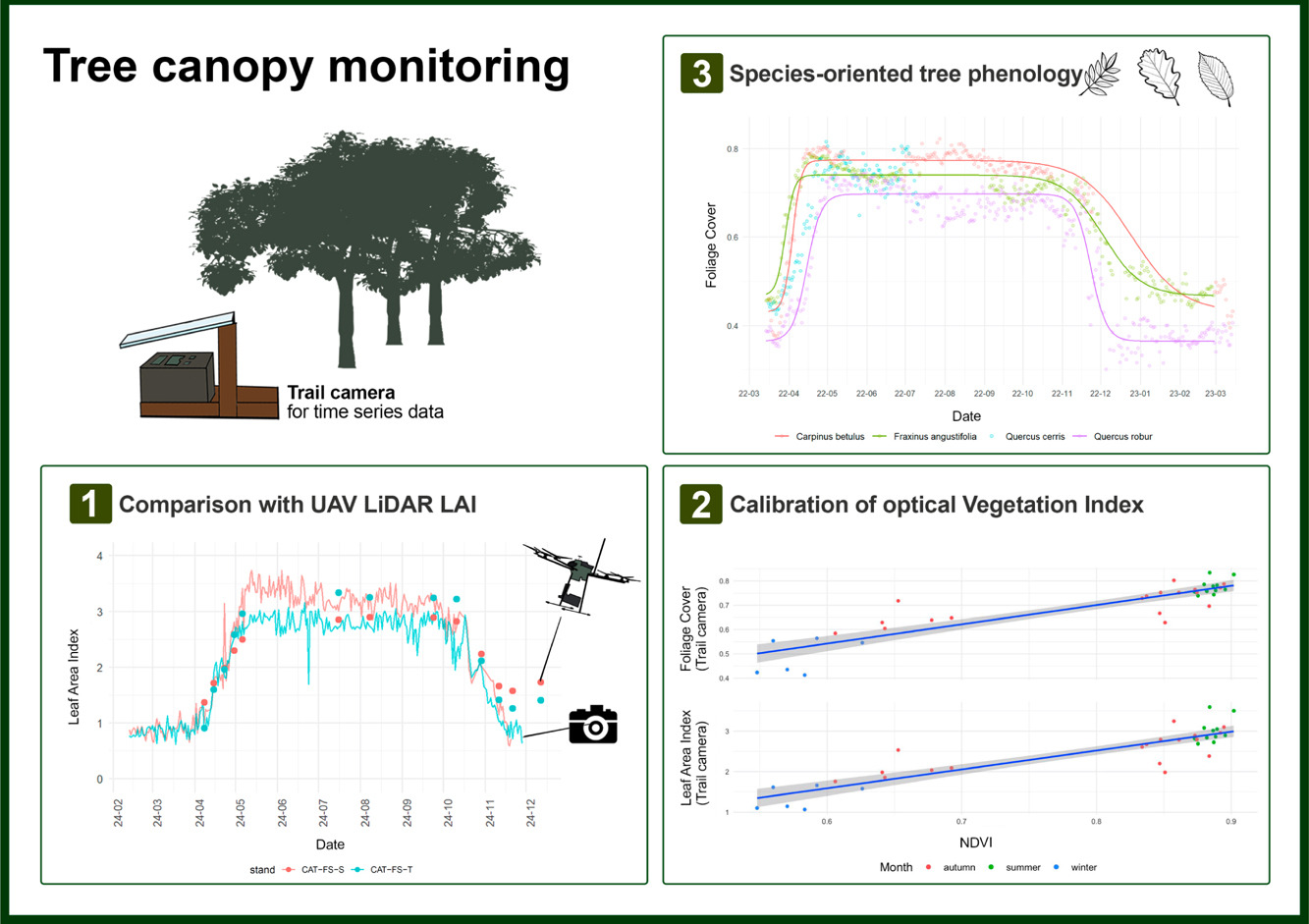
CrowNet: a trail-camera canopy monitoring system
Chianucci
,
Francesco
,
Lenzi
,
Alice
,
Minari
,
Emma
,
Guasti
,
Matteo
,
Gisondi
,
Silvia
,
Gonnelli
,
Marco
,
Innocenti
,
Simone
,
Ferrara
,
Carlotta
,
Campanaro
,
Alessandro
,
Ciampelli
,
Paola
,
Cutini
,
Andrea
,
Puletti
,
Nicola
Mostra abstract
Continuous monitoring of forest canopy structure and phenology is pivotal for the assessment of ecosystem responses to environmental variability and changes. The present study evaluated the use of repeat digital trail cameras as a low-cost, flexible, and accessible in situ monitoring solution for quantifying daily canopy attributes, including effective leaf area index (Le) and canopy cover. A trial camera monitoring network (CrowNet) was established encompassing 20 forest stands in Italy, under different management and environmental conditions, resulting in over 44,000 daily images collected over three years. We demonstrated that taking the mean daily canopy attribute allowed to obtain smooth time series from trail cameras, from which phenological transition dates can be inferred. Daily canopy attributes were validated against manual digital cover photography measurement. To further explore the applicability of this monitoring solution, we performed a comparison between daily Le time series derived from a subset of trail cameras located in beech forests and data collected by multitemporal UAV LiDAR. Results demonstrated the close agreement between the two methods across the entire phenological period (start and end of season). We also illustrated use of continuous trail camera estimates to calibrate a vegetation index (NDVI) to infer leaf area and canopy cover from optical multi-temporal UAV data. We further investigated use of trail camera to detect species-specific differences in tree phenology from time series acquired in a mixed oak-hornbeam forest. We found different canopy structure and phenological transition dates in three broadleaved species (oak, ash, hornbeam), supporting the effectiveness of trail cameras for species-oriented phenology monitoring. We conclude that trail cameras provide a reliable solution for daily canopy monitoring, offering a significant cost-effective and flexible alternative to traditional field methods and providing potential to calibrate, validate or integrate remotely-sensed information. However, camera failures during adverse weather, and the need for more efficient image data quality checking procedures, still represent open challenges. Future improvements, such as weatherproof housing and automated pre-processing screening procedures, are therefore recommended for making trail camera fully operational in ground canopy and phenology monitoring. © 2025 Elsevier B.V.

Multiple drivers of functional diversity in temperate forest understories: Climate, soil, and forest structure effects
Chelli
,
Stefano
,
Bricca
,
Alessandro
,
Tsakalos
,
James L.
,
Andreetta
,
Anna
,
Bonari
,
Gianmaria
,
Campetella
,
Giandiego
,
Carnicelli
,
Stefano
,
Cervellini
,
Marco
,
Puletti
,
Nicola
,
Wellstein
,
Camilla
,
Canullo
,
R.
climate change
functional diversity
bud bank
forest management
plant height
seed mass
specific leaf area
Mostra abstract
In macroecology, shifting from coarse- to local-scale explanatory factors is crucial for understanding how global change impacts functional diversity (FD). Plants possess diverse traits allowing them to differentially respond across a spectrum of environmental conditions. We aim to assess how macro- to microclimate, stand-scale measured soil properties, forest structure, and management type, influence forest understorey FD at the macroecological scale. Our study covers Italian forests, using thirteen predictors categorized into climate, soil, forest structure, and management. We analyzed five traits (i.e., specific leaf area, plant size, seed mass, belowground bud bank size, and clonal lateral spread) capturing independent functional dimensions to calculate the standardized effect size of functional diversity (SES-FD) for all traits (multi-trait) and for single traits. Multiple regression models were applied to assess the effect of predictors on SES-FD. We revealed that climate, soil, and forest structure significantly drive SES-FD of specific leaf area, plant size, seed mass, and bud bank. Forest management had a limited effect. However, differences emerged between herbaceous and woody growth forms of the understorey layer, with herbaceous species mainly responding to climate and soil features, while woody species were mainly affected by forest structure. Future warmer and more seasonal climate could reduce the diversity of resource economics, plant size, and persistence strategies of the forest understorey. Soil eutrophication and acidification may impact the diversity of regeneration strategies; canopy closure affects the diversity of above- and belowground traits, with a larger effect on woody species. Multifunctional approaches are vital to disentangle the effect of global changes on functional diversity since independent functional specialization axes are modulated by different drivers. © 2024 The Authors
An intensity, image-based method to estimate gap fraction, canopy openness and effective leaf area index from phase-shift terrestrial laser scanning
Grotti
,
Mirko
,
Calders
,
Kim
,
Origo
,
Niall
,
Puletti
,
Nicola
,
Alivernini
,
Alessandro
,
Ferrara
,
Carlotta
,
Chianucci
,
Francesco
Mostra abstract
Accurate in situ estimates of leaf area index (LAI) are essential for a wide range of ecological studies and applications. Due to the destructiveness and impracticality of direct measurements, indirect optical methods have mostly been used in the field to derive estimates of LAI from gap fraction measurements. Terrestrial laser scanning (TLS) is strongly supporting use of this active technology, which possesses several advantages compared to passive sensors. However, edge effects and partial beam interceptions are significantly challenges for the accurate retrieval of gap fraction from 3D point cloud data available from TLS, particularly in phase-shift instruments, which in turns require point cloud filtering to correct erroneous point measurements. As the limitations above influences the point cloud, we proposed a new method which is based only on the laser return intensity (LRI) information derived from raw TLS data, which are used to generate 2D intensity images. The intensity image contains all the unfiltered LRI information captured by TLS, which is used to separate gap from non-gap pixels, using a procedure comparable to the standard image analysis processing of digital hemispherical images. This allows a theoretically consistent comparison between active and passive optical measurements of gap fraction across all the zenith angle range. The method was tested in real and simulated forests. Gap fraction, canopy openness and effective leaf area index derived from real and simulated intensity TLS images were compared with those obtained using digital hemispherical photography (DHP). Results indicated that the intensity, image-based method outperformed DHP, as the higher pixel resolution of the intensity images and the larger distance covered by TLS allowed detection of many small canopy elements, particularly at higher zenith angles (longer optical distance), which are not detected in DHP. The main findings support the reliability of the intensity, image-based method to standardize protocols for TLS phase-shift scan data processing and use of the produced canopy estimates as a benchmark for passive optical measurements. © 2019 Elsevier B.V.
Quantifying the effect of sampling plot size on the estimation of structural indicators in old-growth forest stands
Lombardi
,
Fabio
,
Marchetti
,
Marco
,
Corona
,
P.
,
Merlini
,
Paolo
,
Chirici
,
Gherardo
,
Tognetti
,
Roberto
,
Burrascano
,
Sabina
,
Alivernini
,
Alessandro
,
Puletti
,
Nicola
Mostra abstract
There is increasing awareness that structure-based indicators should be considered for assessing the biological value of late successional forests. In order to increase the unique habitat features critical for old-growth associated species, it is important to identify and rank candidate potential forest sites on the basis of their distinctive structural features. Data on living and deadwood components for the identification of old-growth condition are usually acquired in the considered forest stands by two sampling survey: (i) census performed in relatively large monitoring sites; (ii) network of small sampling units, on which inventory practices are usually based. Several authors argued that choosing between these survey strategies might have substantial effects on the values of common indicators of old-growth condition. Our study aims at (i) assessing the total estimate differences among old-growth structural indicators measured in field plots with different sizes, and (ii) defining the optimal sample size for the reliable assessment of such indicators. The study was carried out in six beech dominated forest stands on the Apennines range in Italy. In each stand, living and deadwood components were surveyed and geocoded in 1-ha square areas. Based on these dataset, circular plots with radii ranging from 4m up to 20m were then considered in order to quantify the effect of sampling plot size on the estimation of four structural indicators: (1) number of living trees; (2) number of large trees (dbh≥50cm); (3) total deadwood volume; (4) number of deadwood elements (snags, dead standing trees; lying dead trees, lying deadwood) with dbh (or average diameter for lying deadwood) ≥ 30cm. We found that the size of the sampling plots should be at least 500 m<sup>2</sup> in order to establish a database for the assessment of the investigated indicators. The census approach should be preferred to the sampling plot approach for old-growth forest stands smaller than 3-5ha. The achieved results contribute to define assessment protocols for characterizing and ranking the degree to which forest stands approximate old-growth condition based on standardized indicators. © 2015 Elsevier B.V.
A multi-criteria analysis of forest restoration strategies to improve the ecosystem services supply: an application in Central Italy
Paletto
,
Alessandro
,
Pieratti
,
Elisa
,
De Meo
,
Isabella
,
Agnelli
,
Alessandro Elio
,
Cantiani
,
Paolo
,
Chiavetta
,
U.
,
Mazza
,
Gianluigi
,
Lagomarsino
,
Alessandra
carbon sequestration
carbon stock
biophysical assessment
economic evaluation
multiple-criteria decision analysis (mcda)
recreational activities
Mostra abstract
• Key message: A multi-criteria analysis can be an interesting tool to assess the effects of silvicultural treatments on ecosystem services supply. In the degraded forests, thinning has a positive effect on the provision of ecosystem services such as timber and bioenergy production, climate change mitigation, and recreational attractiveness. • Context: The Millennium Ecosystem Assessment highlights the importance of the ecosystem services for human well-being and for maintaining conditions for life on Earth. Silvicultural treatments can improve the provision of ecosystem services to increase local communities’ well-being. • Aims: The aim of this study is to understand the effects of two-forest restoration practices (selective thinning and thinning from below) on three ecosystem services (wood production, climate change mitigation, and recreational opportunities) in an Italian case study. • Methods: A multi-criteria decision analysis (MCDA) was performed to compare the effects of three forest restoration scenarios (baseline, selective thinning, thinning from below) on ecosystem services. Wood production was estimated considering the local market prices and the wood volumes harvested, while climate change mitigation was quantified through the C-stock and C-sequestration changes in carbon pools due to the silvicultural treatments. The recreational activities were assessed through a questionnaire survey. A sample of 200 visitors was interviewed face-to-face to estimate the impact of thinning on recreational activities. • Results: The results of the MCDA show that the selective thinning scenario is the optimal forest restoration practice to increase the recreational attractiveness and the wood production in the study area. • Conclusion: The results concerning the effects of the silvicultural treatments on ecosystem services supply are an important tool to support decision makers. © 2021, INRAE and Springer-Verlag France SAS, part of Springer Nature.
Individual tree crown segmentation in two-layered dense mixed forests from uav lidar data
Torresan
,
C.
,
Carotenuto
,
Federico
,
Chiavetta
,
U.
,
Miglietta
,
F.
,
Zaldei
,
Alessandro
,
Gioli
,
Beniamino
forest inventory
detection rate
itc detection algorithms
itcsegment package
laser scanning
lidr package
parameter calibration
Mostra abstract
In forests with dense mixed canopies, laser scanning is often the only effective technique to acquire forest inventory attributes, rather than structure-from-motion optical methods. This study investigates the potential of laser scanner data collected with a low-cost unmanned aerial vehicle laser scanner (UAV-LS), for individual tree crown (ITC) delineation to derive forest biometric parameters, over two-layered dense mixed forest stands in central Italy. A raster-based local maxima region growing algorithm (itcLiDAR) and a point cloud-based algorithm (li2012) were applied to isolate individual tree crowns, compute height and crown area, estimate the diameter at breast height (DBH) and the above ground biomass (AGB) of individual trees. To maximize the level of detection rate, the ITC algorithm parameters were tuned varying 1350 setting combinations and matching the segmented trees with field measured trees. For each setting, the delineation accuracy was assessed by computing the detection rate, the omission and commission errors over three forest plots. Segmentation using itcLiDAR showed detection rates between 40% and 57%, while ITC delineation was successful at segmenting trees with DBH larger than 10 cm (detection rate ~78%), while failed to detect trees with smaller DBH (detection rate ~37%). The performance of li2012 was quite lower with the higher detection rate equal to 27%. Errors and goodness-of-fit between field-surveyed and flight-derived biometric parameters (AGB and tree height) were species-dependent, with higher error and lower r<sup>2</sup> for shorter species that constitute the lowermost layer of the forest. Overall, while the application of UAV-LS to delineate tree crowns and estimate biometric parameters is satisfactory, its accuracy is affected by the presence of a multilayered and multispecies canopy that will require specific approaches and algorithms to better deal with the added complexity. © 2020 by the authors. Licensee MDPI, Basel, Switzerland.
Short-term effects of thinning on soil CO2, N2O and CH4 fluxes in Mediterranean forest ecosystems
Mazza
,
Gianluigi
,
Agnelli
,
Alessandro Elio
,
Cantiani
,
Paolo
,
Chiavetta
,
U.
,
Doukalianou
,
Foteini
,
Kitikidou
,
Kyriaki G.
,
Milios
,
Elias
,
Orfanoudakis
,
Michail Z.
,
Radoglou
,
Kalliopi M.
,
Lagomarsino
,
Alessandra
forest floor
global warming potential
green-house gas fluxes
pine plantations restoration
soil moisture
soil temperature
Mostra abstract
In Mediterranean ecosystems an increasing demand for in situ trace gas exchange data is emerging to enhance the adaptation and mitigation strategies under forest degradation. Field-chamber green-house gas fluxes and site characteristics were analysed in two Mediterranean peri-urban pine forests showing degradation symptoms. We examined the effect of different thinning interventions on soil CO<inf>2</inf>, CH<inf>4</inf> and N<inf>2</inf>O fluxes, addressing the relationships with the environmental variables and C and N contents along forest floor-soil layers. Soil temperature resulted as the main driving variable for CO<inf>2</inf> efflux and CH<inf>4</inf> uptake. Soil moisture content and organic matter availability affected CO<inf>2</inf> emission patterns in the two sites. N<inf>2</inf>O fluxes showed a positive correlation with soil moisture under wetter climatic conditions only. GHG fluxes showed significant correlations with C and N content of both forest floor and mineral soil, especially in the deepest layers, suggesting that it should be considered, together with environmental variables when accounting GHG fluxes in degraded forests. Short-term effects of thinning on CO<inf>2</inf> emissions were dependent on disturbance induced by logging operations and organic matter inputs. After thinning CH<inf>4</inf> uptake increased significantly under selective treatment, independently from specific site-induced effects. N<inf>2</inf>O fluxes were characterized by low emissions in both sites and were not affected by treatments. Soil CO<inf>2</inf> efflux was the largest component of global warming potential (GWP) from both sites (11,553 kg ha<sup>−1</sup> y<sup>−1</sup> on average). Although it has a large global warming potential, N<inf>2</inf>O contribution to GWP was about 131 kg CO<inf>2</inf>eq ha<sup>−1</sup> y<sup>−1</sup>. The contribution of CH<inf>4</inf>-CO<inf>2</inf> equivalent to total GWP showed a clear and significant CH<inf>4</inf> sink behaviour under selective treatment (36 kg ha<sup>−1</sup> y<sup>−1</sup> on average). However, in the short-term both thinning approaches produced a weak effect on total GWP. © 2018 Elsevier B.V.
Development and performance assessment of a low-cost UAV laser scanner system (LasUAV)
Torresan
,
C.
,
Berton
,
Andrea
,
Carotenuto
,
Federico
,
Chiavetta
,
U.
,
Miglietta
,
F.
,
Zaldei
,
Alessandro
,
Gioli
,
Beniamino
lidar
forest monitoring
global navigation satellite system
real-time kinematics technology
system designing
system testing
Mostra abstract
This study reports on a low-cost unmanned aerial vehicle (UAV)-borne light detection and ranging (LiDAR) system called LasUAV, from hardware selection and integration to the generation of three-dimensional point clouds, and an assessment of its performance. Measurement uncertainties were estimated in angular static, angular dynamic, and real flight conditions. The results of these experiments indicate that the point cloud elevation accuracy in the case of angular static acquisition was 3.8 cm, and increased to 3.9 cm in angular dynamic acquisition. In-flight data were acquired over a target surveyed by nine single passages in different flight directions and platform orientations. In this case, the uncertainty of elevation ranged between 5.1 cm and 9.8 cm for each single passage. The combined elevation uncertainty in the case of multiple passages (i.e., the combination of one to nine passages from the set of nine passages) ranged between 5 cm (one passage) and 16 cm (nine passages). The study demonstrates that the positioning device, i.e., the Global Navigation Satellite System real-time kinematic (GNSS RTK) receiver, is the sensor that mostly influences the system performance, followed by the attitude measurement device and the laser sensor. Consequently, strong efforts and greater economic investment should be devoted to GNSS RTK receivers in low-cost custom integrated systems. © 2018 by the authors.
Testing Removal of Carbon Dioxide, Ozone, and Atmospheric Particles by Urban Parks in Italy
Fares
,
Silvano
,
Conte
,
Adriano
,
Alivernini
,
Alessandro
,
Chianucci
,
Francesco
,
Grotti
,
Mirko
,
Zappitelli
,
Ilaria
,
Petrella
,
Fabio
,
Corona
,
P.
italy
forestry
carbon dioxide
carbon dioxide process
ecosystems
gas emissions
greenhouse gases
ozone
particles (particulate matter)
atmospheric concentration
atmospheric particles
ecosystem services
in-situ measurement
multilayer canopy model
particulate matter
tree characteristics
tropospheric ozone
air pollution
aerosol
greenspace
pollutant removal
testing method
urban area
air quality
article
canopy
dry deposition
particulate matter 10
recreational park
tree
air pollutant
city
ecosystem
air pollutants
cities
parks
recreational
trees
Mostra abstract
Cities are responsible for more than 80% of global greenhouse gas emissions. Sequestration of air pollutants is one of the main ecosystem services that urban forests provide to the citizens. The atmospheric concentration of several pollutants such as carbon dioxide (CO2), tropospheric ozone (O3), and particulate matter (PM) can be reduced by urban trees through processes of adsorption and deposition. We predict the quantity of CO2, O3, and PM removed by urban tree species with the multilayer canopy model AIRTREE in two representative urban parks in Italy: Park of Castel di Guido, a 3673 ha reforested area located northwest of Rome, and Park of Valentino, a 42 ha urban park in downtown Turin. We estimated a total annual removal of 1005 and 500 kg of carbon per hectare, 8.1 and 1.42 kg of ozone per hectare, and 8.4 and 8 kg of PM10 per hectare. We highlighted differences in pollutant sequestration between urban areas and between species, shedding light on the importance to perform extensive in situ measurements and modeling analysis of tree characteristics to provide realistic estimates of urban parks to deliver ecosystem services. ©
One to rule them all? Assessing the performance of sustainable forest management indicators against multitaxonomic data for biodiversity conservation
Paillet
,
Yoan
,
Zapponi
,
Livia
,
Schall
,
Peter
,
Monnet
,
Jean Matthieu
,
Ammer
,
Christian
,
Balducci
,
Lorenzo
,
Boch
,
Steffen
,
Brazaitis
,
Gediminas
,
Campanaro
,
Alessandro
,
Chianucci
,
Francesco
,
Doerfler
,
Inken
,
Fischer
,
Markus
,
Gosselin
,
Marion
,
Goßner
,
Martin M.
,
Heilmann-Clausen
,
Jacob
,
Hofmeister
,
Jeňýk
,
Hošek
,
Jan
,
Jung
,
Kirsten G.
,
Kepfer-Rojas
,
Sebastian
,
Ódor
,
Péter
,
Tinya
,
Flóra
,
Trentanovi
,
Giovanni
,
Vacchiano
,
Giorgio
,
Vandekerkhove
,
Kris
,
Weisser
,
Wolfgang W.
,
Wohlwend
,
Michael Rudolf
,
Burrascano
,
Sabina
Mostra abstract
Several regional initiatives and reporting efforts assess the state of forest biodiversity through broad-scale indicators based on data from national forest inventories. Although valuable, these indicators are essentially indirect and evaluate habitat quantity and quality rather than biodiversity per se. Therefore, their link to biodiversity may be weak, which decreases their usefulness for decision-making. For several decades, Forest Europe indicators assessed the state of European forests, in particular their biodiversity. However, no extensive study has been conducted to date to assess their performance – i.e. the capacity of the indicators to reflect variations in biodiversity – against multitaxonomic data. We hypothesized that no single biodiversity indicator from Forest Europe can represent overall forest biodiversity, but that several indicators would reflect habitat quality for at least some taxa in a comprehensive way. We tested the set of Forest Europe's indicators against the species richness of six taxonomic and functional groups across several hundreds of sampling units over Europe. We showed that, while some indicators perform relatively well across groups (e.g. deadwood volume), no single indicator represented all biodiversity at once, and that a combination of several indicators performed better. Forest Europe indicators were chosen for their availability and ease of understanding for most people. However, we showed that gaps in the monitoring framework persist, and that surveying certain taxa along with stand structure is necessary to support policymaking and tackle forest biodiversity loss at the large scale. Adding context (e.g. forest type) may also contribute to increase the performance of biodiversity indicators. © 2024 Elsevier Ltd
Where are we now with European forest multi-taxon biodiversity and where can we head to?
Burrascano
,
Sabina
,
Chianucci
,
Francesco
,
Trentanovi
,
Giovanni
,
Kepfer-Rojas
,
Sebastian
,
Sitzia
,
Tommaso
,
Tinya
,
Flóra
,
Doerfler
,
Inken
,
Paillet
,
Yoan
,
Nagel
,
Thomas A.
,
Mitić
,
Božena
,
Morillas
,
Lourdes
,
Munzi
,
Silvana
,
Van Der Sluis
,
Theo
,
Alterio
,
Edoardo
,
Balducci
,
Lorenzo
,
de Andrade
,
Rafael Barreto
,
Bouget
,
Christophe
,
Giordani
,
P.
,
Lachat
,
Thibault
,
Matošević
,
Dinka
,
Napoleone
,
Francesca
,
Nascimbene
,
Juri
,
Paniccia
,
Chiara
,
Roth
,
Nicolas
,
Aszalós
,
Réka
,
Brazaitis
,
Gediminas
,
Cutini
,
Andrea
,
D'Andrea
,
Ettore
,
de Smedt
,
Pallieter
,
Heilmann-Clausen
,
Jacob
,
Janssen
,
Philippe
,
Kozák
,
Daniel
,
Mårell
,
Anders
,
Mikoláš
,
Martin
,
Nordén
,
Björn
,
Matula
,
Radim
,
Schall
,
Peter
,
Svoboda
,
Miroslav
,
Ujházyová
,
Mariana
,
Vandekerkhove
,
Kris
,
Wohlwend
,
Michael Rudolf
,
Xystrakis
,
Fotios
,
Aleffi
,
Michele
,
Ammer
,
Christian
,
Archaux
,
Frédéric
,
Asbeck
,
Thomas
,
N Avtzis
,
Dimitrios N.
,
Ayasse
,
Manfred
,
Bagella
,
Simonetta
,
Balestrieri
,
Rosario
,
Barbati
,
Anna
,
Basile
,
Marco
,
Bergamini
,
Ariel
,
Bertini
,
Giada
,
Biscaccianti
,
Alessandro Bruno
,
Boch
,
Steffen
,
Bölöni
,
János
,
Bombi
,
Pierluigi
,
Boscardin
,
Yves
,
Brunialti
,
Giorgio
,
Bruun
,
Hans Henrik
,
Buscot
,
François
,
Byriel
,
David Bille
,
Campagnaro
,
Thomas
,
Campanaro
,
Alessandro
,
Chauvat
,
Matthieu
,
Ciach
,
Michał
,
Čiliak
,
Marek
,
Cistrone
,
Luca
,
Pereira
,
Joaò Manuel Cordeiro
,
Daniel
,
Rolf
,
de Cinti
,
Bruno
,
de Filippo
,
Gabriele
,
Dekoninck
,
Wouter
,
Di Salvatore
,
Umberto
,
Dumas
,
Yann
,
Elek
,
Zoltán
,
Ferretti
,
Fabrizio
,
Fotakis
,
Dimitrios G.
,
Frank
,
Tamás
,
Frey
,
Julian
,
Giancola
,
Carmen
,
Gömöryová
,
Erika
,
Gosselin
,
Marion
,
Gosselin
,
Frédéric
,
Goßner
,
Martin M.
,
Götmark
,
Frank
,
Haeler
,
Elena
,
Hansen
,
Aslak Kappel
,
Hertzog
,
Lionel R.
,
Hofmeister
,
Jeňýk
,
Hošek
,
Jan
,
Johannsen
,
Vivian Kvist
,
Justensen
,
Mathias Just
,
Korboulewsky
,
Nathalie
,
Kovács
,
Bence
,
Lakatos
,
Ferenc
,
Landivar
,
Carlos Miguel
,
Lens
,
Luc
,
Lingua
,
Emanuele
forest biodiversity
biodiversity conservation
forest stand structure
multi-taxon
sustainable management
Mostra abstract
The European biodiversity and forest strategies rely on forest sustainable management (SFM) to conserve forest biodiversity. However, current sustainability assessments hardly account for direct biodiversity indicators. We focused on forest multi-taxon biodiversity to: i) gather and map the existing information; ii) identify knowledge and research gaps; iii) discuss its research potential. We established a research network to fit data on species, standing trees, lying deadwood and sampling unit description from 34 local datasets across 3591 sampling units. A total of 8724 species were represented, with the share of common and rare species varying across taxonomic classes: some included many species with several rare ones (e.g., Insecta); others (e.g., Bryopsida) were represented by few common species. Tree-related structural attributes were sampled in a subset of sampling units (2889; 2356; 2309 and 1388 respectively for diameter, height, deadwood and microhabitats). Overall, multi-taxon studies are biased towards mature forests and may underrepresent the species related to other developmental phases. European forest compositional categories were all represented, but beech forests were over-represented as compared to thermophilous and boreal forests. Most sampling units (94%) were referred to a habitat type of conservation concern. Existing information may support European conservation and SFM strategies in: (i) methodological harmonization and coordinated monitoring; (ii) definition and testing of SFM indicators and thresholds; (iii) data-driven assessment of the effects of environmental and management drivers on multi-taxon forest biological and functional diversity, (iv) multi-scale forest monitoring integrating in-situ and remotely sensed information. © 2023 The Authors
Handbook of field sampling for multi-taxon biodiversity studies in European forests
Burrascano
,
Sabina
,
Trentanovi
,
Giovanni
,
Paillet
,
Yoan
,
Heilmann-Clausen
,
Jacob
,
Giordani
,
P.
,
Bagella
,
Simonetta
,
Bravo-Oviedo
,
Andrés
,
Campagnaro
,
Thomas
,
Campanaro
,
Alessandro
,
Chianucci
,
Francesco
,
de Smedt
,
Pallieter
,
Itziar
,
García Mijangos
,
Matošević
,
Dinka
,
Sitzia
,
Tommaso
,
Aszalós
,
Réka
,
Brazaitis
,
Gediminas
,
Cutini
,
Andrea
,
D'Andrea
,
Ettore
,
Doerfler
,
Inken
,
Hofmeister
,
Jeňýk
,
Hošek
,
Jan
,
Janssen
,
Philippe
,
Kepfer-Rojas
,
Sebastian
,
Korboulewsky
,
Nathalie
,
Kozák
,
Daniel
,
Lachat
,
Thibault
,
Lõhmus
,
Asko
,
López
,
Rosana
,
Mårell
,
Anders
,
Matula
,
Radim
,
Mikoláš
,
Martin
,
Munzi
,
Silvana
,
Nordén
,
Björn
,
Pärtel
,
Meelis
,
Penner
,
Johannes
,
Runnel
,
Kadri
,
Schall
,
Peter
,
Svoboda
,
Miroslav
,
Tinya
,
Flóra
,
Ujházyová
,
Mariana
,
Vandekerkhove
,
Kris
,
Verheyen
,
Kris
,
Xystrakis
,
Fotios
,
Ódor
,
Péter
Mostra abstract
Forests host most terrestrial biodiversity and their sustainable management is crucial to halt biodiversity loss. Although scientific evidence indicates that sustainable forest management (SFM) should be assessed by monitoring multi-taxon biodiversity, most current SFM criteria and indicators account only for trees or consider indirect biodiversity proxies. Several projects performed multi-taxon sampling to investigate the effects of forest management on biodiversity, but the large variability of their sampling approaches hampers the identification of general trends, and limits broad-scale inference for designing SFM. Here we address the need of common sampling protocols for forest structure and multi-taxon biodiversity to be used at broad spatial scales. We established a network of researchers involved in 41 projects on forest multi-taxon biodiversity across 13 European countries. The network data structure comprised the assessment of at least three taxa, and the measurement of forest stand structure in the same plots or stands. We mapped the sampling approaches to multi-taxon biodiversity, standing trees and deadwood, and used this overview to provide operational answers to two simple, yet crucial, questions: what to sample? How to sample? The most commonly sampled taxonomic groups are vascular plants (83% of datasets), beetles (80%), lichens (66%), birds (66%), fungi (61%), bryophytes (49%). They cover different forest structures and habitats, with a limited focus on soil, litter and forest canopy. Notwithstanding the common goal of assessing forest management effects on biodiversity, sampling approaches differed widely within and among taxonomic groups. Differences derive from sampling units (plots size, use of stand vs. plot scale), and from the focus on different substrates or functional groups of organisms. Sampling methods for standing trees and lying deadwood were relatively homogeneous and focused on volume calculations, but with a great variability in sampling units and diameter thresholds. We developed a handbook of sampling methods (SI 3) aimed at the greatest possible comparability across taxonomic groups and studies as a basis for European-wide biodiversity monitoring programs, robust understanding of biodiversity response to forest structure and management, and the identification of direct indicators of SFM. © 2021 The Authors
Characterizing the climatic niche of mast seeding in beech: Evidences of trade-offs between vegetation growth and seed production
Bajocco
,
Sofia
,
Ferrara
,
Carlotta
,
Bascietto
,
Marco
,
Alivernini
,
Alessandro
,
Chirichella
,
Roberta
,
Cutini
,
Andrea
,
Chianucci
,
Francesco
Mostra abstract
Masting is a complex mechanism which is mainly driven by a combination of internal plant resources and climatic conditions. While the driving role of climate in masting is being intensively studied, the interplay among climate, seed production, vegetation growth and phenology still needs further investigation. The objectives of this study were to identify the climatic determinants of different levels of seed production and of NDVI-based vegetation growth and phenology in European beech, and to evaluate if exists a trade-off between these two plant processes. To answer these questions, we used a 25-year-long dataset of beech seed production. We exploited the concept of ecological niche assuming that a mast year can be modeled like a species with variable preferences for different resources, which are the underlying annual climatic conditions; we performed an Ecological Niche Factor Analysis (ENFA), a presence-only modeling tool conventionally used in zoology and botany, and used seasonal (spring, summer, autumn) Standardized Precipitation-Evaporation Index (SPEI) observations, considering the current year (y−0), and up to one (y−1) and two (y−2) years before the masting event. For analyzing the role of vegetation growth and phenology, we used seasonal Normalized Difference Vegetation Index (NDVI) values and associated NDVI-based phenological metrics derived from Landsat imagery. Results indicated the driving role of climate for masting, especially in VHSP years. A moist summer and dry spring at y−2 and a dry summer at y−1 represented the main driving climatic conditions for masting; while a moist spring during the observation year represented the key condition for triggering higher intensities of seed production. Summer NDVI at y−0 and y−1 represented the variables discriminating best between masting and non-masting years and resulted as driven by opposite summer climatic conditions than seed production, thus indicating a trade-off between seed production and vegetation phenology. We concluded that reproduction and vegetation growth act as two different climate-dependent plant responses in beech, in a way that certain conditions through the years promote mast seeding and the opposite conditions favor vegetation growth. The understanding of climate-growth-masting relationships represents indispensable knowledge for providing a holistic view of masting mechanisms and developing adaptive forest management strategies in this species. © 2020
THz water transmittance and leaf surface area: An effective nondestructive method for determining leaf water content
Pagano
,
Mario
,
Baldacci
,
Lorenzo
,
Ottomaniello
,
Andrea
,
Dato
,
Giovanbattista De
,
Chianucci
,
Francesco
,
Masini
,
Luca
,
Carelli
,
Giorgio
,
Toncelli
,
Alessandra
,
Storchi
,
Paolo
,
Tredicucci
,
Alessandro
,
Corona
,
P.
Mostra abstract
Water availability is a major limiting factor in plant productivity and plays a key role in plant species distribution over a given area. New technologies, such as terahertz quantum cascade lasers (THz‐QCLs) have proven to be non‐invasive, effective, and accurate tools for measuring and monitoring leaf water content. This study explores the feasibility of using an advanced THz-QCL device for measuring the absolute leaf water content in Corylus avellana L., Laurus nobilis L., Ostrya carpinifolia Scop., Quercus ilex L., Quercus suber L., and Vitis vinifera L. (cv. Sangiovese). A recently proposed, simple spectroscopic technique was used, consisting in determining the transmission of the THz light beam through the leaf combined with a photographic measurement of the leaf area. A significant correlation was found between the product of the leaf optical depth (τ) and the leaf surface area (LA) with the leaf water mass (Mw) for all the studied species (Pearson’s r test, p ≤ 0.05). In all cases, the best fit regression line, in the graphs of τLA as a function of Mw, displayed R2 values always greater than 0.85. The method proposed can be combined with water stress indices of plants in order to gain a better understanding of the leaf water management processes or to indirectly monitor the kinetics of leaf invasion by pathogenic bacteria, possibly leading to the development of specific models to study and fight them. © 2019 by the authors. Licensee MDPI, Basel, Switzerland.
An objective image analysis method for estimation of canopy attributes from digital cover photography
Mostra abstract
Key message: A method was proposed to remove the subjectivity of gap size analyses approaches implemented by default in cover photography. The method yielded robust and replicable measurements of forest canopy attributes. Abstract: Digital cover photography (DCP) is an increasingly popular method to estimate canopy attributes of forest canopies. Compared with other canopy photographic methods, DCP is fast, simple, and less sensitive to image acquisition and processing. However, the image processing steps used by default in DCP have a large substantial subjective component, particularly regarding the separation of canopy gaps into large gaps and small gaps. In this study, we proposed an objective procedure to analyse DCP based on the statistical distribution of gaps occurring in any image. The new method was tested in 11 deciduous forest stands in central Italy, with different tree composition, stand density, and structure, which is representative of the natural variation of these forest types. Results indicated that the new method removed the subjectivity of manual and semi-automated gap size classifications performed so far in cover photography. A comparison with direct LAI measurements demonstrated that the new method outperformed the previous approaches and increased the precision of LAI estimates. Results have important implications in forestry, because the simplicity of the method allowed objective, reliable, and highly reproducible estimates of canopy attributes, which are largely suitable in forest monitoring, where measures are routinely repeated. In addition, the use of a restricted field of view enables implementation of this photographic method in many devices, including smartphones, downward-looking cameras, and unmanned aerial vehicles. © 2018, Springer-Verlag GmbH Germany, part of Springer Nature.
Tree-oriented silviculture for valuable timber production in mixed Turkey oak (Quercus cerris L.) coppices in Italy
Giuliarelli
,
Diego
,
Mingarelli
,
Elena
,
Corona
,
P.
,
Pelleri
,
F.
,
Alivernini
,
Alessandro
,
Chianucci
,
Francesco
Mostra abstract
Coppice management in Italy has traditionally focused on a single or few dominating tree species. Tree-oriented silviculture can represent an alternative management system to get high value timber production in mixed coppice forests. This study illustrates an application of the tree-oriented silvicultural approach in Turkey oak (Quercus cerris L.) coppice forests. The rationale behind the proposed silvicultural approach is to combine traditional coppicing and localized, single-tree practices to favor sporadic trees with valuable timber production. At this purpose, a limited number of target trees are selected and favored by localized thinning. In this study, the effectiveness of the proposed tree-oriented approach was compared with the customary coppice management by a financial evaluation. Results showed that the tree-oriented approach is a reliable silvicultural alternative for supporting valuable timber production in mixed oak coppice forests.
Multifunctionality assessment in forest planning at Landscape Level. The study case of Matese mountain community (Italy)
Di Salvatore
,
Umberto
,
Ferretti
,
Fabrizio
,
Cantiani
,
Paolo
,
Paletto
,
Alessandro
,
De Meo
,
Isabella
,
Chiavetta
,
U.
forest landscape management planning
forest multifunctionality
function fulfilment index
matese district (italy)
silvicultural system
Mostra abstract
The main objective is to improve a method that aims at evaluating forest multifunctionality from a technical and practical point of view. A methodological approach - based on the index of forest multifunctionality level - is proposed to assess the "fulfilment capability" of a function providing an estimate of performance level of each function in a given forest. This method is aimed at supporting technicians requested to define most suitable management guidelines and silvicultural practices in the framework of a Forest Landscape Management Plan (FLMP). The study area is the Matese district in southern Apennines (Italy), where a landscape planning experimentation was implemented. The approach includes the qualitative and quantitative characterization of selected populations, stratified by forest category by a sampling set of forest inventory plots. A 0.5 ha area around the sample plot was described by filling a form including the following information: site condition, tree species composition, stand origin and structure, silvicultural system, health condition, microhabitats presence. In each sample plot, both the multifunctionality assessment and the estimate of the effect of alternative management options on ecosystem goods and services, were carried out. The introduction of the term "fulfilment capability" and the modification of the concept of priority level - by which the ranking of functions within a plot is evaluated - is an improvement of current analysis method. This enhanced approach allows to detect the current status of forest plot and its potential framed within the whole forest. Assessing functional features of forests with this approach reduces the inherent subjectivity and allows to get useful information on forest multifunctionality to support forest planners in defining management guidelines consistent with current status and potential evolutive pattern.
Linking taxonomical and functional biodiversity of saproxylic fungi and beetles in broad-leaved forests in southern Italy with varying management histories
Persiani
,
Anna Maria
,
Audisio
,
P. Aldo
,
Lunghini
,
Dario
,
Maggi
,
Oriana
,
Granito
,
Vito Mario
,
Biscaccianti
,
Alessandro Bruno
,
Chiavetta
,
U.
,
Marchetti
,
Marco
beetles
coarse woody debris
fungi
old-growth forest
saproxylic communities
taxonomical and functional biodiversity
trophic guilds
Mostra abstract
The fundamental ecological significance of deadwood decomposition in forests has been highlighted in several reviews, some conclusions regarding silviculture being drawn. Old-growth forests are natural centres of biodiversity. Saproxylic fungi and beetles, which are vital components of these ecosystems, occupy a variety of spatial and trophic niches. Fungal and beetle diversity on coarse woody debris (CWD) was analysed in 36 forest sites in the Cilento and Vallo di Diano National Park, Italy. The data were analysed by DCA and Spearman's rank correlation. The results provide empirical evidence of the existence of a pattern of joint colonization of the woody substrate by fungi and beetles, which includes an assemblage of reciprocal trophic roles within fungal/beetle communities. These organisms act together to form a dynamic taxonomical and functional ecosystem component within the complex set of processes involved in wood decay. The variables most predictive of correlations between management-related structural attributes and fungal/beetle species richness and their trophic roles for old-growth forest are: number of logs, number of decay classes and CWD total volume. Deadwood spatiotemporal continuity should be the main objective of forest planning to stop the loss of saproxylic fungal and insect biodiversity. © 2010 Società Botanica Italiana.
Post fire natural regeneration monitoring with the integrated use of high resolution remotely sensed images: The case study of the Pineta di Castel Fusano; Monitoraggio della rinnovazione naturale post incendio tramite l'uso integrato di immagini telerilevate ad alta risoluzione: Il caso della pineta di Castel Fusano
Chirici
,
Gherardo
,
Balsi
,
Marco
,
Bertini
,
Roberta
,
Bonora
,
Nico
,
Chiavetta
,
U.
,
Ottaviano
,
Marco
,
Corona
,
P.
,
Lamonaca
,
Andrea
,
Giuliarelli
,
Diego
,
Mastronardi
,
Alessandro
,
Nardinocchi
,
Giovanni
,
Sambucini
,
Valter
,
Tonti
,
Daniela
,
Marchetti
,
Marco
remote sensing
forest wildfires
k-nearest neighbors
natural re generation
neural networks
spatialisation
Mostra abstract
Stone pine stand of Castel Fusano (Rome) burnt on July the 4th 2000 during a huge wildfire. As a consequence of the fire an intensive natural sexual and asexual regeneration began. In order to monitor such a regeneration field surveys were carried out in 2003 and 2006 in sample plots. Remotely sensed high resolution images from Ikonos and Quick Bird were acquired for the same years. The purpose of this work is to test different methodologies for modeling existing relationships between remotely sensed images and ground collected data in order to estimate and to map both sexual and asexual regeneration. For such a purpose different methodologies were tested: step-wise Muliple Linear Regression, Neural Networks (Relevance-Vector-Machine and the Multi-Layered-Perceptron) and the k-Nearest-Neighbors. These activities were carried out within the framework of the GRINFOMED- MEDIFIRE also developing a specific software named Spatial Forest Modeler (SFM) able to analyze existing relationships between remotely sensed variables and data collected in the field in order to identify the best available models to map and estimate the studied variables acquired on the basis of a field sampling design. The present paper presents data collected in the field, analysis and modeling methods and achieved results. The SFM software is also presented.