
Loading...
Pubblicazioni Scientifiche
Filtri di ricerca 10 risultati
Pubblicazioni per anno
CrowNet: a trail-camera canopy monitoring system
Chianucci
,
Francesco
,
Lenzi
,
Alice
,
Minari
,
Emma
,
Guasti
,
Matteo
,
Gisondi
,
Silvia
,
Gonnelli
,
Marco
,
Innocenti
,
Simone
,
Ferrara
,
Carlotta
,
Campanaro
,
Alessandro
,
Ciampelli
,
Paola
,
Cutini
,
Andrea
,
Puletti
,
Nicola
Mostra abstract
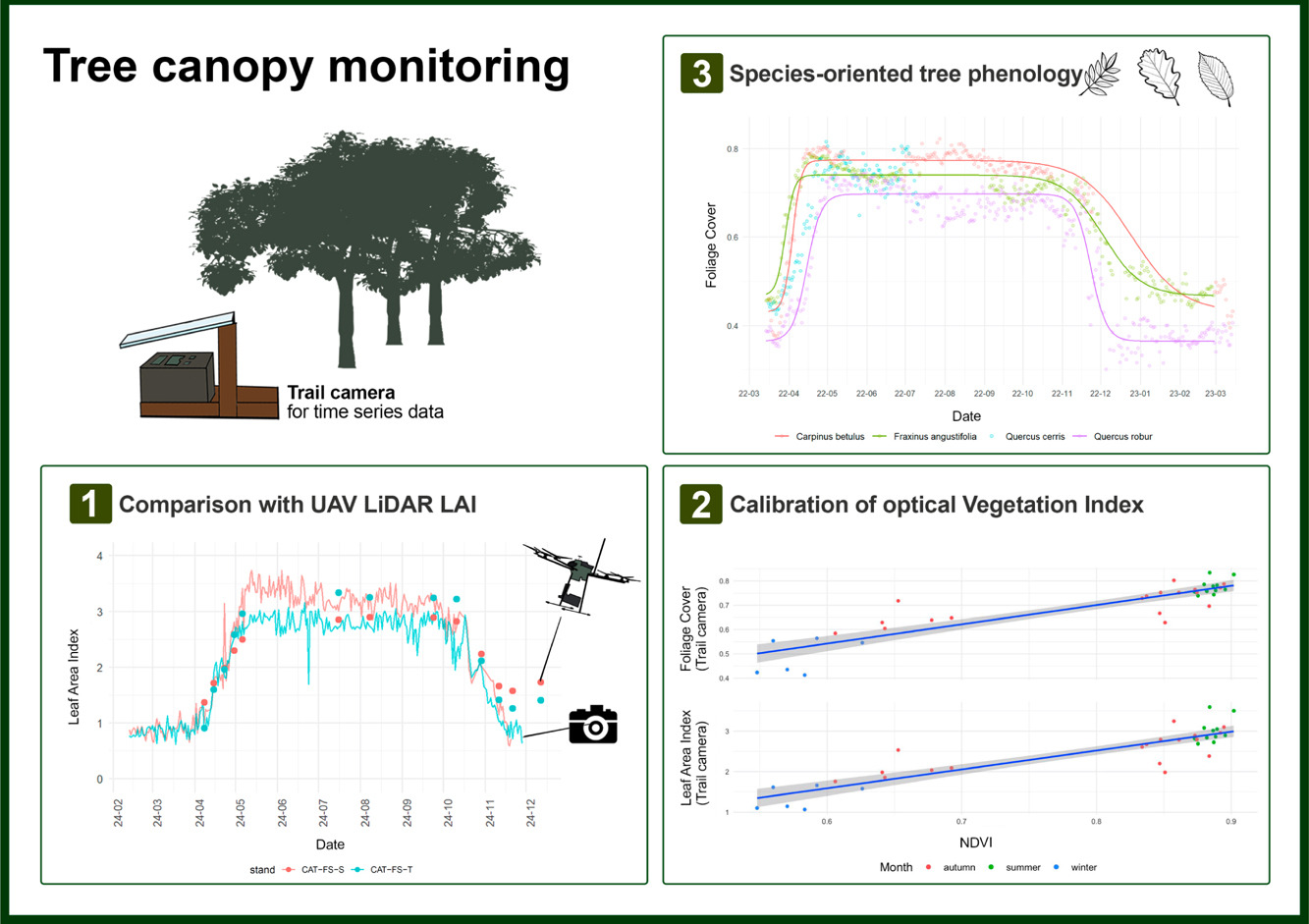
Continuous monitoring of forest canopy structure and phenology is pivotal for the assessment of ecosystem responses to environmental variability and changes. The present study evaluated the use of repeat digital trail cameras as a low-cost, flexible, and accessible in situ monitoring solution for quantifying daily canopy attributes, including effective leaf area index (Le) and canopy cover. A trial camera monitoring network (CrowNet) was established encompassing 20 forest stands in Italy, under different management and environmental conditions, resulting in over 44,000 daily images collected over three years. We demonstrated that taking the mean daily canopy attribute allowed to obtain smooth time series from trail cameras, from which phenological transition dates can be inferred. Daily canopy attributes were validated against manual digital cover photography measurement. To further explore the applicability of this monitoring solution, we performed a comparison between daily Le time series derived from a subset of trail cameras located in beech forests and data collected by multitemporal UAV LiDAR. Results demonstrated the close agreement between the two methods across the entire phenological period (start and end of season). We also illustrated use of continuous trail camera estimates to calibrate a vegetation index (NDVI) to infer leaf area and canopy cover from optical multi-temporal UAV data. We further investigated use of trail camera to detect species-specific differences in tree phenology from time series acquired in a mixed oak-hornbeam forest. We found different canopy structure and phenological transition dates in three broadleaved species (oak, ash, hornbeam), supporting the effectiveness of trail cameras for species-oriented phenology monitoring. We conclude that trail cameras provide a reliable solution for daily canopy monitoring, offering a significant cost-effective and flexible alternative to traditional field methods and providing potential to calibrate, validate or integrate remotely-sensed information. However, camera failures during adverse weather, and the need for more efficient image data quality checking procedures, still represent open challenges. Future improvements, such as weatherproof housing and automated pre-processing screening procedures, are therefore recommended for making trail camera fully operational in ground canopy and phenology monitoring. © 2025 Elsevier B.V.

Mapped tree dataset of public green areas in the Municipality of Arezzo, Tuscany (Italy)
Chianucci
,
Francesco
,
Sansone
,
Dalila
,
Lazzerini
,
Giada
,
Tiberi
,
Gioele
,
Cristina Monteverdi
,
Maria
,
Chiavetta
,
U.
Mostra abstract
The dataset reports data from more than 9,000 trees, which were sampled in 2024-2025 to create a first urban tree inventory of public green areas in the Municipality of Arezzo. For each tree, spatial position, species, diameter were sampled in different public green space types. Data are available as table and spatial vector layer. Data can support urban planners and managers for assessing the state-of-the-art of urban greening, supporting tree management practices and monitoring, feeding urban tree models and calibrating remotely-sensed information. Non-spatial and spatial metrics can be derived to assess the diversity of urban tree spaces to implement sustainable urban greening practices. © 2025 Istituto Sperimentale per la Selvicoltura. All rights reserved.
Drivers of vascular species diversity on floodplain poplar stands: An integrated approach for ecological and functional assessment
Corli
,
Anna
,
Vannucchi
,
Francesca
,
Traversari
,
Silvia
,
Orsenigo
,
Simone
,
Giovannelli
,
Alessio
,
Chiarabaglio
,
Pier Mario
,
Chianucci
,
Francesco
,
Calfapietra
,
Carlo
,
Scartazza
,
Andrea
,
Mascherpa
,
Marco Carlo
,
Traversi
,
Maria Laura
,
Cristaldi
,
Luca
,
Trentanovi
,
Giovanni
soil properties
stand structure
management
populus spp.
soil enzymatic activities
vascular plants diversity
Mostra abstract
Biodiversity restoration is pivotal to enhance natural ecological processes in riparian ecosystems, affected by intensive human impact. Improving the riparian area functionality through new plantations is an effective Nature-based Solution. Poplar plantations have great potential for preventing soil erosion and providing habitats, but their impact on biodiversity has been little studied. Aims of this study were to: (1) investigate the effect of different poplar woodland management on vascular species diversity; (2) define the main drivers of vascular plant species richness, community composition, invasiveness and functional strategies. In three sites (Po river, Italy), an integrated survey protocol was applied to assess vascular species diversity, stand structure and soil properties. For each site, three stands with different management (cultivated, semi-natural and natural) were surveyed. Differences among all stand structural parameters and the management types were found. Tree diameter did not change between natural and seminatural stands but mean quadratic diameter of seminatural stands (28.1 cm) was similar to cultivated ones (26.8 cm). While cultivated stands showed the highest species richness (mean 28 species), semi-natural stands showed the highest number of native species (82 %) and an efficient soil N cycle (microbial N limitation, MNL < 0). The total Ca and MNL in soil resulted the main drivers of species diversity in the studied poplar stands. Semi-natural stands highlighted the best trade-off amongst vascular plant species diversity, invasiveness and soil process. The used integrated approach was effective and extendable to ecological and functional assessment of poplar riparian forests under different management gradients. © 2025 The Authors
Linking Acoustic Indices to Vegetation and Microclimate in a Historical Urban Garden: Setting the Stage for a Restorative Soundscape
Portaccio
,
Alessia
,
Chianucci
,
Francesco
,
Pirotti
,
Francesco
,
Piragnolo
,
Marco
,
Sozzi
,
Marco
,
Zangrossi
,
Andrea
,
Celli
,
Miriam
,
Mazzella Di Bosco
,
Marta
,
Bolognesi
,
Monica
,
Sella
,
Enrico
,
Corbetta
,
Maurizio
,
Pazzaglia
,
Francesca
,
Cavalli
,
R.
Mostra abstract
Urban soundscapes are increasingly recognized as fundamental for both ecological integrity and human well-being, yet the complex interplay between the vegetation structure, seasonal dynamics, and microclimatic factors in shaping these soundscapes remains poorly understood. This study tests the hypothesis that vegetation structure and seasonally driven biological activity mediate the balance and the quality of the urban acoustic environment. We investigated seasonal and spatial variations in five acoustic indices (NDSI, ACI, AEI, ADI, and BI) within a historical urban garden in Castelfranco Veneto, Italy. Using linear mixed-effects models, we analyzed the effects of season, microclimatic variables, and vegetation characteristics on soundscape composition. Non-parametric tests were used to assess spatial differences in vegetation metrics. Results revealed strong seasonal patterns, with spring showing increased NDSI (+0.17), ADI (+0.22), and BI (+1.15) values relative to winter, likely reflecting bird breeding phenology and enhanced biological productivity. Among microclimatic predictors, temperature (p < 0.001), humidity (p = 0.014), and solar radiation (p = 0.002) showed significant relationships with acoustic indices, confirming their influence on both animal behaviour and sound propagation. Spatial analyses showed significant differences in acoustic patterns across points (Kruskal–Wallis p < 0.01), with vegetation metrics such as tree density and evergreen proportion correlating with elevated biophonic activity. Although the canopy height model did not emerge as a significant predictor in the models, the observed spatial heterogeneity supports the role of vegetation in shaping urban sound environments. By integrating ecoacoustic indices, LiDAR-derived vegetation data, and microclimatic parameters, this study offers novel insights into how vegetational components should be considered to manage urban green areas to support biodiversity and foster acoustically restorative environments, advancing the evidence base for sound-informed urban planning. © 2025 by the authors.
Sustainable forest planning: Assessing biodiversity effects of Triad zoning based on empirical data and virtual landscapes
Duflot
,
Rémi
,
Heinrichs
,
Steffi
,
Balducci
,
Lorenzo
,
Chianucci
,
Francesco
,
Hofmeister
,
Jeňýk
,
Paillet
,
Yoan
,
Trentanovi
,
Giovanni
,
Archaux
,
Frédéric
,
Boch
,
Steffen
,
Bouget
,
Christophe
,
Dvořák
,
Daniel
,
Fischer
,
Markus
,
Gosselin
,
Frédéric
,
Gosselin
,
Marion
,
Goßner
,
Martin M.
,
Holá
,
Eva
,
Hošek
,
Jan
,
Jung
,
Kirsten G.
,
Palice
,
Zdeněk
,
Renner
,
Swen C.
,
Weisser
,
Wolfgang W.
,
Nagel
,
Thomas A.
,
Burrascano
,
Sabina
,
Schall
,
Peter
Mostra abstract
The Triad framework seeks to balance the economic and ecological functions in forested landscapes by combining intensively, extensively, and unmanaged areas, assuming a higher support to biodiversity in extensively rather than in intensively managed forests. We quantified the effects of Triad zoning on biodiversity in (sub)montane eutrophic European beech forests. Using a European-wide multitaxon database and a “virtual” landscape approach (i.e., by resampling empirical data), we evaluated how the proportion of Triad management categories affected the landscape-level species diversity of birds, saproxylic beetles, vascular plants, epiphytic bryophytes, lichens, and wood-inhabiting fungi, as well as multitaxonomic diversity. The results varied greatly among taxonomic groups. Multitaxonomic diversity peaked in landscapes composed of 60% unmanaged and 40% intensively managed forests. While intensive management can benefit some taxa through the creation of open habitats, unmanaged forests are the backbone of biodiversity conservation, underlining the need to safeguard the remaining old-growth forests under natural dynamics, and to extend the current area of unmanaged forests in Europe. Extensive forest management, however, did not contribute to biodiversity conservation as expected. As withdrawing such a high proportion of European forest landscapes from management is unfeasible given the increasing demand for timber, efforts are needed to increase the presence of structural features supporting biodiversity into extensively managed forests. © © 2025 the Author(s).
Behaviour of Brown Bears Under Fluctuating Resource Availability
Tattoni
,
Clara
,
Corradini
,
Andrea
,
Chianucci
,
Francesco
,
Ciolli
,
Marco
,
Giusti
,
Roberta
,
Bragalanti
,
Natalia
,
Cagnacci
,
Francesca
,
Martinoli
,
Adriano
,
Preatoni
,
Damiano G.
,
Bisi
,
Francesco
Mostra abstract
Mast seeding, the variable and intermittent production of seeds, has cascading effects on ecosystem functioning. This study explores its influence on the brown bear populations in the Italian Alps, focusing on beechnuts (Fagus sylvatica L.), the primary food source for bears in the region. Using historical data and field sampling, we estimated and mapped the annual seed biomass from 2007 to 2021 for the province of Trento. The energy content of beechnuts was assessed through high heating values, providing the caloric resources available. Data on beechnuts production, records of damages and GPS data from 16 Eurasian brown bears were integrated to perform a temporal and spatial analysis at home range and at landscape level. Standardised damages to beehives and livestock decreased during mast years, suggesting that bears met their trophic needs through natural food sources. In fact, bears used more agricultural areas and less beech forest during years of beech crop failure. At landscape level, agriculture and pasture areas close to beech forests and distant from cities showed a higher risk of damage, providing a tool to anticipate management actions. This work provides insights on the ecological dynamics and conservation implications of brown bears in the study area by mapping the spatial and temporal aspects of mast seeding and bear-related damages. © 2025 The Author(s). Ecology and Evolution published by British Ecological Society and John Wiley & Sons Ltd.
Managed forests are a stronghold of non-native beetles in Europe
Basile
,
Marco
,
Lachat
,
Thibault
,
Balducci
,
Lorenzo
,
Chianucci
,
Francesco
,
Chojnacki
,
Lucas
,
Archaux
,
Frédéric
,
N Avtzis
,
Dimitrios N.
,
Bouget
,
Christophe
,
de Smedt
,
Pallieter
,
Doerfler
,
Inken
,
Dumas
,
Yann
,
Elek
,
Zoltán
,
Gosselin
,
Marion
,
Goßner
,
Martin M.
,
Heilmann-Clausen
,
Jacob
,
Hofmeister
,
Jeňýk
,
Hošek
,
Jan
,
Janssen
,
Philippe
,
Justesen
,
Mathias Just
,
Hansen
,
Aslak Kappel
,
Schmidt
,
Inger Kappel
,
Kepfer-Rojas
,
Sebastian
,
Mårell
,
Anders
,
Matula
,
Radim
,
Müller
,
Jörg C. C.
,
Nordén
,
Björn
,
Ódor
,
Péter
,
Paillet
,
Yoan
,
Ravera
,
Sonia
,
Sitzia
,
Tommaso
,
Tinya
,
Flóra
,
Burrascano
,
Sabina
,
Brockerhoff
,
Eckehard G.
Mostra abstract
The species richness of vascular plants in forests can have contrasting effects on the occurrence of non-native insects. The establishment of non-native insect populations may be facilitated by low plant species richness, which reflects the availability of few but easily accessible resources, or hampered by high plant species richness due to spatial dilution of resources or biotic resistance (i.e., resistance against biological invasions). The relationship between the species richness of plants and non-native insects is likely influenced by disturbance regimes, which, in European forests, mostly consists of timber harvesting. We investigated this relationship considering two major forest attributes: (i) species richness of non-native vascular plants and (ii) forest management. From 1101 forest plots in Europe, we gathered occurrences of 1212 vascular plant species, including 160 non-native species, and of 2404 beetle species, including 29 non-native species. We tested the relationship between the species richness of non-native beetles and plants using non-linear quantile regressions. We disentangled the effect of non-native plant species richness from that of management on the species richness of non-native beetles, while accounting for forest structural variables, using structural equation models. We found clear evidence of a hump-shaped relationship between non-native beetle and plant species richness. The general shape of the relationship persisted when considering only woody or non-woody plants, as well as only non-native plants. The relationship was also similar between managed and unmanaged forests. However, the proportion of non-native beetles in managed forests was higher than in unmanaged forests at the same plant species richness. Management had a direct negative effect on non-native beetle species richness, whereas non-native plant species richness had a direct positive effect. When considering all direct and indirect effects, management facilitated the occurrence of non-native beetles indirectly via non-native plants rather than directly. Synthesis and applications. Species richness of native and non-native vascular plants modulates the species richness of non-native beetles through relationships with opposite signs. The interplay with management regimes and forest structures determines whether non-native beetles are promoted. Forest management aimed at reducing the intensity of disturbance while encouraging native plant species richness could promote the dominance of dilution effects and biotic resistance and could moderate the establishment of non-native insects. © 2025 The Author(s). Journal of Applied Ecology © 2025 British Ecological Society.
Towards an effective in-situ biodiversity assessment in European forests
Burrascano
,
Sabina
,
Chojnacki
,
Lucas
,
Balducci
,
Lorenzo
,
Chianucci
,
Francesco
,
Haeler
,
Elena
,
Kepfer-Rojas
,
Sebastian
,
Paillet
,
Yoan
,
de Andrade
,
Rafael Barreto
,
Boch
,
Steffen
,
de Smedt
,
Pallieter
,
Fischer
,
Markus
,
Mijangos
,
Itziar Garcia
,
Heilmann-Clausen
,
Jacob
,
Hofmeister
,
Jeňýk
,
Hošek
,
Jan
,
Kozák
,
Daniel
,
Kutszegi
,
Gergely
,
Lachat
,
Thibault
,
Mikoláš
,
Martin
,
Samu
,
Ferenc
,
Ravera
,
Sonia
,
Schall
,
Peter
,
Sitzia
,
Tommaso
,
Svoboda
,
Miroslav
,
Trentanovi
,
Giovanni
,
Ujházyová
,
Mariana
,
Vandekerkhove
,
Kris
,
Tinya
,
Flóra
,
Ódor
,
Péter
forest biodiversity
vascular plants
birds
epiphytic bryophytes
epiphytic lichens
monitoring network
multivariate standard error
rarefaction curves
saproxylic beetles
wood-inhabiting fungi
Mostra abstract
Assessing multi-taxon biodiversity is crucial to understand forests’ response to environmental changes and to inform management strategies. In Europe, forest biodiversity monitoring is still scattered and heterogeneous, although a long-term monitoring network has long been advocated. Given the monitoring aims reported in various EU policies, this network should be accurately designed also through the estimation of its sampling effort, here intended as the number of sampling plots and sites. We used a novel database of forest multi-taxon biodiversity for a pilot study to: estimate the minimum sampling effort needed to: assess variation in species richness and composition; compare these estimates with the efforts invested in the pilot database; discuss estimates’ differences across taxonomic groups and forest categories. We focused on six taxonomic groups (vascular plants, birds, epiphytic lichens and bryophytes, wood-inhabiting fungi and saproxylic beetles) across six forest categories. Based on 6,165 plots at 2,084 different locations across Europe, we benchmarked the effort to achieve: a complete species richness estimate through interpolation/extrapolation curves, and a precise evaluation of species composition variation through multivariate standard error. Our estimates differed widely, especially among taxonomic groups. For species richness, estimates range from 3 to 147 plots per site across 3 to 29 sites per forest category, with birds and epiphytic bryophytes requiring the least effort. For species composition, estimates range from 5 to over 25 plots per site across 5 to 20 sites per forest category, with saproxylic beetles, vascular plants, and fungi displaying the highest estimates. The taxonomic groups requiring an effort comparable to existing data were the least diverse, all the others need greater efforts, either for species richness (e.g., saproxylic beetles), or species composition (e.g., vascular plants), or both (e.g., wood-inhabiting fungi). An effective monitoring network of European forests’ biodiversity should thoroughly account for these benchmarks and for their taxon-dependency. © 2025
Reliability of canopy photography for forest ecology and biodiversity studies
von Meijenfeldt
,
Anouk
,
Chianucci
,
Francesco
,
Rigo
,
Francesca
,
Ottenburghs
,
Jente
,
Hilpold
,
Andreas
,
Mina
,
Marco
leaf area index
canopy photography
canopy structure
hemispherical photography
mountain forests
understory vegetation
Mostra abstract
Understory is a key component of forest biodiversity. The structure of the forest stand and the horizontal composition of the canopy play a major role on the light regime of the understory, which in turn affects the abundance and the diversity of the understory plant community. Reliable assessments of canopy structural attributes are essential for forest research and biodiversity monitoring programs, as well as to study the relationship between canopy and understory plant communities. Canopy photography is a widely used method but it is still not clear which photographic techniques is better suited to capture canopy attributes at stand-level that can be relevant in forest biodiversity studies. For this purpose, we collected canopy structure and understory plant diversity data on 51 forest sites in the north-eastern Italian Alps, encompassing a diversity of forest types from low-elevation deciduous, to mixed montane stands to subalpine coniferous forests. Canopy images were acquired using both digital cover (DCP) and hemispherical (DHP) photography, and analysed canopy structural attributes. These attributes were then compared to tree species composition data to evaluate whether they were appropriate to differentiate between forest types. Additionally, we tested what canopy attributes derived from DCP and DHP best explained the species composition of vascular plants growing in the understory. We found that hemispherical canopy photography was most suitable to capture differences in forest types, which was best expressed by variables such as leaf inclination angle and canopy openness. On our sites, DHP-based canopy attributes were also able to better distinguish between different conifer forests. Leaf clumping was the most important attribute for determining plant species distribution of the understory, indicating that diverse gap structures create different microclimate conditions enhancing diverse plant species with different ecological strategies. This study supports the reliability of canopy photography to derive meaningful indicators in forest and biodiversity research, but also provide insights for increasing understory diversity in managed forests of high conservation value. © 2025
Monitoring hybrid poplar plantations using continuous canopy photography: influence of clone and water status
Mostra abstract
Hybrid poplar plantations are essential for bioenergy, pulp and paper industries, and contribute to carbon sequestration and environmental restoration. Effective plantation management, including monitoring of canopy structure, is crucial to maximize productivity, but traditional inventory methods often lack the spatial and temporal resolution needed for precision forestry application. In this study, we evaluated use of continuous canopy photography for continuous monitoring of poplar plantations. Daily canopy attributes like foliage cover and leaf area index were derived from time-lapse trail cameras. Three poplar clones (Soligo, I-214, and Neva), having differing growth rates and drought tolerances, were tested under different water (irrigated vs non-irrigated) regimes. We demonstrated that continuous canopy attributes allow to quantify significant variations in canopy cover, associated with both clone type and water status. Non-irrigated trials exhibited early senescence and canopy decline, while irrigated clones showed more robust canopy development. We concluded that continuous cameras offer a low-cost, effective solution for improving hybrid poplar plantation management by timely tracking the ability to respond to varying environmental conditions and optimizing resource use. © 2025 Istituto Sperimentale per la Selvicoltura. All rights reserved.